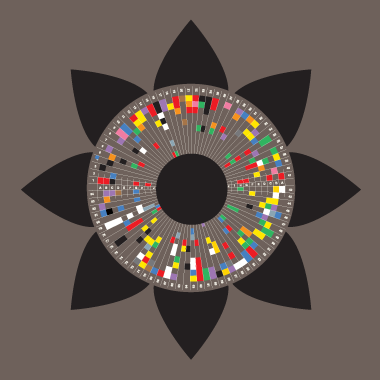
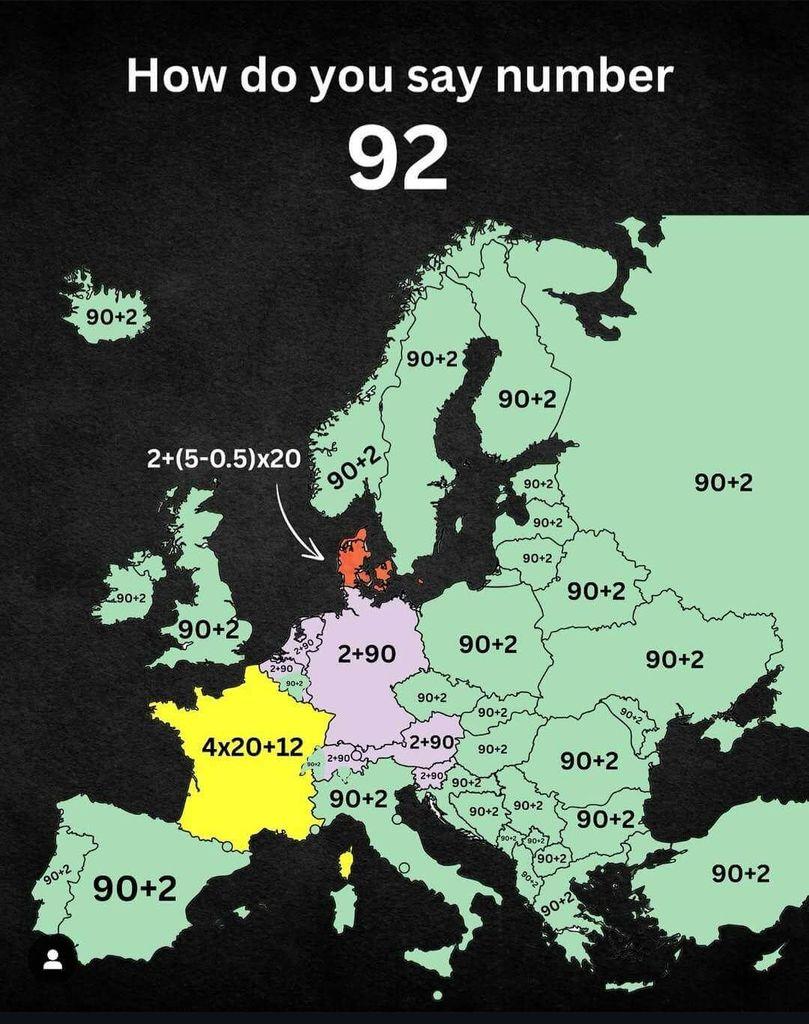
 @infobeautifulInformation Is Beautiful Danish isn't actually that different from the 2+90 countries. It just looks that way due to litteral translation.
• Some core numbers are 'named' as units equal to multiples of twenty. 'Tres' is three twenties, thus 'sixty'. 'Firs' is four twenties, thus 'eighty'. 'Fems' would be five twenties, thus '[one] hundred' (though for 100 itself they would normally use 'hundrede'). The naming of these are leftovers from an abbreviated description of a 'vigesimal' (Base-20) counting system.
• When 'halv' is in front of one of these, it is effectively subtracting half of such a [20] unit, i.e. it is subtracting 10.
• Danish people are not calculating numbers named in this way. They do not think out the logic that 'Tres' is three twenties, thus it is sixty. They just learned that 'Tres' means sixty as a child or that 'halvfems' means ninety. It mainly becomes weird for non-Danes when the components that make up the name of a number are read/translated litterally.
• Additional digits are added in front of the numeric description with 'og' meaning 'and' (or 'added to').
Thus 'tooghalvfems' could also be read as 'two added to five units [of 20], with a half a [20] unit [10] subtracted' or 2+(5x20)-(20/2)=92. However in the Danish mind, this is parsed more simply as 'two & [plus] ninety' [2+90].









 Frédéric Jacobs
 愚痴をこぼしても一人







 @
@










 ゼケ(ベ)
ゼケ(ベ)


 しゅいろ
しゅいろ





 MJ+
MJ+


 daniel:// stenberg://


 @gyptazy@gyptazy.com