What is Hackers' Pub?

Hackers' Pub is a place for software engineers to share their knowledge and experience with each other. It's also an ActivityPub-enabled social network, so you can follow your favorite hackers in the fediverse and get their latest posts in your feed.
5/
Preface
The world we live in is made up of innumerable particles: elementary particles, atoms and molecules, and a multitude of substances with different and diverse properties: natural and synthetic substances, organic and inorganic compounds, and pure and composite materials. All of these are found in outer space and on Earth, in the air, in water sources, and on land, as well as in plants (“flora”) and animals (“fauna”).

0

4/
Designed for researchers, scholars, and advanced students in environmental science, geochemistry, and systems ecology, this work provides a robust conceptual and analytical framework. It is an essential reference for those seeking to understand the material basis of life and the complex interdependencies that define our planet’s future.


0

2/
The book frames the ecological crisis through three interlinked dimensions: the chemical crisis (pollution), the biological crisis (biodiversity loss), and the physical crisis (climate change). These are analyzed both microscopically—at the level of atomic and molecular interactions—and macroscopically, through phenomena such as air and ocean pollution, global warming, and ecosystem degradation.


3/
Through detailed chapters, the book examines elemental formation, ecosystem structure and function, and provides a critical analysis of the , highlighting how human activity has reshaped Earth’s systems and accelerated environmental decline. It critically addresses sustainability, resource management, and the systemic challenges posed by the current human-environment crisis.


0

Chemodiversity and the Ecological Crisis by Adi Wolfson, 2020

This book covers the origins, transformations, and interactions of matter—from atoms and molecules to complex biological and composite materials—across abiotic, biotic, and anthropogenic systems. It offers a unique chronological narrative, tracing the evolution of from the Big Bang to the present, and explores how these material changes underpin the ecological crises of our time.


The book frames the ecological crisis through three interlinked dimensions: the chemical crisis (pollution), the biological crisis (biodiversity loss), and the physical crisis (climate change). These are analyzed both microscopically—at the level of atomic and molecular interactions—and macroscopically, through phenomena such as air and ocean pollution, global warming, and ecosystem degradation. Through detailed chapters, the book examines elemental formation, ecosystem structure and function, and provides a critical analysis of the anthroposphere, highlighting how human activity has reshaped Earth’s systems and accelerated environmental decline. It critically addresses sustainability, resource management, and the systemic challenges posed by the current human-environment crisis. Designed for researchers, scholars, and advanced students in environmental science, geochemistry, and systems ecology, this work provides a robust conceptual and analytical framework. It is an essential reference for those seeking to understand the material basis of life and the complex interdependencies that define our planet’s future.

2/
The book frames the ecological crisis through three interlinked dimensions: the chemical crisis (pollution), the biological crisis (biodiversity loss), and the physical crisis (climate change). These are analyzed both microscopically—at the level of atomic and molecular interactions—and macroscopically, through phenomena such as air and ocean pollution, global warming, and ecosystem degradation.


0

Chemodiversity and the Ecological Crisis by Adi Wolfson, 2020

This book covers the origins, transformations, and interactions of matter—from atoms and molecules to complex biological and composite materials—across abiotic, biotic, and anthropogenic systems. It offers a unique chronological narrative, tracing the evolution of from the Big Bang to the present, and explores how these material changes underpin the ecological crises of our time.


The book frames the ecological crisis through three interlinked dimensions: the chemical crisis (pollution), the biological crisis (biodiversity loss), and the physical crisis (climate change). These are analyzed both microscopically—at the level of atomic and molecular interactions—and macroscopically, through phenomena such as air and ocean pollution, global warming, and ecosystem degradation. Through detailed chapters, the book examines elemental formation, ecosystem structure and function, and provides a critical analysis of the anthroposphere, highlighting how human activity has reshaped Earth’s systems and accelerated environmental decline. It critically addresses sustainability, resource management, and the systemic challenges posed by the current human-environment crisis. Designed for researchers, scholars, and advanced students in environmental science, geochemistry, and systems ecology, this work provides a robust conceptual and analytical framework. It is an essential reference for those seeking to understand the material basis of life and the complex interdependencies that define our planet’s future.
0

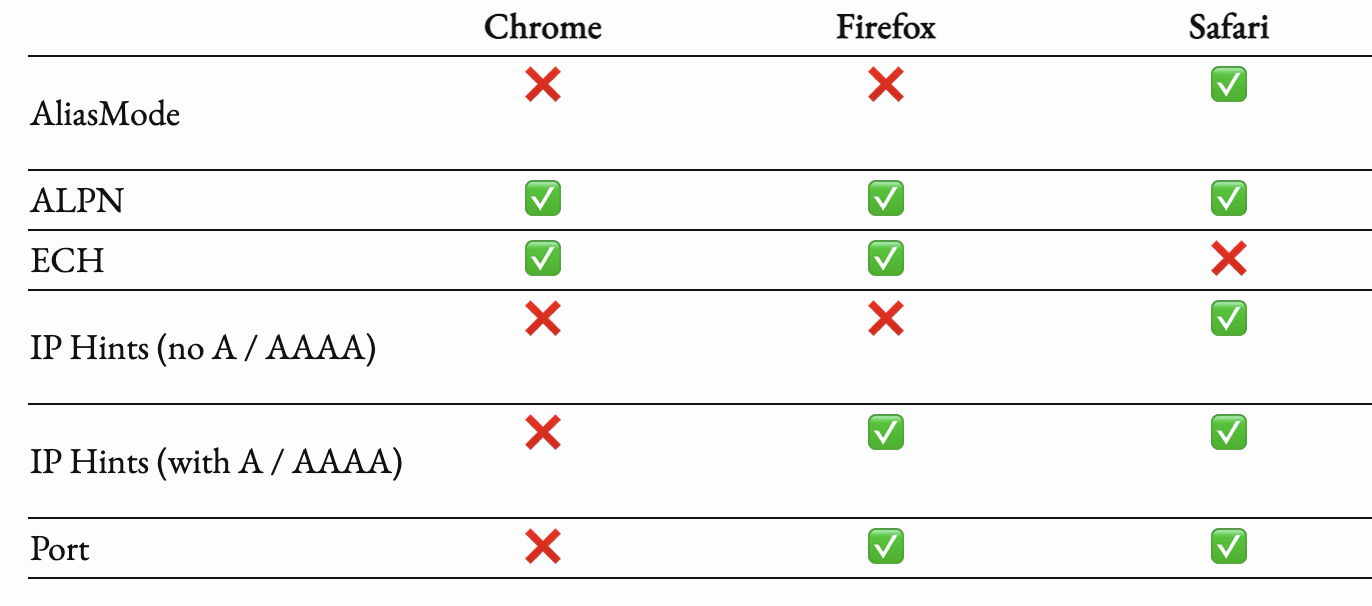
I finally jotted down a table of in how far the big three browsers currently support RFC9460 HTTPS records.

In summary:
- All browsers support ALPN
- Safari has the best support; it's the only browser that supports AliasMode, but Safari doesn't support ECH
- Firefox requires DoH, but then supports several parameters
- Chrome only support ALPN and ECH

See this page for details, I may update it in the future:
netmeister.org/blog/https-cani

A table mapping browsers to capabilities:

 	            Chrome	Firefox	Safari
AliasMode	❌	❌	✅
ALPN	✅	✅	✅
ECH	✅	✅	❌
IP Hints (no A / AAAA)	❌	❌	✅
IP Hints (with A / AAAA)	❌	✅	✅
Port	❌	✅	✅
0
0
0
0

Content Confusion by Michelle A. Amazeen, 2025

News Media, Native Advertising, and Policy in an Era of Disinformation

How mainstream news organizations and advertisers contribute to and legitimize disinformation by blurring the line between ads and journalism.
We often blame social media for the rampant problem of disinformation, but the truth is that mainstream news media is often equally at fault.


Not only do news outlets disguise paid content to look like online news articles, a practice called “native advertising,” but new research suggests that this form of advertising even influences the real journalism that appears next to it—both perceptions of the journalism as well as its actual substance. In Content Confusion, Michelle Amazeen explores the origins and evolution of this mainstream media practice, how it affects audiences and the industry, and what the implications are for an accurately informed democracy. 
For policy makers, in particular, the book highlights the longstanding principles from governmental regulation as well as industry professional codes that serve to support clear identification of the provenance of content, an issue that will no doubt intensify with the release of generative artificial intelligence in the wild.
0

"The world is not directly given to us’, Paul Feyerabend writes in Against Method, his philosophical manifesto. Perhaps, as in anthropology, we give ourselves to the world. Feyerabend proposes that any grasp of the world is filtered through whatever competing worldviews, traditions, or beliefs the observer of the world might hold or encounter..."

Sverker Finnström

Source:
Contextual Ethics, 2025


0
0

"Love is likely one of our first emotions. Indeed, it is probably what most human beings first experience as they become aware of existence in the embraces of their caregiver. This fundamental primacy of love—the fact that it is such an elemental part of humanity from the very first moment of awareness—means that as an emotion it is challenging to intellectually categorise."

Source:
Contextual Ethics, 2025


0

"Love is likely one of our first emotions. Indeed, it is probably what most human beings first experience as they become aware of existence in the embraces of their caregiver. This fundamental primacy of love—the fact that it is such an elemental part of humanity from the very first moment of awareness—means that as an emotion it is challenging to intellectually categorise."

Source:
Contextual Ethics, 2025


0
0

Is there a PyLady that has made meaningful impact in your community?
Nominate them for the Outstanding PyLady Award as your way to say thanks.

People don't magically receive award and recognitions. Someone need to submit the nomination. Why not you?

I've just submitted several nominations to people I admire. Now it's your turn.

Ideas on who you can nominate:
Community leader, speaker, educator, open source contributor, mentor, blogger, volunteer, etc

secretcodes.dev/outstanding-py

0
0
0
1
0
0
1
0
0
0

relays are recently getting more artful in their web presence 🤩 Nice examples:

darkrun.dev in Ontario, or
bloc7.icu/ in Warszawa.

We estimate there are ~4 times more relays than in the published list at chatmail.at/relays

Many relays are smaller ones, but that's fine. A 5 EUR per month VPS can go a long way (thousands or tens of thousands of monthly users). Thanks for the service to all the operators of which around 40 are in a loose group chat 💗

a cyberpunk warrior-type picture from the front page of https://darkrun.dev 
where also an anime-style video is running in the background a wintery situation in a park, with some people you can't recognize walking through the park.  It's on the front page of https://bloc7.icu
0

Your chat profile/identity: a tar file.

Your social web app: a zip file.

chatmail.at and webxdc.org are spearheading ever new and more fun ways to deny power to servers and platform billionaires.

Unlike classic email servers, relays do not store user identities which solely live on end-user devices.There also is no encrypted value on the server like with Proton Mail or Signal. There are only relays, endless federating networks of relays to onboard safely :)

Neo-spoon meme (scene from matrix movie where neo looks at a child bending a spoon which eventually tells him "there is no spoon") with the following words top: "On which server is your account?" and below the bending spoon "there is no account."
0
0
0
1
0
1

Bench Love (8 Photos)

STREET ART UTOPIA @streetartutopia@streetartutopia.com

This collection brings together benches and nearby street elements that quietly suggest affection, care, memory, or presence. From a Christmas-time intervention highlighting homelessness in Birmingham to playful lamp posts, heart-shaped seating, painted messages, and sculptural benches that turn reading or resting into part of the artwork, each piece uses familiar public furniture to communicate something personal. More: Creative Benches (27 Photos) 1. Love Is Here Bench A metal bench […]

Read more →
0
0
2
0

Apobangpo.space is a Mastodon server for BTS ARMY and KPop Fans. All welcome! Share your favourite music, scream for your Idol(s), learn together. All fun and no drama. Bangtan Forever, ARMY forever. KPop Forever. (NOTE: You must be over 18 to join.)

:Fediverse: apobangpo.space

Find out more at apobangpo.space/about or contact the admin account @pixelcatsPixelcats⁷

cc @kpop

0
0
0
0
0
0

4/
HAMM: Get me ready. [CLOV does not move.] Go and get the sheet. [CLOV does not move.] Clov!
CLOV: Yes.
HAMM: I’ll give you nothing more to eat.
CLOV: Then we’ll die.
HAMM: I’ll give you just enough to keep you from dying. You’ll be hungry all the time.
CLOV: Then we shan’t die. [Pause.] I’ll go for the sheet. [He goes towards the door.]


5/
HAMM: No! [CLOV halts.] I’ll give you one biscuit per day. [Pause.] One and a half. [Pause.] Why do you stay with me?
CLOV: Why do you keep me?
HAMM: There’s no one else.
CLOV: There’s nowhere else.
[Pause.]
HAMM: You’re leaving me all the same.
CLOV: I’m trying.
HAMM: You don’t love me.
CLOV. No.

(Beckett 1964, [1958], pp. 13–14)

Source:

Ylva Gustafsson: The Tragedy of Alzheimer’s Disease

Contextual Ethics, 2025


0

3/
HAMM: […] What time is it?
CLOV: The same as usual.
HAMM: [Gesture towards window right.] Have you looked?
CLOV: Yes.
HAMM: Well?
CLOV: Zero. […]
HAMM: Haven’t you had enough?
CLOV: Yes! [Pause.] Of what?
HAMM: Of this … this … thing.
CLOV: I always had. [Pause.] Not you?
HAMM: [Gloomily]. Then there’s no reason for it to change.
CLOV: It may end. [Pause.] All life long the same questions all life long, the same answers.


0

3/
HAMM: […] What time is it?
CLOV: The same as usual.
HAMM: [Gesture towards window right.] Have you looked?
CLOV: Yes.
HAMM: Well?
CLOV: Zero. […]
HAMM: Haven’t you had enough?
CLOV: Yes! [Pause.] Of what?
HAMM: Of this … this … thing.
CLOV: I always had. [Pause.] Not you?
HAMM: [Gloomily]. Then there’s no reason for it to change.
CLOV: It may end. [Pause.] All life long the same questions all life long, the same answers.


0

Endgame
Samuel Beckett’s play Endgame is not about Alzheimer’s or dementia, but it is about old age, illness, poverty, and dysfunctional family relationships. The scene consists of an empty room where a family of four people live. Hamm is blind and sits in a wheelchair. Nell and Nagg are Hamm’s elderly parents who are bedridden. Their “beds” consist of them sitting in separate garbage cans beside each other. Clov is Hamm’s adopted son.


0

Endgame
Samuel Beckett’s play Endgame is not about Alzheimer’s or dementia, but it is about old age, illness, poverty, and dysfunctional family relationships. The scene consists of an empty room where a family of four people live. Hamm is blind and sits in a wheelchair. Nell and Nagg are Hamm’s elderly parents who are bedridden. Their “beds” consist of them sitting in separate garbage cans beside each other. Clov is Hamm’s adopted son.


0

Creatures of Darkness by Dani Robertson, 2025

A compendium of 100 of the planet's weird and wonderful creatures that come at night. Most of us assume that living creatures prefer the sunlit hours of daytime. However, when the sun sets and the stars emerge, the planet truly comes alive. Creatures of Darkness takes readers on an extraordinary global journey, revealing the hidden world of 100 nocturnal species that thrive when the lights go out.


From the deepest, densest rainforests and jungles to the wide-open savannahs and deserts, and even rural countryside, this stunningly illustrated book showcases the incredible adaptability of these incredible animals. Plunge into the darkest depths of the ocean and discover how life flourishes in the very darkness humans often overlook. Creatures of Darkness is packed with fascinating facts and stunning visuals, bringing to light the mysterious behaviours, unique adaptations, and survival strategies of nocturnal animals. Whether it's the silent flight of an owl, the bioluminescent glow...
0

Decisions by Baruch Fischhoff, 2025

Studying and Supporting People Facing Hard Choices

A lively, authoritative insider’s account of how we make decisions and how decision-making research has developed over the last half century.
Decisions describes the evolution of decision science (also called behavioral decision research and related to behavioral economics) through its application to challenging personal and public policy decisions.


Baruch Fischhoff covers all major topics in basic research, including how people create options, determine what matters to them, evaluate their chances of achieving those goals, and engage their emotions. He shows how those processes play out in an exceptionally wide variety of decisions regarding health, safety, the environment, disasters, and national security, among other topics. He also examines how decision-making abilities vary across individuals and across the lifespan, as well as the ethics and politics of how research is conducted and its results are shared and applied.
1

7/
To truly understand suffering, we must move beyond the surface of pain. We must acknowledge the intricate web of emotions, thoughts, and memories that ensnare us. We struggle with fear, anger, and despair. We are haunted by the past and terrified of the future. We wrestle with intrusive thoughts, unwanted urges, and the crushing weight of our own mortality (Hayes & Smith, 2005).


8/
Even in the face of profound darkness, demonstrate an extraordinary capacity for radical healing resilience. They confront fear with courage, offering boundless love and compassion amidst overwhelming loss. They find the strength to carry their pain and move forward, driven by an unwavering will to nurture, to hope, and to build meaning for their children and themselves, even in a world overshadowed by suffering.

Source:
, 2025


This cutting‑edge book re‑imagines what a truly decolonial psychology could look like. It explores questions of what counts as psychological knowledge and whose knowledge is valid, and who controls the production of knowledge in psychology. This book builds on the expanding knowledge 
base in decolonial psychology to meaningfully address the varied social and psychological trajectories of decolonization and liberation.
Featuring a wide range of international contributors, this book is grounded in an ethic of inclusion and includes contributions from researchers as well as contributions from those who engage in decolonial work outside of academia. It considers how the discipline of psychology could be transformed and how it can embrace a decolonial resistance with ideas about justice, freedom, and liberation. Drawing together a variety of expertise and ways of knowing that centers psychological research from the Global South, this book explores how we can decolonize the field and curriculum of psychology, imagining new future possibilities for the discipline.
Accessibly and compellingly written, this will be essential reading for students and researchers interested in decolonizing psychology. It will be especially relevant for upper‑level undergraduate and postgraduate students of cultural psychology, social psychology, and community psychology, as well as researchers, psychologists, and activists working with marginalized communities.
0

6/
This journey delves into the raw, visceral reality of suffering—not merely the physical sensation of pain but the profound depths of anguish that reverberate through the human experience. It’s a descent into my own unconscious, a confrontation with the genocidal horrors imprinted on my memory, and an overwhelming empathy for the mothers of Gaza who have known the unbearable grief of losing a child, and for the children who now navigate a world without their mothers


7/
To truly understand suffering, we must move beyond the surface of pain. We must acknowledge the intricate web of emotions, thoughts, and memories that ensnare us. We struggle with fear, anger, and despair. We are haunted by the past and terrified of the future. We wrestle with intrusive thoughts, unwanted urges, and the crushing weight of our own mortality (Hayes & Smith, 2005).


0

5/
Their love, a fierce and unwavering force, becomes a shield against despair, a beacon of hope for a future where their children can finally breathe free. This is the enduring strength of Palestinian motherhood, a testament to the power of love to transcend even the deepest wounds, a promise that even in the face of unimaginable loss, life, like the olive tree, will find a way to flourish again.


6/
This journey delves into the raw, visceral reality of suffering—not merely the physical sensation of pain but the profound depths of anguish that reverberate through the human experience. It’s a descent into my own unconscious, a confrontation with the genocidal horrors imprinted on my memory, and an overwhelming empathy for the mothers of Gaza who have known the unbearable grief of losing a child, and for the children who now navigate a world without their mothers


0

4/
And yet, amidst this pain, amidst the rubble and the tears, Palestinian mothers and daughters continue to gather. They rebuild homes, both physical and emotional. They cultivate gardens of hope in the barren landscape of occupation. They weave stories of resilience and resistance into the fabric of their children’s lives. They embody the spirit of , steadfastness, a quiet defiance that refuses to be extinguished.


5/
Their love, a fierce and unwavering force, becomes a shield against despair, a beacon of hope for a future where their children can finally breathe free. This is the enduring strength of Palestinian motherhood, a testament to the power of love to transcend even the deepest wounds, a promise that even in the face of unimaginable loss, life, like the olive tree, will find a way to flourish again.


0

3/
It is the inherited trauma of dispossession, passed down through generations, a silent scream echoing through their DNA. The loss is tangible: the stolen land, the demolished homes, the vanished olive groves, the silenced stories. It is the constant struggle for basic human rights, the denial of freedom of movement, the humiliation of checkpoints, the ever‑present specter of violence.


4/
And yet, amidst this pain, amidst the rubble and the tears, Palestinian mothers and daughters continue to gather. They rebuild homes, both physical and emotional. They cultivate gardens of hope in the barren landscape of occupation. They weave stories of resilience and resistance into the fabric of their children’s lives. They embody the spirit of , steadfastness, a quiet defiance that refuses to be extinguished.


0

2/
The settler colonial project, with its relentless violence and dispossession, inflicts wounds that run deep, impacting not only individual lives but also the very fabric of Palestinian society. This pain is not abstract; it is etched into the bodies and souls of Palestinian women. It manifests as the chronic ache of displacement, the gnawing anxiety of living under constant threat, the gut‑wrenching fear for their children’s safety.


3/
It is the inherited trauma of dispossession, passed down through generations, a silent scream echoing through their DNA. The loss is tangible: the stolen land, the demolished homes, the vanished olive groves, the silenced stories. It is the constant struggle for basic human rights, the denial of freedom of movement, the humiliation of checkpoints, the ever‑present specter of violence.


0

“Al‑Umm Bitlim”
A Life Source and Life Force Amid Grief,
Loss, and Death

Hana R. Masud

Al‑umm bitlim—“the mother gathers”—speaks to the vital role mothers play in holding families and communities together. Yet, for Palestinian mothers and daughters, this act of gathering, of nurturing and sustaining life, takes place against a backdrop of profound loss and ongoing oppression.
1/


2/
The settler colonial project, with its relentless violence and dispossession, inflicts wounds that run deep, impacting not only individual lives but also the very fabric of Palestinian society. This pain is not abstract; it is etched into the bodies and souls of Palestinian women. It manifests as the chronic ache of displacement, the gnawing anxiety of living under constant threat, the gut‑wrenching fear for their children’s safety.


0

“Al‑Umm Bitlim”
A Life Source and Life Force Amid Grief,
Loss, and Death

Hana R. Masud

Al‑umm bitlim—“the mother gathers”—speaks to the vital role mothers play in holding families and communities together. Yet, for Palestinian mothers and daughters, this act of gathering, of nurturing and sustaining life, takes place against a backdrop of profound loss and ongoing oppression.
1/


0
0