And here comes a stunning image of Interstellar Comet 3I/ATLAS, taken on Dec. 2 by the dynamic astrophotographer duo of Gerald Rhemann and Michael Jäger, showing the comet's tails in full glory.

It clearly shows a long wispy plasma tail and a dust tail that appears as an "anti-tail" pointing in the opposite direction.

The image was taken by their remote telescope in Namibia.

facebook.com/groups/2270023586
Credit: Gerald Rhemann & Michael Jäger
6/n
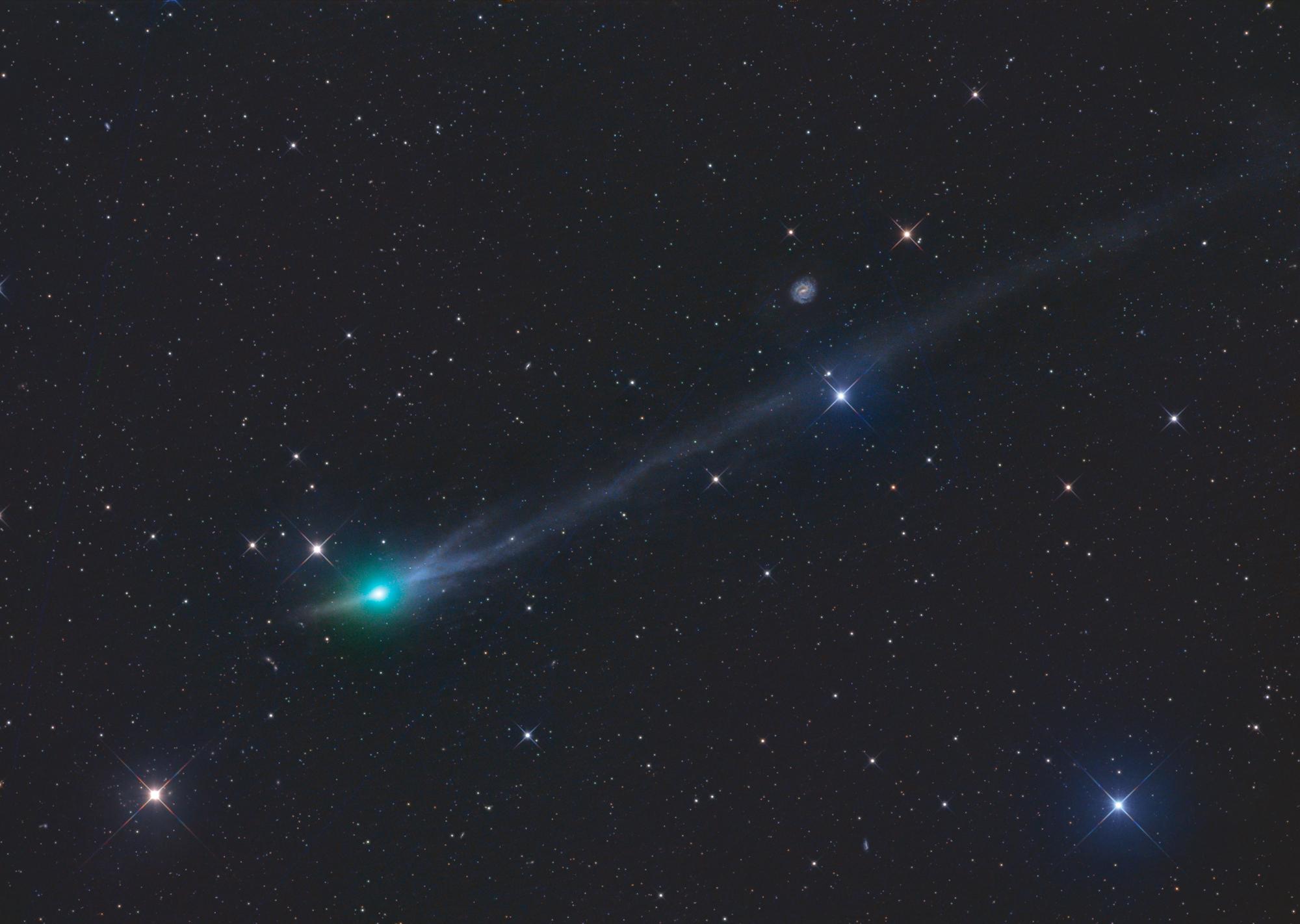
Image of comet 3I/ATLAS posted on facebook by Gerald Rhemann
Text:
Interstellar Comet 3I/Atlas 02 12 2025 UT 01h39m

Location: Farm Tivoli, Namibia
Telescope: ASA Astrograph 12" f3.6
Camera: ZWO ASI 6200 MM Pro
Exp. Time: LRGB 20/6/6/6 min.
North is up FOV: 75x110´

Gerald Rhemann and Michael Jäger

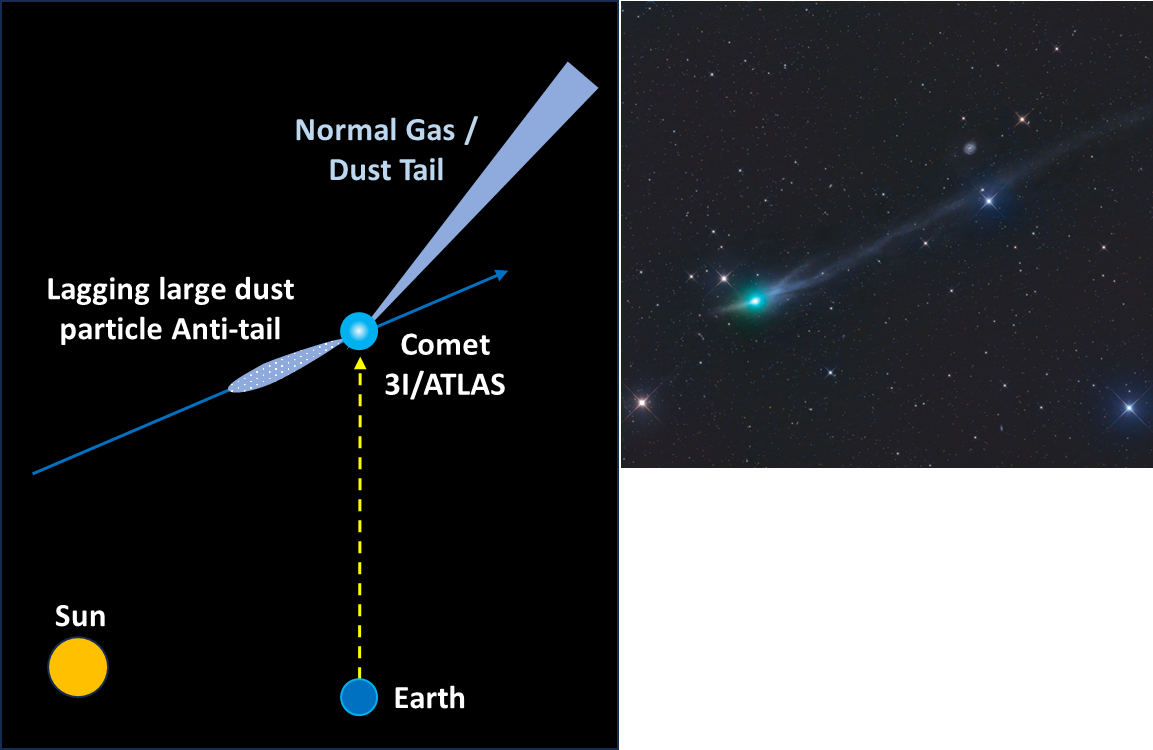
Here is a simple graphic illustrating the formation and viewing of a comet's anti-tail.

The anti-tail consists of larger dust particles, which are less affected by the Sun's radiation pressure, and which create a cloud/disc trailing in the comet's orbital plane. As Earth passes through the comet's orbital plane, this disc is seen side on and appears as the anti-tail.

From outside the comet's orbital plane, the anti-tail is too faint to be imaged.

More info at en.wikipedia.org/wiki/Comet_ta
7/n

A simple diagram to illustrate the formation and viewing of a comet's anti-tail.

Comet pic credit: Gerald Rhemann & Michael Jäger
0

If you have a fediverse account, you can quote this note from your own instance. Search https://fosstodon.org/users/AkaSci/statuses/115666545351314020 on your instance and quote it. (Note that quoting is not supported in Mastodon.)