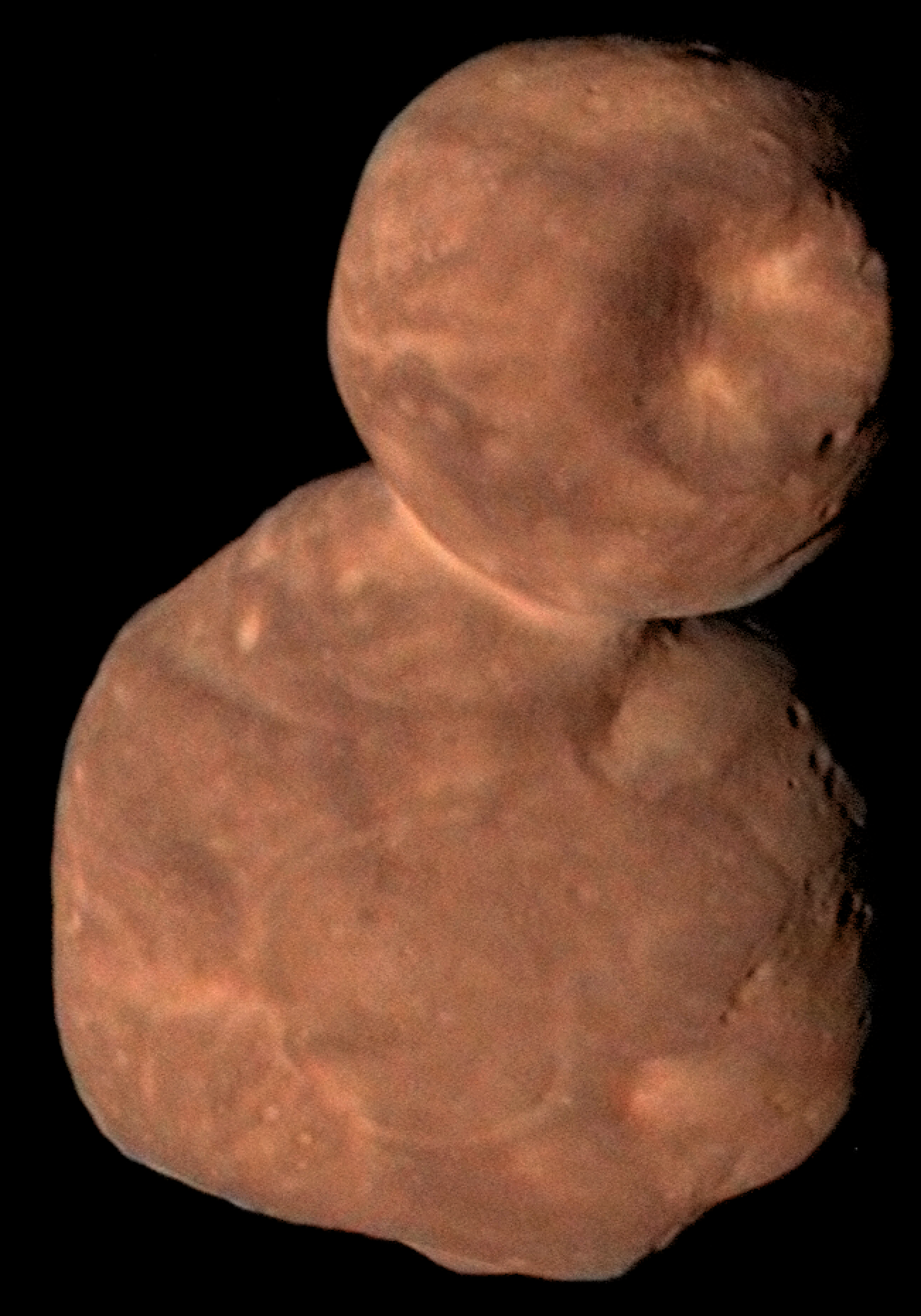
7 years ago, on New Year's Day, Jan 1, 2019, the NASA New Horizons spacecraft flew by the most distant object ever visited by a spacecraft, the contact binary trans-Neptunian object 2014 MU6, now named Arrokoth.

Arrokoth means "sky" in the Powhatan/Algonquin language.

New Horizons also saw evidence for methanol, water ice and organic molecules on the red surface of the 35 km Kuiper Belt object.

pluto.jhuapl.edu/
en.wikipedia.org/wiki/486958_A
Also see fosstodon.org/@AkaSci/11168114

1/n

Composite Image of 2014 MU69 (Arrokoth)
Release Date: May 16, 2019
Keywords: MU69, News Article
This composite image of the primordial contact binary Kuiper Belt object 2014 MU69 (officially named Arrokoth) was compiled from data obtained by NASA's New Horizons spacecraft as it flew by the object on Jan. 1, 2019. The image combines enhanced color data (close to what the human eye would see) with detailed high-resolution panchromatic pictures.

Credit: NASA/Johns Hopkins University Applied Physics Laboratory/Southwest Research Institute//Roman Tkachenko

New Horizons was launched on 19 January 19 2006.
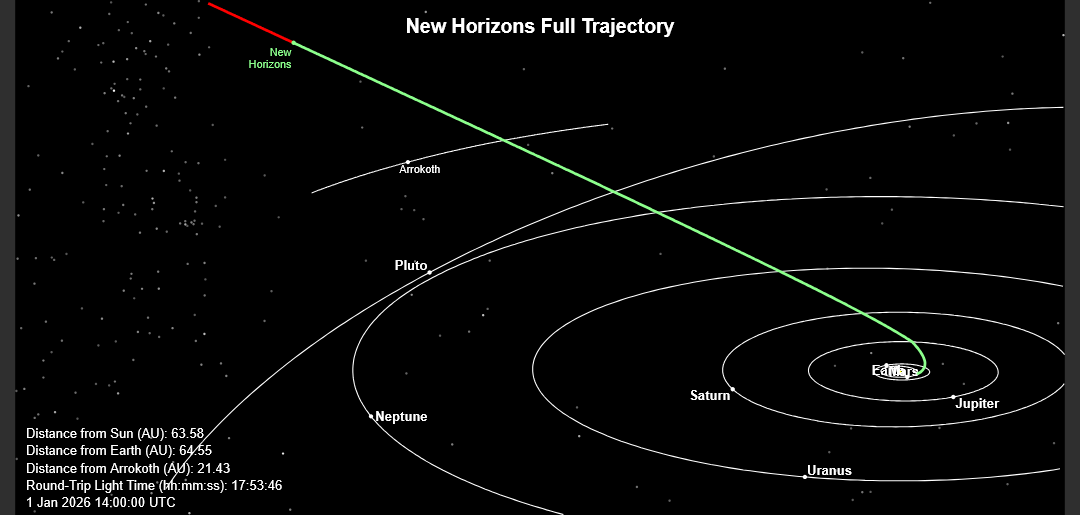
After close to 20 years of travel, it is currently 64.55 AU from earth.
One-way light time is 08:56:53 (hh:mm:ss).

By comparison, Voyager 1, launched on 05 Sept 1977, is 170.78 AU from earth, one-way light time is 23:40:23, close to one light day.

One Astronomical Unit (AU) is the average distance between the Sun and Earth, about 149.6 million km.

pluto.jhuapl.edu/Mission/Where
science.nasa.gov/mission/voyag
2/n

Graphic showing the location and trajectory of the New Horizons spacecraft in the solar system.
0

If you have a fediverse account, you can quote this note from your own instance. Search https://fosstodon.org/users/AkaSci/statuses/115820411429313630 on your instance and quote it. (Note that quoting is not supported in Mastodon.)