Some ways of trying to describe to strangers. It's mostly about , in a style that existed commercially (on the fringes) from the early 80s until sometime in the mid-to-late 90s, before disappearing from game retail.

I run Discord workshops that teach the basics of designing in this style. Even if you don't have an interest in this style, there's plenty to pilfer for others. Just ask! Workshops are free, text-only, and 1-on-1. I'm ghalev on Discord.
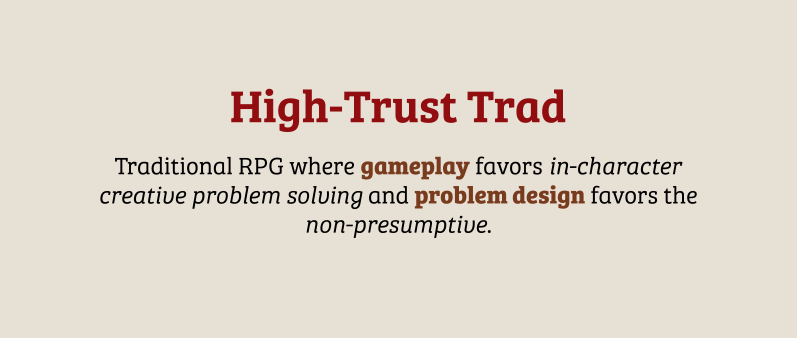
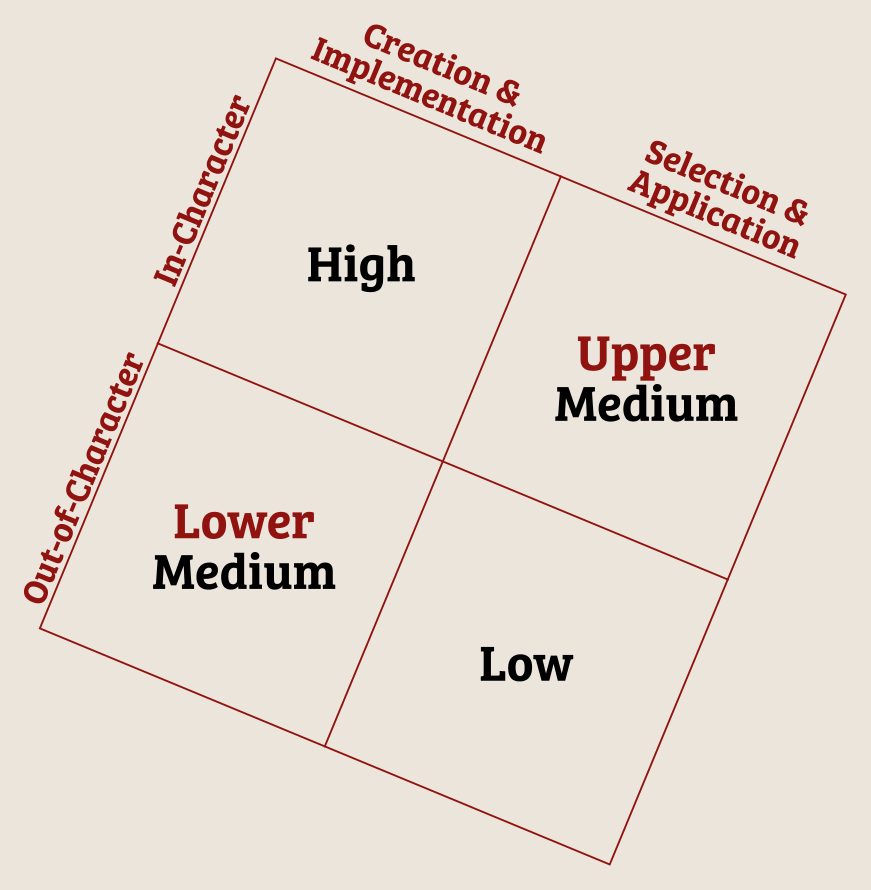
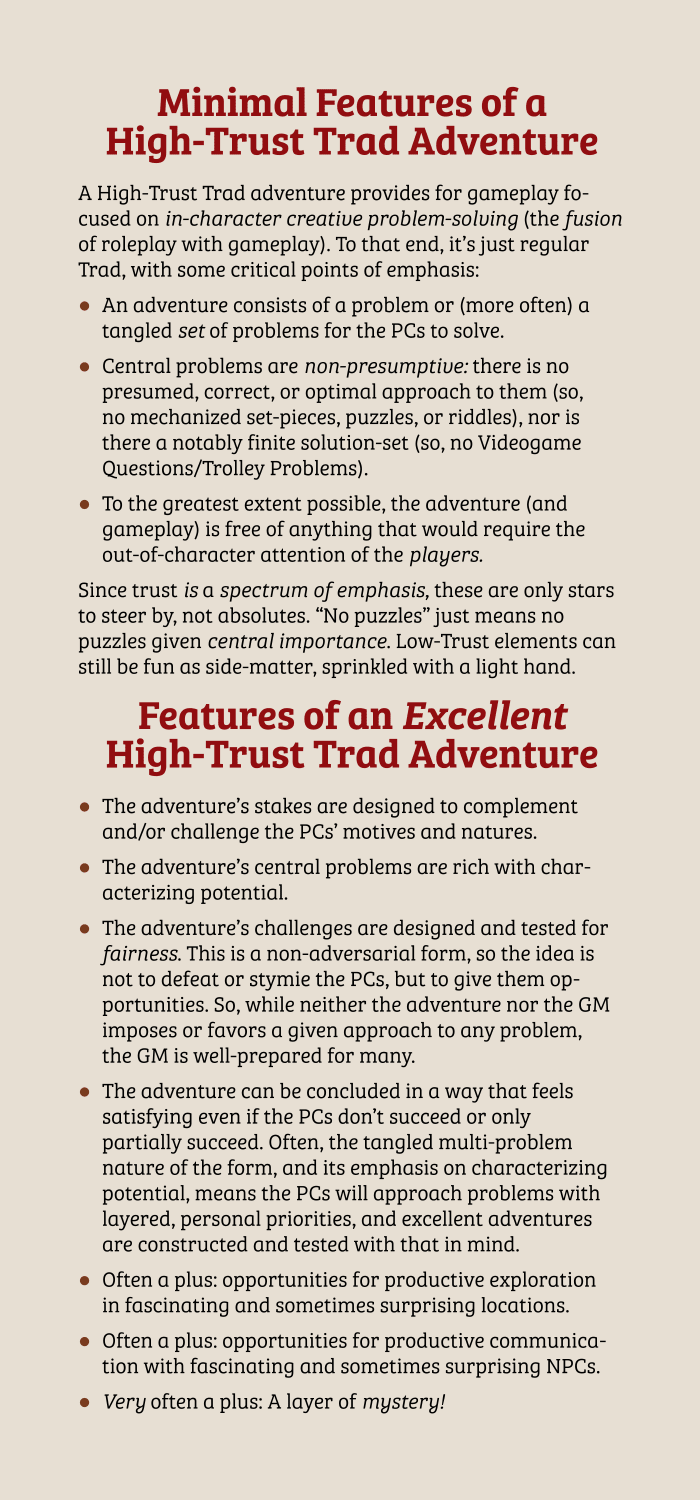
High-Trust Trad Traditional RPG where gameplay favors in-character creative problem solving and problem design favors the non-presumptive. A simple square-graph diagram emphasizing that the high-to-low spectrum of trad gameplay has "In-Character | Creation and Implementation" as the intersection labeled High-Trust and "Out-of-Character | Selection and Application" at the lowest. The graph is tilted slightly to indicate that the axes are not evenly weighted. The intersection of "In-Character | Selection and Application" is labeled "Upper Medium" and, due to the tilt, sits visibly higher than the "Lower Medium" intersection of "Out-of-Character | Creation and Implementation."Minimal Features of a . High-Trust Trad Adventure

A High-Trust Trad adventure provides for gameplay fo-

cused on in-character creative problem-solving (the fusion

of roleplay with gameplay). To that end, it’s just regular

Trad, with some critical points of emphasis:

e An adventure consists of a problem or (more often) a tangled set of problems for the PCs to solve.

o Central problems are non-presumptive: there is no presumed, correct, or optimal approach to them (so, no mechanized set-pieces, puzzles, or riddles), nor is there a notably finite solution-set (so, no Videogame Questions/Trolley Problem:s).

e To the greatest extent possible, the adventure (and gameplay) is free of anything that would require the out-of-character attention of the players.

Since trust is a spectrum of emphasis, these are only stars

to steer by, not absolutes. “No puzzles” just means no

puzzles given central importance. Low-Trust elements can still be fun as side-matter, sprinkled with a light hand. Features of an Excellent . High-Trust Trad Adventure

o The adventure’s stakes are designed to complement and/or challenge the PCs’ motives and natures.

o The adventure’s central problems are rich with char- acterizing potential.

o The adventure’s challenges are designed and tested for fairness. This is a non-adversarial form, so the idea is not to defeat or stymie the PCs, but to give them op- portunities. So, while neither the ...

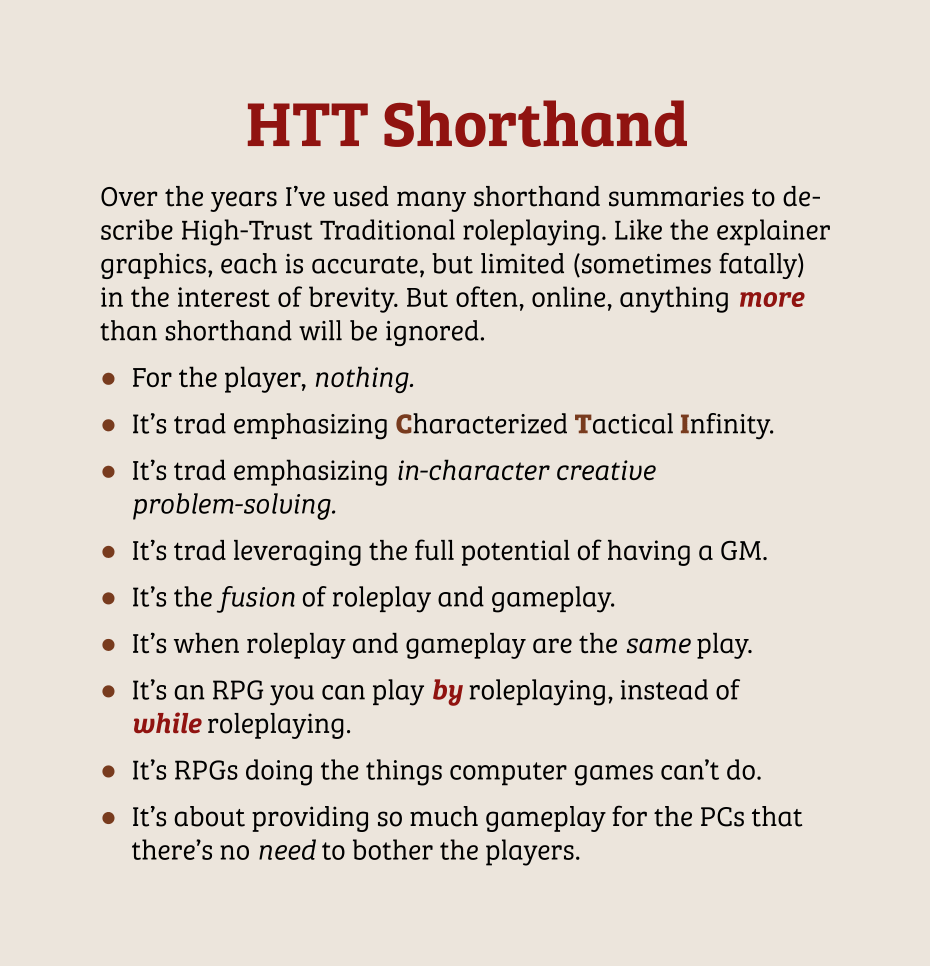
Text continues beyond the alt-text character limit.Over the years I've used many shorthand summaries to describe High-Trust Traditional roleplaying. Like the explainer graphics, each is accurate, but limited (sometimes fatally) in the interest of brevity. But often, online, anything more than shorthand will be ignored.

For the player, nothing.

It's trad emphasizing Characterized Tactical Infinity.

It's trad emphasizing in-character creative problem-solving.

It's trad leveraging the full potential of having a GM.

It's the fusion of roleplay and gameplay.

It's when roleplay and gameplay are the same play.

It's an RPG you can play by roleplaying, instead of while roleplaying.

It's RPGs doing the things computer games can’t do.

It's about providing so much gameplay for the PCs that there’s no need to bother the players.
0

If you have a fediverse account, you can quote this note from your own instance. Search https://dice.camp/users/SJohnRoss/statuses/114084832620828972 on your instance and quote it. (Note that quoting is not supported in Mastodon.)