
You are on Bondi Bidjigal land! 2020 from the series You are here!

‘Anne Zahalka’s photographs have become iconic and represent key moments in Australia’s history. Her practice has persistently challenged and questioned the status quo for more than 40 years, which has included interrogating Australia’s national and cultural identity, addressing pressing issues such as the climate emergency’ – Anouska Phizacklea, director and curator of Zahalkaworld.



You are on Bondi Bidjigal land! 2020 from the series You are here!

 In You are on Bondi Bidjigal land!, Zahalka uses digital compositing to immerse the viewer in a landscape choked by the hazy, orange smoke of the 2019–2020 bushfires. Crucially, the foreground of the cliff features ancient First Nations rock engravings—stylized renderings of fish and a whale. These carvings provide the physical evidence for the Bidjigal land claim, grounding the ecological catastrophe within a broader context of traditional ownership and the ongoing displacement of Indigenous sovereignty.

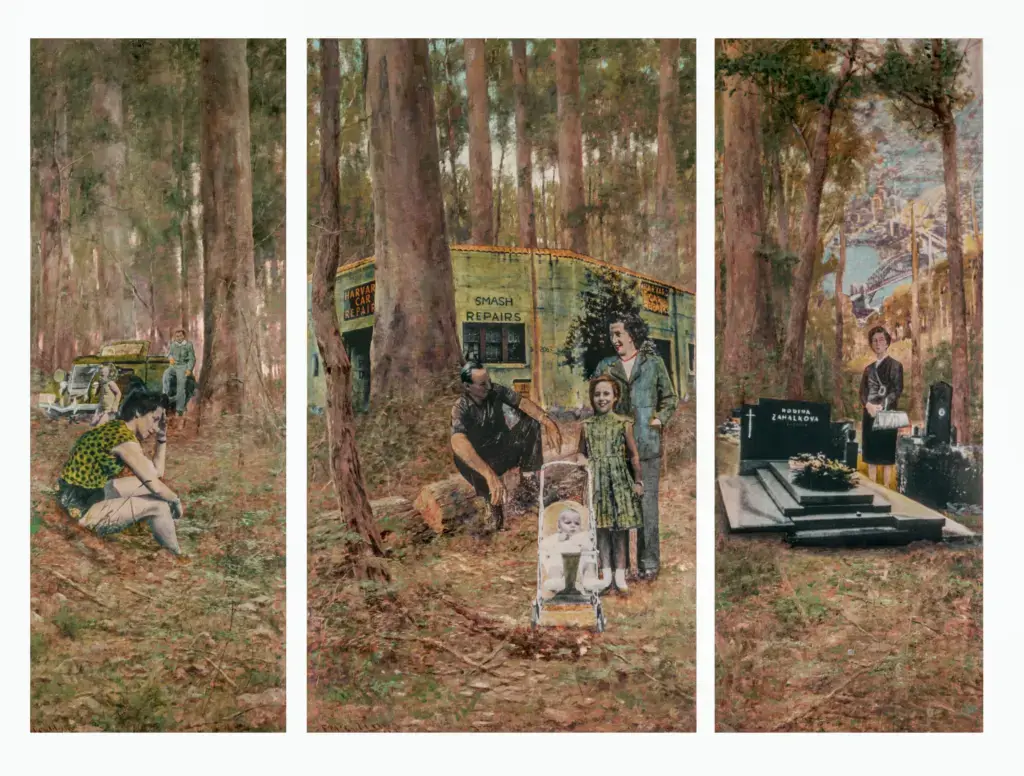
The Immigrants #2 1983 from the series The Landscape Re-presented

The Immigrants reworks a reproduction of Frederick McCubbin’s The Pioneer (1904) by collaging photos of herself and her family – post-WWII refugees – over the original Australian pioneer figures. This intervention questions her family’s place within the then predominantly Anglo-Celtic demographic and implants her family’s immigrant story on to the Australian landscape.


The Immigrants #2 1983 from the series The Landscape Re-presented.

This work constitutes a profound intervention into Frederick McCubbin’s The Pioneer (1904). While McCubbin’s triptych romanticizes Anglo-Celtic settlement, Zahalka "implants" her own family of post-WWII refugees into the frame. The visual juxtaposition is startling: in the central panel, the romanticized pioneer cottage is replaced by a prosaic, olive-drab "Smash Repairs" workshop, grounding the immigrant experience in industrial labor rather than pastoral idealism. In the right panel, the man crouching over a grave is replaced by a figure standing before a polished black headstone inscribed with "Rodina Zahalkova" (Zahalka Family). This intervention asserts an immigrant history of mourning and belonging within the "sacred" space of the Australian bush.
0

If you have a fediverse account, you can quote this note from your own instance. Search https://mastodon.social/users/appassionato/statuses/116111068737498026 on your instance and quote it. (Note that quoting is not supported in Mastodon.)