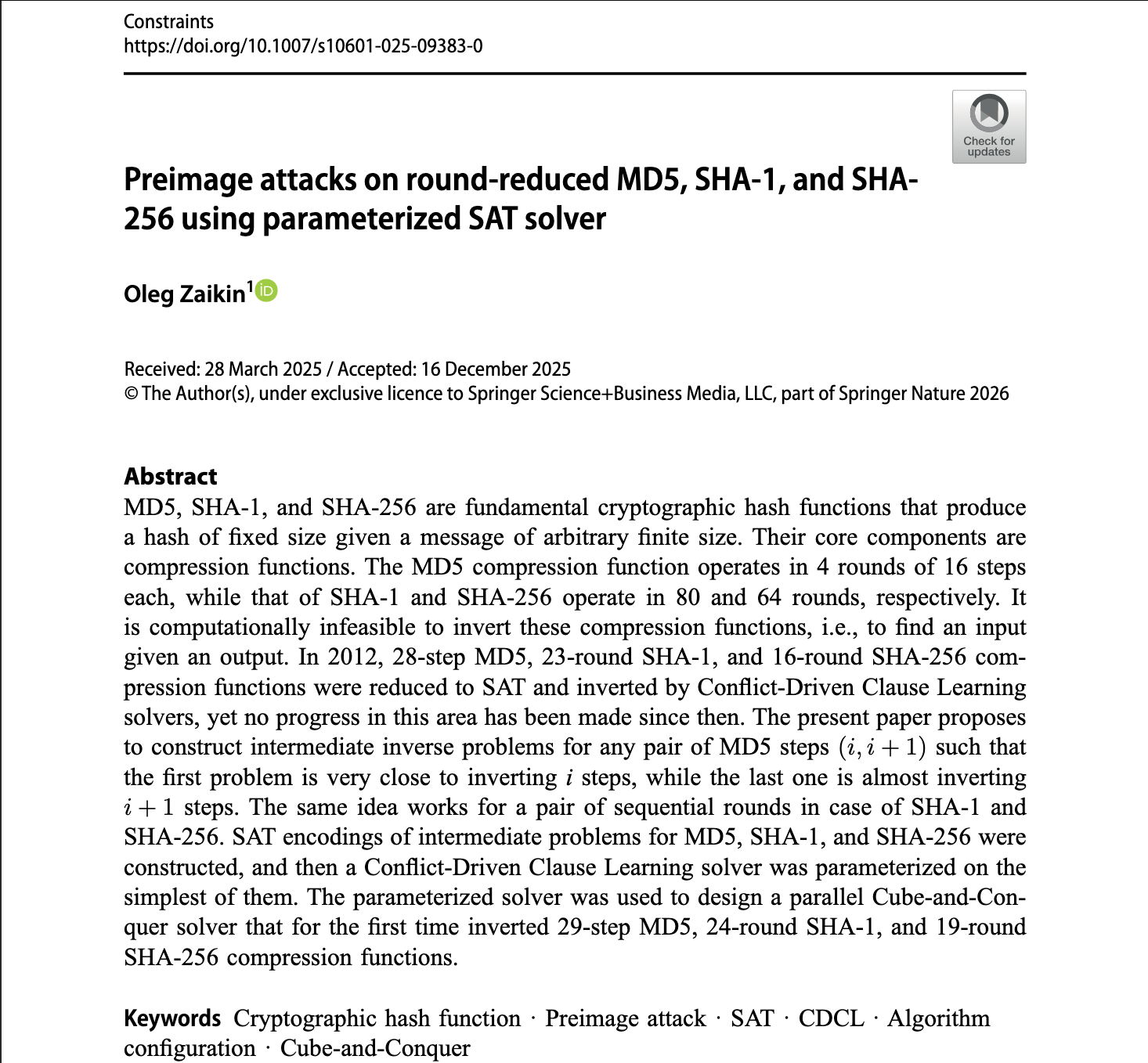
1/2 Exciting news: we just published a new paper: "Preimage attacks on round-reduced MD5, SHA-1, and SHA-256 using parameterized SAT solver", by Oleg Zaikin

If you are interested in security, cryptology, or Constraint Programming, definitely give this paper a read!

link.springer.com/article/10.1

Abstract: MDS, SHA-1, and SHA-256 are fundamental cryptographic hash functions that produce a hash of fixed size given a message of arbitrary finite size. Their core components are compression functions. The MDS compression function operates in 4 rounds of 16 steps each, while that of SHA-1 and SHA-256 operate in 80 and 64 rounds, respectively. It is computationally infeasible to invert these compression functions, i.e., to find an input given an output. In 2012, 28-step MDS, 23-round SHA-1, and 16-round SHA-256 compression functions were reduced to SAT and inverted by Conflict-Driven Clause Learning solvers, yet no progress in this area has been made since then. The present paper proposes to construct intermediate inverse problems for any pair of MDS5 steps (i, i + 1) such that the first problem is very close to inverting i steps, while the last one is almost inverting i + 1 steps. The same idea works for a pair of sequential rounds in case of SHA-1 and SHA-256. SAT encodings of intermediate problems for MD5, SHA-1, and SHA-256 were constructed, and then a Conflict-Driven Clause Learning solver was parameterized on the simplest of them. The parameterized solver was used to design a parallel Cube-and-Conquer solver that for the first time inverted 29-step MDS, 24-round SHA-1, and 19-round SHA-256 compression functions.
Keywords: Cryptographic hash function; Preimage attack; SAT; CDCL; Algorithm
configuration + Cube-and-Conquer
0

If you have a fediverse account, you can quote this note from your own instance. Search https://mastodon.acm.org/users/constraintsjournal/statuses/116120980953354543 on your instance and quote it. (Note that quoting is not supported in Mastodon.)