Sophie on Substack
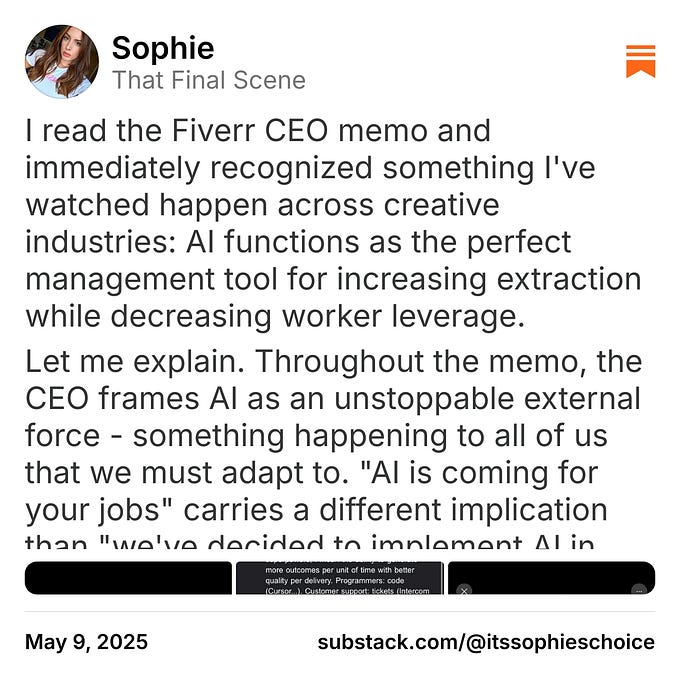
I read the Fiverr CEO memo and immediately recognized something I've watched happen across creative industries: AI functions as the perfect management tool for increasing extraction while decreasing worker leverage.
Let me explain. Throughout the memo, the CEO frames AI as an unstoppable external force - something happening to all of us that we must adapt to. "AI is coming for your jobs" carries a different implication than "we've decided to implement AI in ways that will eliminate positions." The first framing removes human agency and responsibility. The second acknowledges a choice.
This matters because it completely reshapes how workers can respond. You can protest a decision. You can organize against a policy. But how do you fight a technological inevitability? The very framing forecloses resistance.
I want to focus on what the memo actually demands: work "more, faster, and more efficiently now" while maintaining the same compensation structure. This represents the core transaction being offered. Your productivity must increase dramatically while your share of the value created remains fixed or diminishes. The CEO positions this as adaptation.
The directive to "become a prompt engineer" is brilliant. First, create fear that AI will replace you. Then offer salvation through serving the very system threatening your livelihood. The worker transitions from creator to supervisor of their own replacement, maintaining just enough agency to feel responsible for their fate while watching their leverage erode.
The story always sounds the same: Technology will change everything. Adapt or perish. Yet adaptation mysteriously always means producing more for less, with an ever-smaller slice of the pie.
When the CEO invites employees to "sit with me" if they "want to be on the winning side of history," he’s telling on himself. He decides who wins in this scenario. The rules get written by people with interests. The technology serves those interests while being presented as neutral, inevitable progress.
I wrote about this dynamic in my newsletter this week - how the emerging AI narrative treats creative work as merely a process to optimize rather than a fundamentally human activity with its own rhythms and values.
Here's my advice, worth exactly what you're paying for it: When someone demands your labor intensify while suggesting your compensation remain static, all while invoking the specter of AI, ask yourself who benefits from your fear. It's rarely you.
I believe we can demand more than becoming prompt engineers for our own obsolescence. I believe we can create technology that serves human flourishing rather than quarterly profits. And I know many of you feel the same way.
https://www.thatfinalscene.com/p/ai-knows-how-we-write-but-not-why
substack.com · Substack