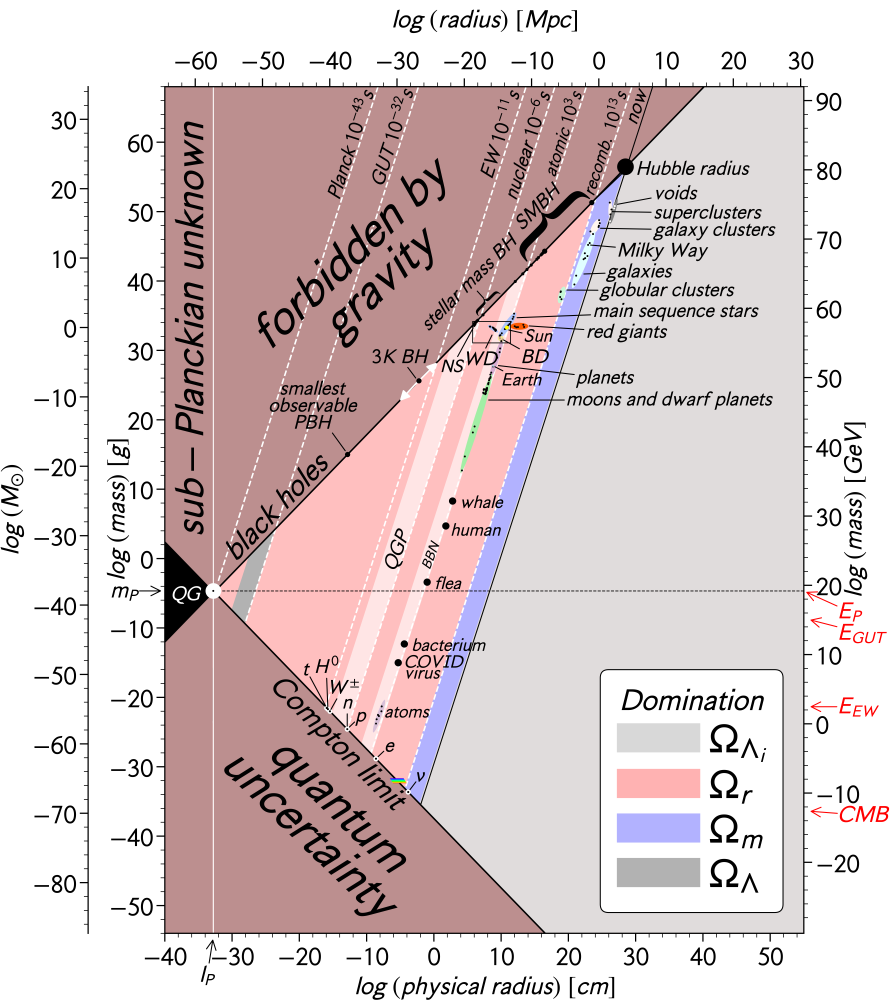
This chart shows all objects in the Universe, arranged by mass (vertical) and radius (horizontal).
The edge of the upper left corner is the "Schwarzschild radius" - anything along this edge becomes a black hole, so we don't expect stuff above and to the left of that.
The edge of the lower left corner is the "Compton wavelength" - anything here has a size so small that measuring its position that accurately would require enough energy to create a new one.
These two corners intersect in a white dot. This would be a black hole so small that it's heavily affected by quantum mechanics. By definition its mass would be the Planck mass, and its radius the Planck length. Nobody has seen such a thing.
The black region to the left of that dot, labeled "QG", contains imaginary objects that are more compressed than black holes, yet also ruled out by the uncertainty principle. So they're doubly impossible - unless Quantum Gravity, which we don't understand, changes the rules.
The pink strips of slope 3 are lines of constant density. For example "QGP" is the density of quark-gluon plasma, "BBN" is the density of the universe when Big Bang nucleosynthesis was going on, and so on.
The Earth is only slightly more dense than a flea.
The black dot labeled "Hubble radius" is the whole observable universe.
I like this chart a lot. It's from here:
C. H. Lineweaver and V. M. Patel, “All objects and some questions”, American Journal of Physics 91 (2023), 819-825. Free at https://pubs.aip.org/aapt/ajp/article-pdf/91/10/819/20107261/819_1_5.0150209.pdf
A higher-resolution version is on Wikicommons:
https://commons.wikimedia.org/wiki/File:Masses_and_sizes_of_objects_in_our_Universe.png
See the alt text for more!