New result: you can build a universal computer using a single billiard ball on a carefully crafted table!

More precisely: you can create a computer that can run any program, using just a single point moving frictionlessly in a region of the plane and bouncing off the walls elastically.

Since the halting problem is undecidable, this means there are some yes-or-no questions about the eventual future behavior of this point that cannot be settled in a finite time by any computer program.

This is true even though the point's motion is computable to arbitrary accuracy for any given finite time. In fact, since the methodology here does *not* exploit the chaos that can occur for billiards on certain shaped tables, it's not even one of those cases where the point's motion is computable in principle but your knowledge of the initial conditions needs to be absurdly precise.

This result is not surprising to me - it would be much more surprising if you *couldn't* make a universal computer this way. Universal computation seems to be a very prevalent feature of sufficiently complex systems. But still it's very nice.

• Eva Miranda and Isaac Ramos, Classical billiards can compute, arxiv.org/abs/2512.19156.

Classical billiards can compute
Eva Miranda, Isaac Ramos

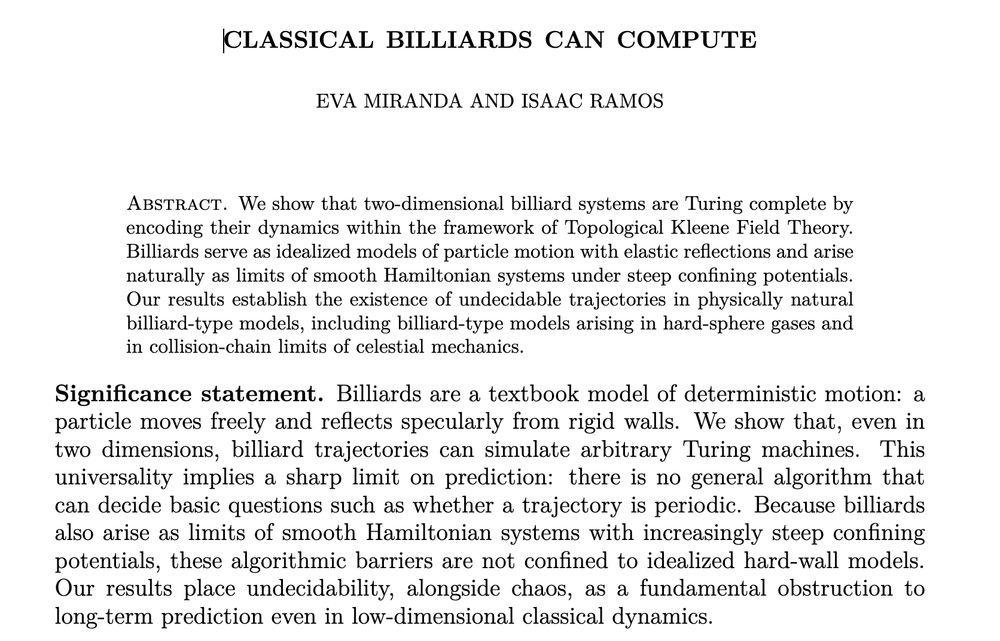
We show that two-dimensional billiard systems are Turing complete by encoding their dynamics within the framework of Topological Kleene Field Theory. Billiards serve as idealized models of particle motion with elastic reflections and arise naturally as limits of smooth Hamiltonian systems under steep confining potentials. Our results establish the existence of undecidable trajectories in physically natural billiard-type models, including billiard-type models arising in hard-sphere gases and in collision-chain limits of celestial mechanics.

Significance statement.  Billiards are a textbook model of deterministic motion: a particle moves freely and reflects specularly from rigid walls. We show that, even in two dimensions, billiard trajectories can simulate arbitrary Turing machines. This universality implies a sharp limit on prediction: there is no general algorithm that can decide basic questions such as whether a trajectory is periodic. Because billiards also arise as limits of smooth Hamiltonian systems with increasingly steep confining potentials, these algorithmic barriers are not confined to idealized hard-wall models. Our results place undecidability, alongside chaos, as a fundamental obstruction to long-term prediction even in low-dimensional classical dynamics.

From here: https://arxiv.org/abs/2512.19156
0
0
0

If you have a fediverse account, you can quote this note from your own instance. Search https://mathstodon.xyz/users/johncarlosbaez/statuses/115768302725297754 on your instance and quote it. (Note that quoting is not supported in Mastodon.)