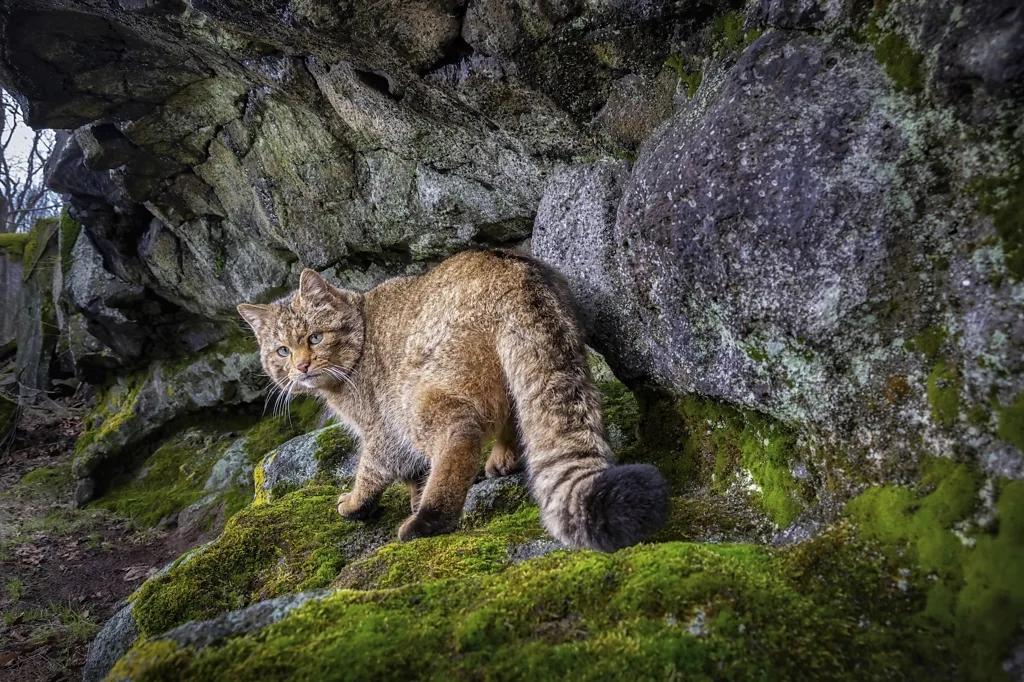
Some good news in a time of darkness: the European wildcat, Felis sylvestris, is making a comeback! This thoughtful-looking example was photographed in a mountainous region of the Czech republic.
The European wildcat's extreme elusiveness may have helped it avoid hunters in places where a larger native cat, the lynx, has been killed off. There may be about 140,000 European wildcats spread across more than two dozen countries. But they are very hard to find!
Wildlife photographer Andrea Giovanni, who made a video of one, writes:
"I'd never even thought of taking photos of wildcats, for a simple reason: I thought it was impossible, or at least, extremely difficult. It's considered 'the ghost of the forests' because it's very, very elusive, and it's hard to predict where it can be spotted. Other animals tend to follow the same trails through the forest. The wildcat goes wherever she wants to."
One reason the European wildcat is coming back is increased legal protections. But another is that villages in Italy and other regions are becoming depopulated! Some are very worried about declining human populations. But it does make room for other species. That gives me some hope for the future.
I got this picture, taken by Vladimír Čech Jr in the Doupov mountains, from a very nice article on the European wildcat:
https://www.bbc.com/future/article/20260112-rare-images-of-europes-ghost-cat
For more on this species:
https://en.wikipedia.org/wiki/European_wildcat
Seven subspecies have been demarcated!