TIL the way piano keys are laid out is not well documented on the internet, and not even standardized!
This site explains the problem... but neither of the solutions it proposes are what actually happens as far as I can tell.
http://datagenetics.com/blog/may32016/index.html
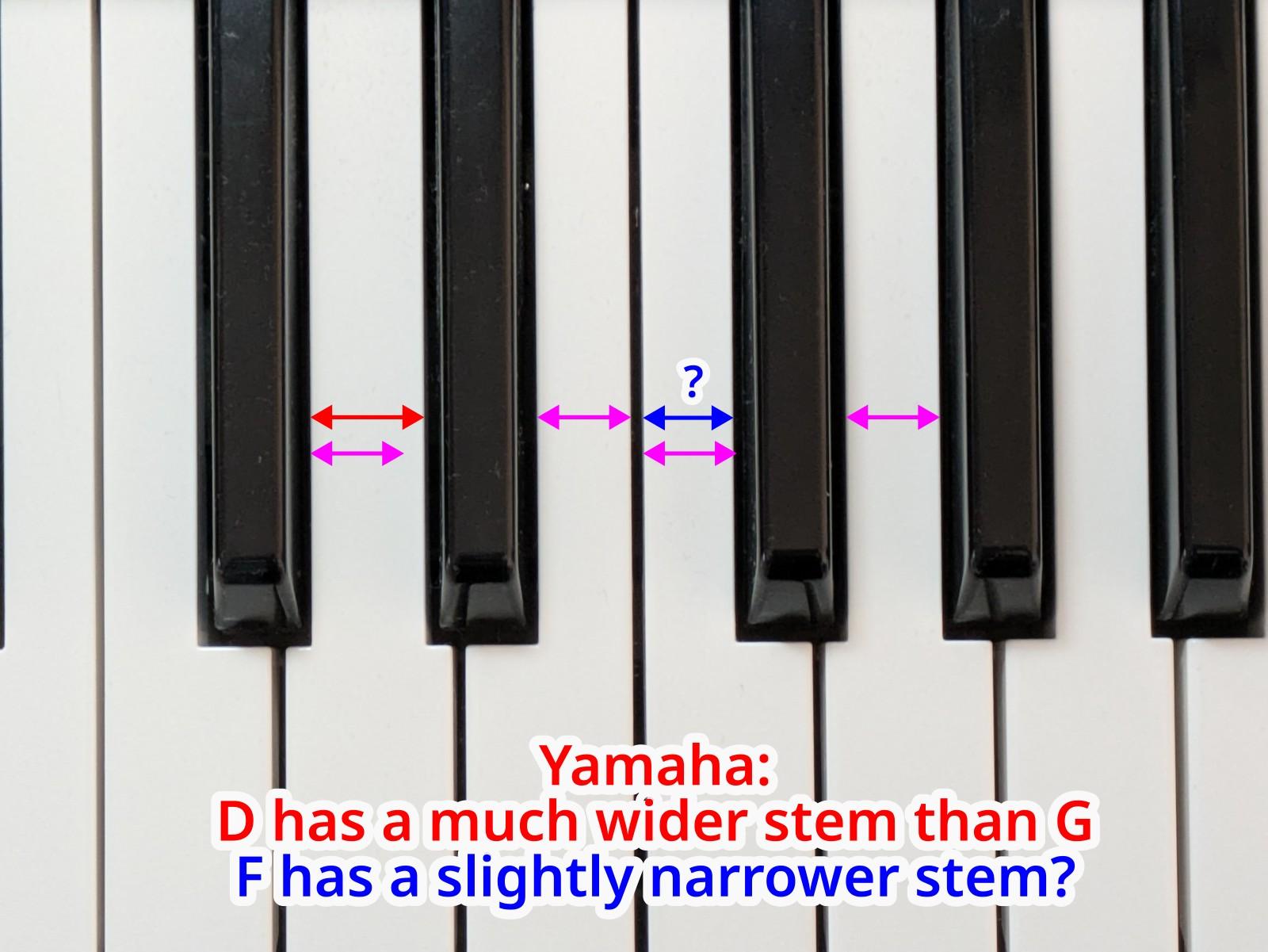
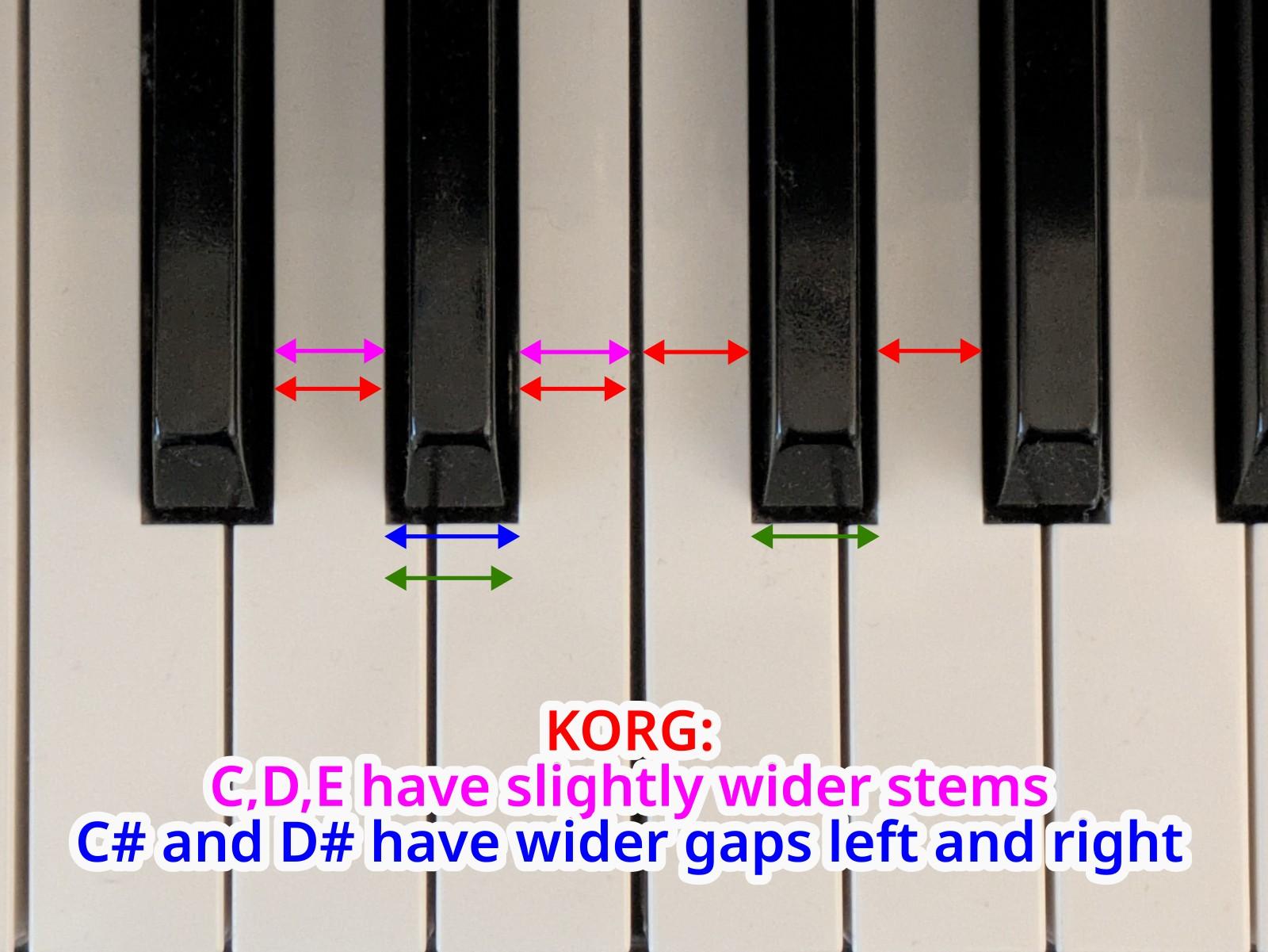
On both my KORG and my Yamaha keyboards, the key giveaway is that C# and D# are significantly further apart than F# and G# (and G# and A#). You can easily feel this if you slide your finger on top of D and G/A.
I don't have a good way to measure exactly, but just looking closely at my keyboards, I think what actually happens is roughly:
- F through B are laid out as in "Scenario #1" on that site.
- Then, KORG and Yamaha do two things:
- Yamaha has C=F and E=B, and places C# and D# at the same relative positions to C and E as F# and A# are to F and B, which leaves D an oddball white key: its "stem" is much wider than that of the other white keys. Also maybe F is a bit weird?
- KORG cheats more: They split the difference between the CDE stems (which are slightly wider) and the gaps around C# and D# (which are now positioned slightly closer together than Yamaha's, but still further apart than F# and G#).
- For both designs, I believe the underlying mechanism/sensors are evenly spaced across the octave, and the mismatch (most prominent at the boundary between E and F) is just handwaved away (sensors are not on the centerline of keys).
I wonder if this correct, and what other solutions are out there in the wild?