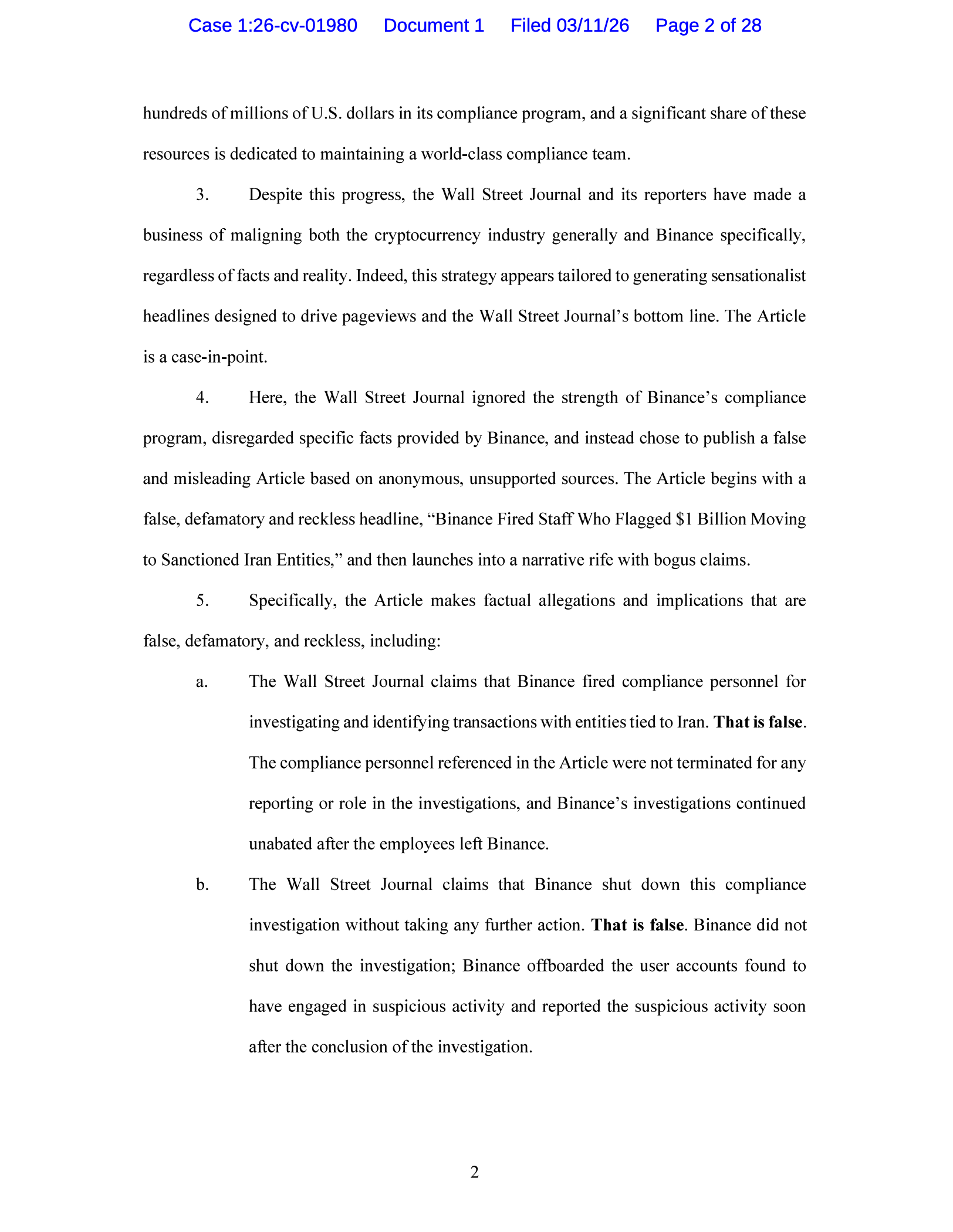
The Binance crypto exchange has just filed a defamation lawsuit against the Wall Street Journal over its article reporting that Binance's own compliance investigators had found $1 billion in transfers to Iran-backed terror groups, and then were fired.

Complaint: courtlistener.com/docket/72409

WSJ report: wsj.com/finance/currencies/bin

Binance Holdings Limited ("Binance" or "Plaintiff'), as and for its Complaint against Dow Jones & Company, Inc. d/b/a The Wall Street Journal ("Dow Jones" or "Wall Street Journal"), alleges as follows: INTRODUCTION 1. Binance brings this action against the Wall Street Journal for publishing a false and defamatory article on February 23, 2026, which is the subject of this complaint (the "Article"). In the Article, the Wall Street Journal made numerous false and disparaging statements about Binance, and did so knowingly, recklessly, or negligently, and despite the fact that Binance provided factual corrections prior to publication, which the Wall Street Journal disregarded. 2. Binance is the world's largest cryptocurrency exchange by trading volume and users. In addition to holding licenses, registrations, and authorizations in more than 20 jurisdictions, Binance is the first cryptocurrency exchange to have secured full authorization under the Financial Services Regulatory Authority of the Abu Dhabi Global Market's regulatory framework. Binance has built one of the largest and most robust compliance programs in the digital asset industry, dedicating more than 1,500 individuals, nearly a quarter of its global workforce, to compliance, investigative, and risk functions. Binance investshundreds of millions of U.S. dollars in its compliance program, and a significant share of these resources is dedicated to maintaining a world-class compliance team. 3. Despite this progress, the Wall Street Journal and its reporters have made a business of maligning both the cryptocurrency industry generally and Binance specifically, regardless of facts and reality. Indeed, this strategy appears tailored to generating sensationalist headlines designed to drive pageviews and the Wall Street Journal's bottom line. The Article is a case-in-point. 4. Here, the Wall Street Journal ignored the strength of Binance's compliance program, disregarded specific facts provided by Binance, and instead chose to publish a false and misleading Article based on anonymous, unsupported sources. The Article begins with a false, defamatory and reckless headline, "Binance Fired Staff Who Flagged $1 Billion Moving to Sanctioned Iran Entities," and then launches into a narrative rife with bogus claims. 5. Specifically, the Article makes factual allegations and implications that are false, defamatory, and reckless, including: a. The Wall Street Journal claims that Binance fired compliance personnel for investigating and identifying transactions with entities tied to Iran. That is false. The compliance personnel referenced in the Article were not terminated for any reporting or role in the investigationc. The Wall Street Journal claims that Binance diminished its compliance with law enforcement requests. That is false. The compliance investigation started as a result of law enforcement requests seeking information about transactions, and Binance complied with those requests and cooperated with law enforcement, while also conducting an independent investigation that resulted in Binance oflboarding user accounts it identified that were engaged in suspicious activity. d. The Wall Street Journal claims that Binance knowingly registered customers with false documentation and provided preferential treatment to those customers. That is false. Identity verification is mandatory for all customers. 6. The Wall Street Journal contacted Binance at the eleventh hour seeking any comment Binance had on identified points and questions related to the Article, and refused to grant a good-faith extension for Binance to respond. Binance nevertheless worked with all haste to get factual corrections to the Wall Street Journal, but unfortunately, the Wall Street Journal then disregarded those corrections and refused an immediate request for correction. While it is incumbent upon a responsible publisher to seek to understand the true position prior to publication, it is apparent that the Wall Street Journal had already drafted the Article to conform to its own pre-existing agenda without regard to t
0

If you have a fediverse account, you can quote this note from your own instance. Search https://hachyderm.io/users/molly0xfff/statuses/116210832826175994 on your instance and quote it. (Note that quoting is not supported in Mastodon.)