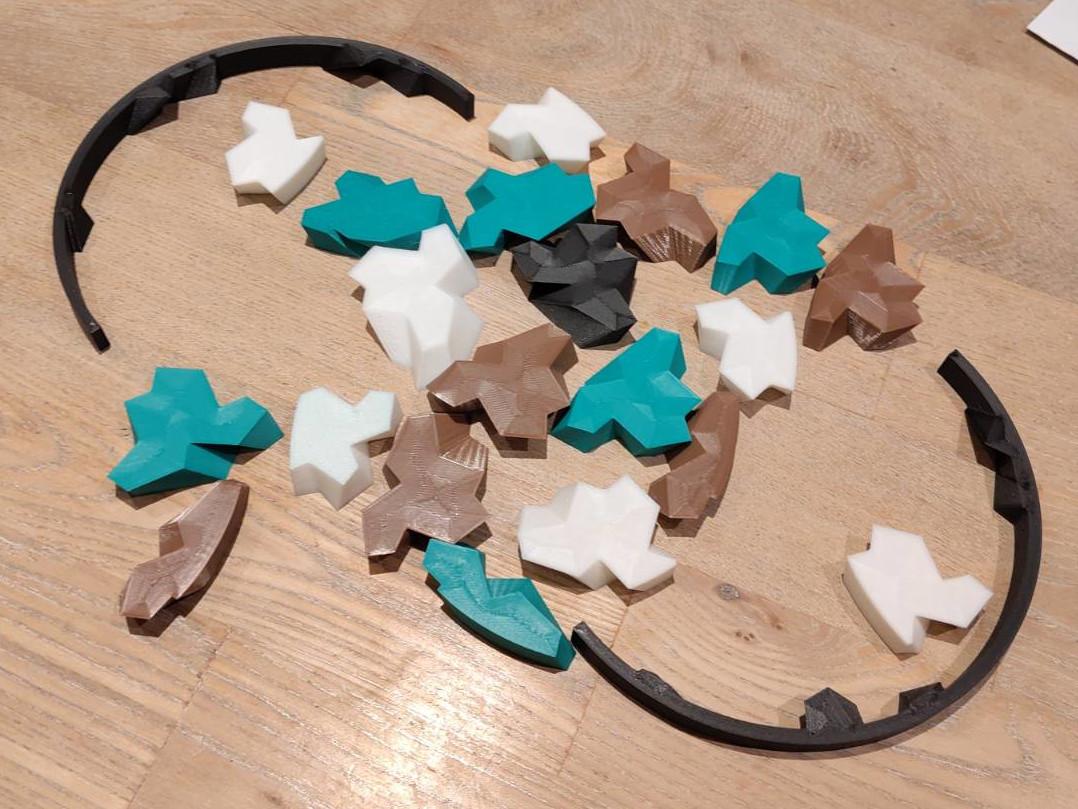
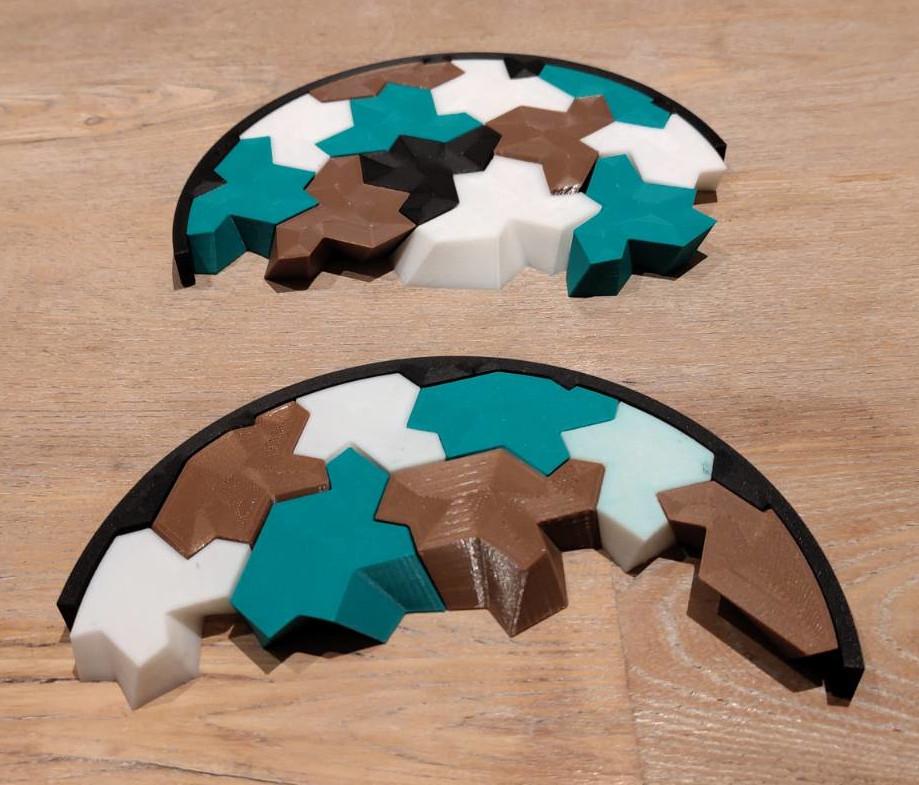
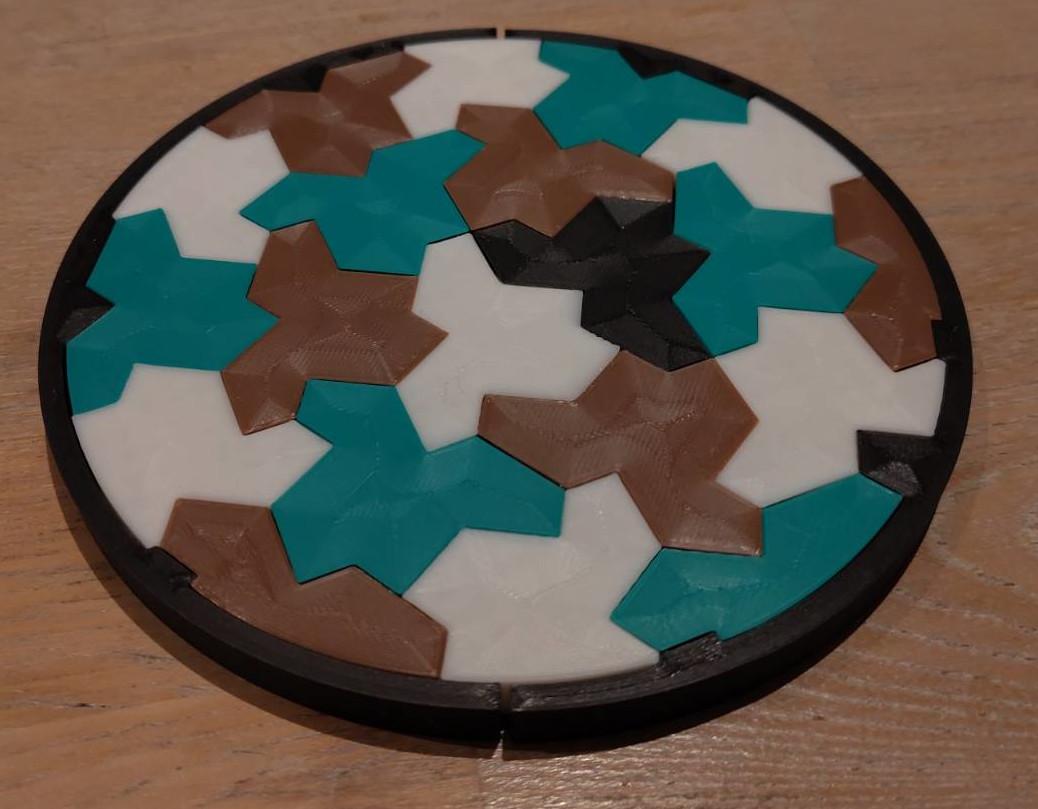
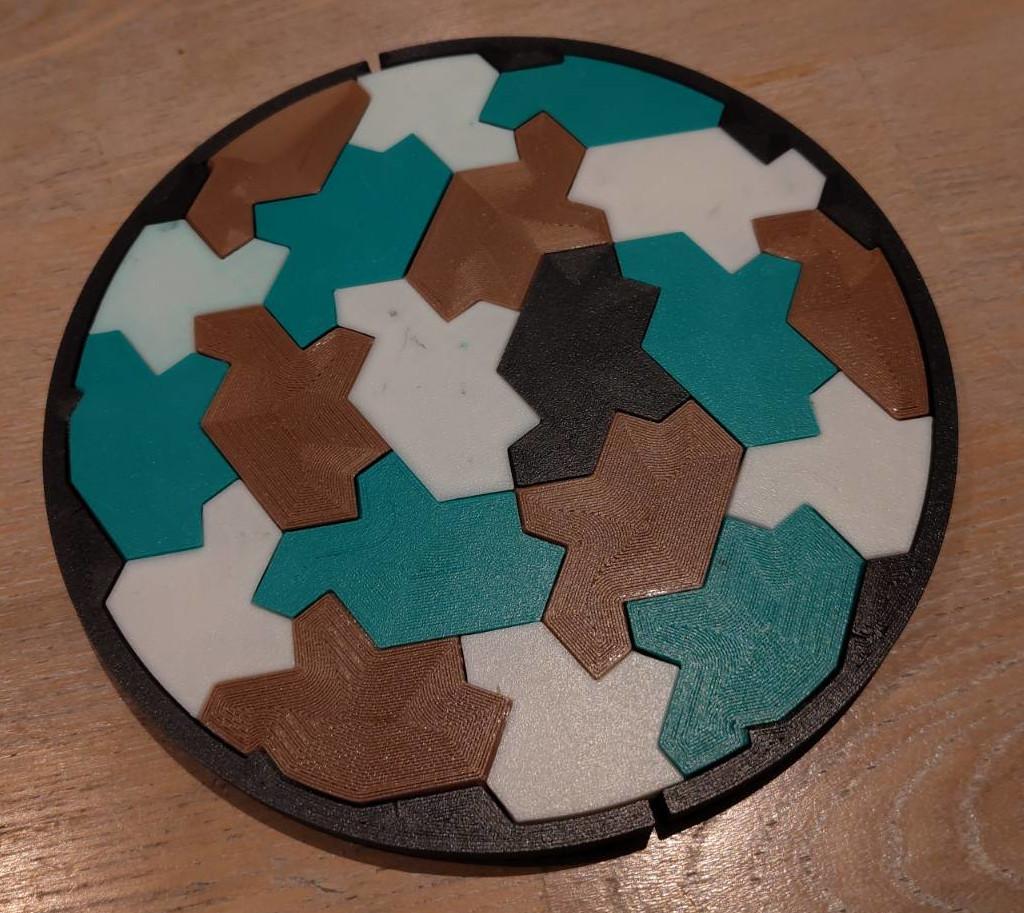
Visiting my sister and family for Christmas, and they have a shiny new 3D printer, so naturally we've been playing with it. Here's a hats-and-turtles jigsaw puzzle.
The puzzle was made by taking a hat tiling and its combinatorially identical turtle tiling, and making a puzzle piece from each pair of corresponding tiles, so that each piece (or at least each non-edge piece) has a hat-shaped face on one side and a turtle on the other.
Despite this, every piece is different. To make a hat and turtle tiling correspond as closely as possible you must scale the turtles down by an irrational factor √(4/5) to make a turtle have the same area as a hat, and rotate by an irrational angle tan⁻¹(1/√15) to keep the distance between each hat and its turtle bounded. As a result of these irrationals, no two pieces have the hat and turtle in quite the same position relative to each other. Also, the rotation makes corresponding edges skew to each other, so the sides of the puzzle pieces aren't flat planes – they all have a compound curve.
Some of the tiles are truncated by the circular frame, of course. When a piece of tile was just _too_ small, I made it part of the frame, which gives a starting point for placing other pieces. The four-colouring (suggested by my brother-in-law) also provides clues to the layout. I was quite scared that this puzzle would be too hard, and _might_ have gone a bit too far in the other direction making sure it was possible!
Inspired by a thread last year https://hachyderm.io/@simontatham/113329520560963878. Hat tip to Oskar van Deventer, who had a similar idea, and produced a puzzle with hats on one side and the degenerate chevron tile on the other (and without the four-colouring or frame protrusions).