What is Hackers' Pub?

Hackers' Pub is a place for software engineers to share their knowledge and experience with each other. It's also an ActivityPub-enabled social network, so you can follow your favorite hackers in the fediverse and get their latest posts in your feed.

0
0
0
0

3/

From-time-to-time these local Linux User Groups (LUGs) would put on a Linux InstallFest —

An in-person event where people (who weren't using Linux yet, but were interested) would bring their computer to the Linux InstallFest, and someone from the local LUG would help install Linux for them on their computer.

This helped spread Linux.

We (of the Fediverse) could do something similar.

...

4/

We (of the Fediverse) could learn from the Linux User Groups (LUGs).

We could have our own version of a Linux InstallFest — a Fediverse JoinFest.

An in-person event where people who are interested in the Fediverse, but are having trouble joining — can bring their mobile phone or laptop, and some Fediverse-savvy person (like us) could help them join the Fediverse.

We could install a Fediverse app on their mobile phone for them.

We could help them pick a server to join.

.

0
0
0

+++Medienspiegel zu unseren Palantir-Recherchen und die Stellungnahme von Palantir-Kadern selbst+++

In Deutschland haben unsere Schweiz-Scoops einige Fragen aufgeworfen.. "Grünen-Geheimdienstexperte Konstantin von Notz kritisiert den Einsatz der Überwachungssoftware Palantir in Deutschland. Grund sind neue Erkenntnisse aus der Schweiz. Innenminister Dobrindt gerät unter Druck", schreibt beispielsweise die Wirtschaftswoche. Der Standard, Netzpolitik.org und weitere griffen diese Woche unsere Recherche mit Fokus auf den Evaluationsreport der Schweizer Armee ebenfalls auf. Und es folgen bald noch weitere Artikel (stay tuned!)

In der Schweiz? Schweigen im digitalen Blätterwald (bis auf ein paar Ausnahmen wie 20min.ch, soweit ich es überblicken kann). 😉 🤨 Bei den Ringier-Medien verwundert das ja nicht. Aber bei den Anderen?

Meanwhile hat ein von uns befragter Palantir-Kadermann mit seinem eigenen "Factchecking" auf unsere beiden Artikel bei LinkedIn reagiert. "It’s a shame that with all the cooperation and access granted to Republik, they couldn’t exercise the integrity to push beyond salacious conspiracies and cheap recitals of already-debunked Palantir myths. Swiss readers deserve better."

Na dann... 😉

wiwo.de/politik/deutschland/pa

linkedin.com/pulse/fact-checki

„Das Festhalten an Palantir irritiert massiv“
Grünen-Geheimdienstexperte Konstantin von Notz kritisiert den Einsatz der Überwachungssoftware Palantir in Deutschland. Grund sind neue Erkenntnisse aus der Schweiz.
0
0
0
0
0
0
1
0
0
0

@mxk @Xobs@mastodon.socia

To give some background, I "hitchhiked" my functions on another tape-out that was paid for by a company called Crossbar Inc. Crossbar took the unusual step of agreeing to open source all the RTL they were legally allowed to, and they held up to that agreement.

Thus from the get-go, I was not the architect of the chip, but rather, a guest on someone else's chip. I could politely advise, but not dictate the terms of the cores.

Here's the what:

The components that aren't open sourced are the foundry IP (analog + detailed memory models + USB), the AMBA bus framework, plus a couple small blocks (RTC, MDMA) that I didn't have a say in and are not required for normal operation.

Here's the why:

Foundry IP models (analog+memory) are quite difficult to open source and considered to be out of scope for this project. There's people working on it, but at the moment there are no processes smaller than 130nm that have open source IP. To give some context, at 130nm you might be able to do a chip that runs at dozens of MHz with a few dozen kilobytes of RAM. In contrast, Baochip runs at 350/700MHz with a couple megabytes of RAM.

USB/AMBA models were picked for their maturity. The open-source alternatives didn't provide the same feature set or validation quality. Eventually such IP can be brought up to standard but one has to allocate risk strategically; if the chip doesn't boot because of a bus framework bug, then you have no chip at all.

For the blocks I was directly responsible for, I picked a fully open source bus framework. The framework did turn out to have several subtle bugs, which took a lot of effort to rectify (open source comes with no warranty, so all the testing falls on your shoulders!).

One bug unfortunately made it through to the final silicon and requires a less than desirable work-around (the chip has to reboot itself once to get a clock domain synchronizer into a reliable state; end users barely notice it because it's quite fast, but this is only possible because the main CPU boot is reliable). So in the end, Crossbar's choice to insist on a battle-proven bus framework was prescient: the chip probably wouldn't have worked at all if we went with the fully open source framework on the first go around.

The other small blocks were mostly last-minute add-ons and we didn't have the time/resources to qualify open source versions and we already had off-the-shelf, tape-out proven, closed-source versions. There was only one of me involved in the tape out, versus dozens of engineers on their end, and the schedule was fixed by their needs.

The Crossbar version of the chip also has a Cortex-M7 in it - they viewed it too risky to go with a pure open source core, and I respect that opinion - but their CPU is fused off in my version of the chip, so it is dead silicon.

Basically, the question is equivalent to "how come you didn't boil the ocean in a single kettle", and the answer is "the kettle isn't big enough, so we have to boil it one kettle at a time".

As to which kettles were picked to boil: all the blocks that can perform a computation on my version of the chip are open source.

The remaining blocks can either be verified to be working correctly by e.g. read/write tests (fill the memory with random values, read back & compare; the existence of "shadow" memory can be disproven with IRIS), or they can't affect computation (eg analog blocks), or they should just be passing data around without modification (eg bus frameworks).

This approach does not disprove the existence of malicious code buried somewhere in the closed source blocks, but it does say you can inspect all the blocks that we say *should* be doing computation and you can confirm their function. It's a "better-than-nothing" approach, and it enables some pretty neat stuff in terms of simulating the chip to develop/debug firmware.

I understand this approach will disappoint those who want the highest bar cleared on the first try. To those who disapprove: it's open source, please jump in and help clear the bar!

But, let's consider that we can raise the bar now, so why not raise it? We don't have to settle for fully closed source solutions, so long as incremental progress is considered acceptable.


0
1
1

Hong Kong's oldest pro-democracy party announces dissolution

> Hong Kong's oldest pro-democracy party has decided to disband, the group announced Sunday (Dec 14), after its members formally voted to dissolve the organisation and enter liquidation.

> The Democratic Party was founded in 1994, near the end of British colonial rule, when Hong Kong's leading liberal groups merged.
channelnewsasia.com/asia/hong-

0
0
0
0

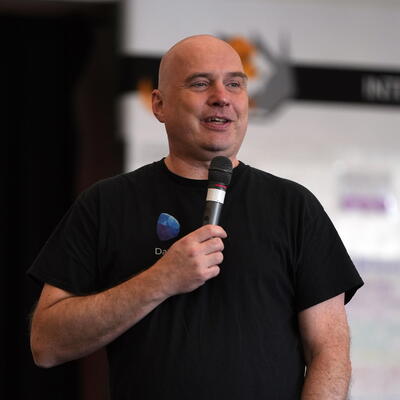
I'll be presenting some of my latest work on Xous & Baochip with @Xobs at on Day two, 11PM room One:

fahrplan.events.ccc.de/congres

Hope to see you there!

For more on Baochip, checkout bluesky: bsky.app/profile/baochip.com or read the source at github: github.com/baochip/baochip-1x

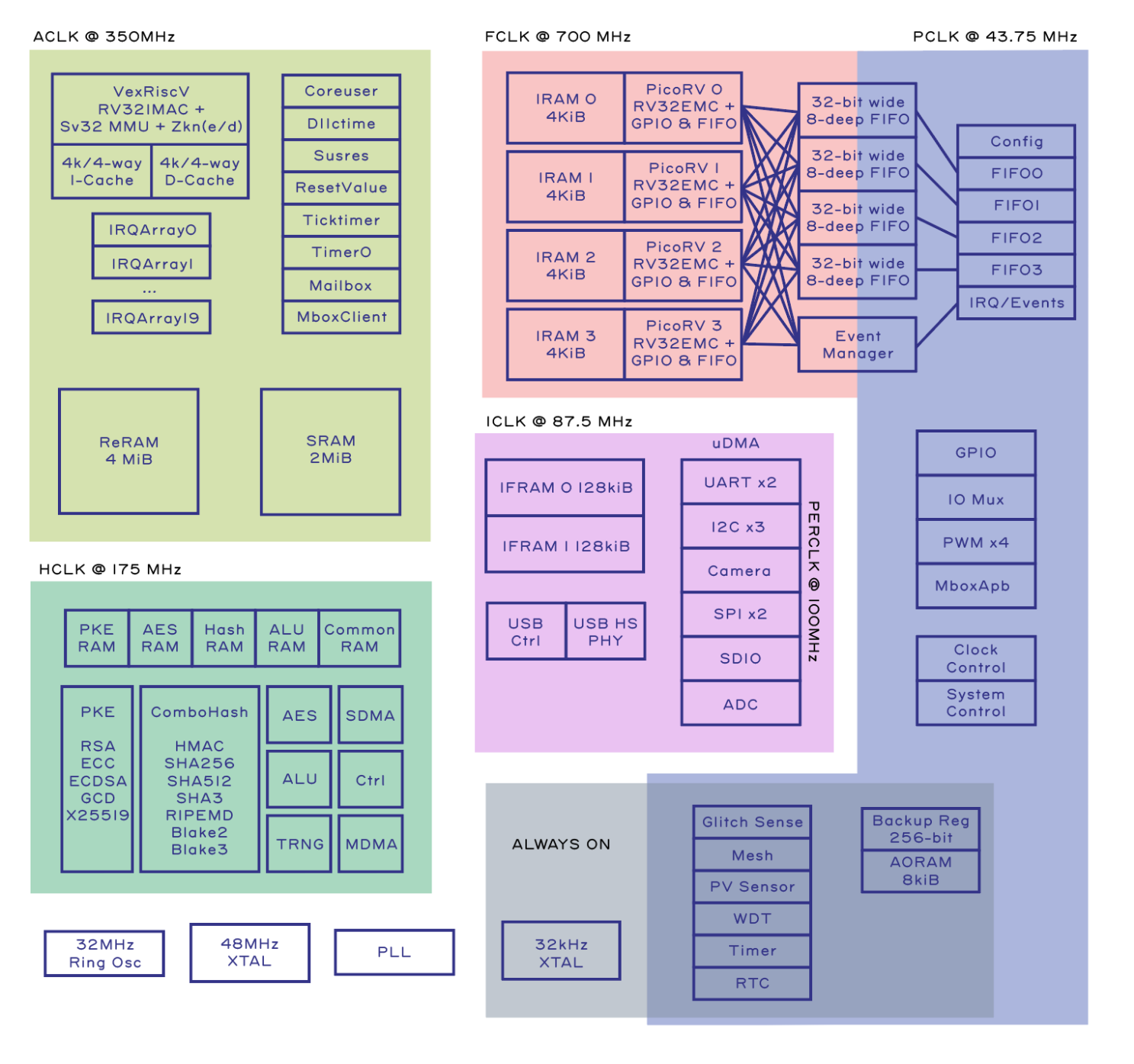
The TL;DR is that Baochip is a "mostly-open" RTL SoC in 22nm TSMC, purpose-built for Xous and expressly packaged for IRIS inspection. It packs in five RISC-V CPU cores (one Vexriscv CPU at 350MHz, and four PicoRV's at 700MHz), 2MiB on-chip SRAM and 4MiB on-chip RRAM (basically FLASH).

I'm aiming to have the chip broadly available by early 2026. Right now I have first silicon. You can follow development & ask questions on the Baochip discord at discord.gg/yesbcPF9Xy

Sorry, no website yet - I suck at marketing - but hey, at least the source code is up!

Block diagram of the Baochip-1x SoC
0
0
1

Proposal for a new regulation, dear @EUCommissionEuropean Commission. When a digital service like Apple iCloud, Google, Facebook etc decides to block or delete your account, they MUST give you a way for a limited time (I'd propose 6 months) to download all data/files they have stored under that account. You should be able to access it using the last known credentials. AFTER a full download has occurred, the account may be finally deleted. I am sure it needs more refinement, but the principle should be established.

0
0
0

Proposal for a new regulation, dear @EUCommissionEuropean Commission. When a digital service like Apple iCloud, Google, Facebook etc decides to block or delete your account, they MUST give you a way for a limited time (I'd propose 6 months) to download all data/files they have stored under that account. You should be able to access it using the last known credentials. AFTER a full download has occurred, the account may be finally deleted. I am sure it needs more refinement, but the principle should be established.

0
0
0
0

You know that saying, "How do you eat an elephant? One bite at a time," that is supposed to represent how big tasks can be accomplished in small steps?

I think about the times when I go into hyper-focus mode and churn out thousands of words in a day or complete a months-long project in a weekend, and I wonder if I'm more like a snake, unhinging my jaw and just inhaling the whole thing at once.

0
0
0
0

3/

From-time-to-time these local Linux User Groups (LUGs) would put on a Linux InstallFest —

An in-person event where people (who weren't using Linux yet, but were interested) would bring their computer to the Linux InstallFest, and someone from the local LUG would help install Linux for them on their computer.

This helped spread Linux.

We (of the Fediverse) could do something similar.

...

4/

We (of the Fediverse) could learn from the Linux User Groups (LUGs).

We could have our own version of a Linux InstallFest — a Fediverse JoinFest.

An in-person event where people who are interested in the Fediverse, but are having trouble joining — can bring their mobile phone or laptop, and some Fediverse-savvy person (like us) could help them join the Fediverse.

We could install a Fediverse app on their mobile phone for them.

We could help them pick a server to join.

.

0

3/

From-time-to-time these local Linux User Groups (LUGs) would put on a Linux InstallFest —

An in-person event where people (who weren't using Linux yet, but were interested) would bring their computer to the Linux InstallFest, and someone from the local LUG would help install Linux for them on their computer.

This helped spread Linux.

We (of the Fediverse) could do something similar.

...

4/

We (of the Fediverse) could learn from the Linux User Groups (LUGs).

We could have our own version of a Linux InstallFest — a Fediverse JoinFest.

An in-person event where people who are interested in the Fediverse, but are having trouble joining — can bring their mobile phone or laptop, and some Fediverse-savvy person (like us) could help them join the Fediverse.

We could install a Fediverse app on their mobile phone for them.

We could help them pick a server to join.

.

0
0

2/

I am old enough to remember when Linux was not yet common.

(I started using Linux back in 1996. And have been using some distro of Linux since then.)

Back then, Linux User Groups (LUGs) got created in different cities by regular people who were enthusiastic abut Linux — to provide help, support, and community for those who were interested in Linux.

(I used to be an active member of VanLUG — the Vancouver Linux User Group.)

3/

From-time-to-time these local Linux User Groups (LUGs) would put on a Linux InstallFest —

An in-person event where people (who weren't using Linux yet, but were interested) would bring their computer to the Linux InstallFest, and someone from the local LUG would help install Linux for them on their computer.

This helped spread Linux.

We (of the Fediverse) could do something similar.

...

0

2/

I am old enough to remember when Linux was not yet common.

(I started using Linux back in 1996. And have been using some distro of Linux since then.)

Back then, Linux User Groups (LUGs) got created in different cities by regular people who were enthusiastic abut Linux — to provide help, support, and community for those who were interested in Linux.

(I used to be an active member of VanLUG — the Vancouver Linux User Group.)

0
0
0
0
0
0
0
0
0
0
0
0
2
0
0
0
0
0

I made a mental list of horror movies I'm never going to watch but by making the thought explicit (can thoughts be explicit?) this is now something my subconscious can keep dangling in front of me. "Go on, it's just a movie..."

0
1

I clicked on a link and started reading. It read like a thoughtful interview from years passed...

And then I read this question: "You passed away on your eighty-eighth birthday – 4th August 2020. Do you reflect on mortality?"

What the fuck?

At the end of the article:
"Editorial note: This interview transcript is a work of dramatised historical reconstruction. Frances Allen died on 4th August 2020, and cannot speak. The words, reflections, and responses attributed to her in this document are constructed from historical records, published interviews, biographical materials, technical papers, and documented accounts of her life and work – but they are not her actual words, spoken in real time."

Tell me you used AI without telling me you used AI.

ALSO, this was "written" by a MAN dramatizing the perspective of a woman pioneer in computer science. He's got a whole series on dead woman.

FUCK RIGHT THE FUCK OFF.

0
0
1
0