What is Hackers' Pub?

Hackers' Pub is a place for software engineers to share their knowledge and experience with each other. It's also an ActivityPub-enabled social network, so you can follow your favorite hackers in the fediverse and get their latest posts in your feed.

0
0
0

Look, all of these can be true:

- the fosdem organisers cannot be trusted to enforce a CoC violation
- they have no covid safety concept that would allow at-risk folks to attend safely
- open hard- and software is the only way forward in this increasingly enshittified and enclosed software world
- the list of people I’d love to meet who are attending is a mile long
- building communities is more important than ever while the forces in power enshrine divide and conquer into the fabric of our societies
- meeting in-person is effective to forge new bonds and deepen existing relationships
- we must continue to demand better from organisers
- see you in Brussels

0
0
0
2
0
0

The truth is that the right wants to use the same playbook it used against the press, whining about "liberal bias," but for LLM chatbots. And it's working! All the AI companies are responding to this by injecting right-wing bias into their models www.theguardian.com/technology/2...

Latest ChatGPT model uses Elon...

0
0
0
0
0
0
0
0
0
0

Wo will Mensch denn in Frankfurt/Main japanisch essen gehen, wenn das Budget nicht übertrieben hoch ist? (Ich kenne bisher nur das Bistro Okame in Hausen und das ist mittlerweile auch teurer geworden)

0
0

mostly because you can't actually do that without strangling culture in the first place. but! i'm not a visual artist, and so i try to mostly stay in my lane here, which is software. i think software is possibly the least ethically problematic part of the space

0

i think the biggest issue where i split ethically in a meaningful way with people is that i have long been against intellectual property as a concept. i think IP helps disney, not small artists. a lot of people want to strengthen IP in response to ai stuff and i just don't think that's a good thing

0
0
0
0

With these recent days of news showing that the Trump regime is on their heels about ICE, my refrain has been: “It’s working. Punch harder.”

Last night I let myself savor the “It’s working” part for a few happy minutes, but this morning I’m squarely focused on “Punch harder.”

0
0

the shortest way i can put it (which means it loses a lot of nuance) is that i don't perceive any of the problems in the AI space as being different than any other technology problem. a lot of people seem to frame this as something special. it's just technology.

0

I keep thinking of that phrase — something like, “They reduce the meaning of the word to that which their machines can achieve.” And now I just see it everywhere.

- They made artificial "intelligence".
- They made a "browser" in a weekend.
- They added “presence” to the UI.

Rich human concepts narrowed to fit what a technology can achieve, then they lay claim to the name.

0

We knew this was coming, but now the clock is running. From Privacy International:

"Yesterday the Trump Administration announced a proposed change in policy for travellers to the U.S. It applies to the powers of data collection by the Customs and Border Police (CBP)."

"If the proposed changes are adopted after the 60-day consultation, then millions of travellers to the U.S. will be forced to use a U.S. government mobile phone app, submit their social media from the last five years and email addresses used in the last ten years, including of family members. They’re also proposing the collection of DNA."

PI linked to and summarized a Federal Register entry describing the proposed requirements:

-All visitors must submit ‘their social media from the last 5 years’

-ESTA (Electronic System for Travel Authorization) applications will include ‘high value data fields’, ‘when feasible’
‘telephone numbers used in the last five years’
-‘email addresses used in the last ten years’
-‘family number telephone numbers (sic) used in the last five years’
-biometrics – face, fingerprint, DNA, and iris
-business telephone numbers used in the last five years
-business email addresses used in the last ten years.

privacyinternational.org/news-

The Federal Register entry says comments are encouraged and
must be submitted (no later than February 9, 2026) to be assured of consideration.

Federal Register entry: govinfo.gov/content/pkg/FR-202

0
0
3
0
0
0
0

If you read an article online and it has no mentioned author, do you automatically assume it was AI-generated?

0
0
0
0
0

I started a documentation repo for advise - for new and old visitors, attendees and speakers. I figure we can crowdsource it so bring your pull-requests. I will greatly appreciate help.

If not, I will populate it myself slowly over time but it won't be as good.

github.com/bagder/FOSDEM

0
0
0

so my furnace has developed a problem this winter. afaict there is a sensor that detects whether the flame has lit. if not, it shuts the gas off for safety

it's malfunctioning in such a way that it only allows gas to flow after it has been off for hours

procrastinating on calling for repair, i've taken to heating once in the morning and evening rather than let the thermostat try to keep the house level all day

so far it looks like i've got a 26% lower gas bill than last year 👍

0
0
0

Twelve years. I started this project twelve years ago, and today I hold the result in my hand. It’s a book that combines bead weaving with math called, “Beading with Algorithms: Cellular Automata in Peyote Stitch.” With help from mathematician and artist Roger Antonsen, graphic designer Zelda Lin, a handful of talented proof readers, and the good people from World Scientific Publishing Company, my dream of combining my loves of math, art, and teaching into a book is finally a reality.

This book is the first of its kind, a recipe book of algorithms that can be used and combined to generate colorful patterns in peyote stitch beadwork in any size and shape you desire. These algorithms could also be applied to other pixelated art forms like tile laying, embroidery, crochet, and quilts. We included projects like bracelets, pill pouches, pendants, beaded beads, and key chains. We also included a bunch of different grids that you can photocopy and color with markers.

Of course I’m biased, but I think it’s a really beautiful book. We included multiple colorful images on almost every page, 172 pages in all. It was a huge layout challenge, but Zelda nailed it. My original goal was to write 128 pages on how to use algorithms to make beaded jewelry, but the more we explored the space, the more we found. Not just millions of algorithms, the space of possibilities is infinite. So of course, we couldn’t include them all. But we used math and Roger’s custom software that he wrote for this project to help us find dozens of the easiest algorithms and more than a hundred more in increasing levels of complexity. We included all of our favorites. 1/2

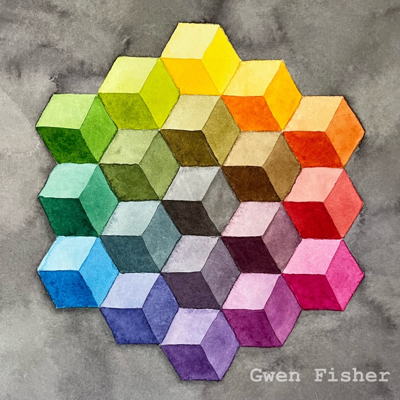
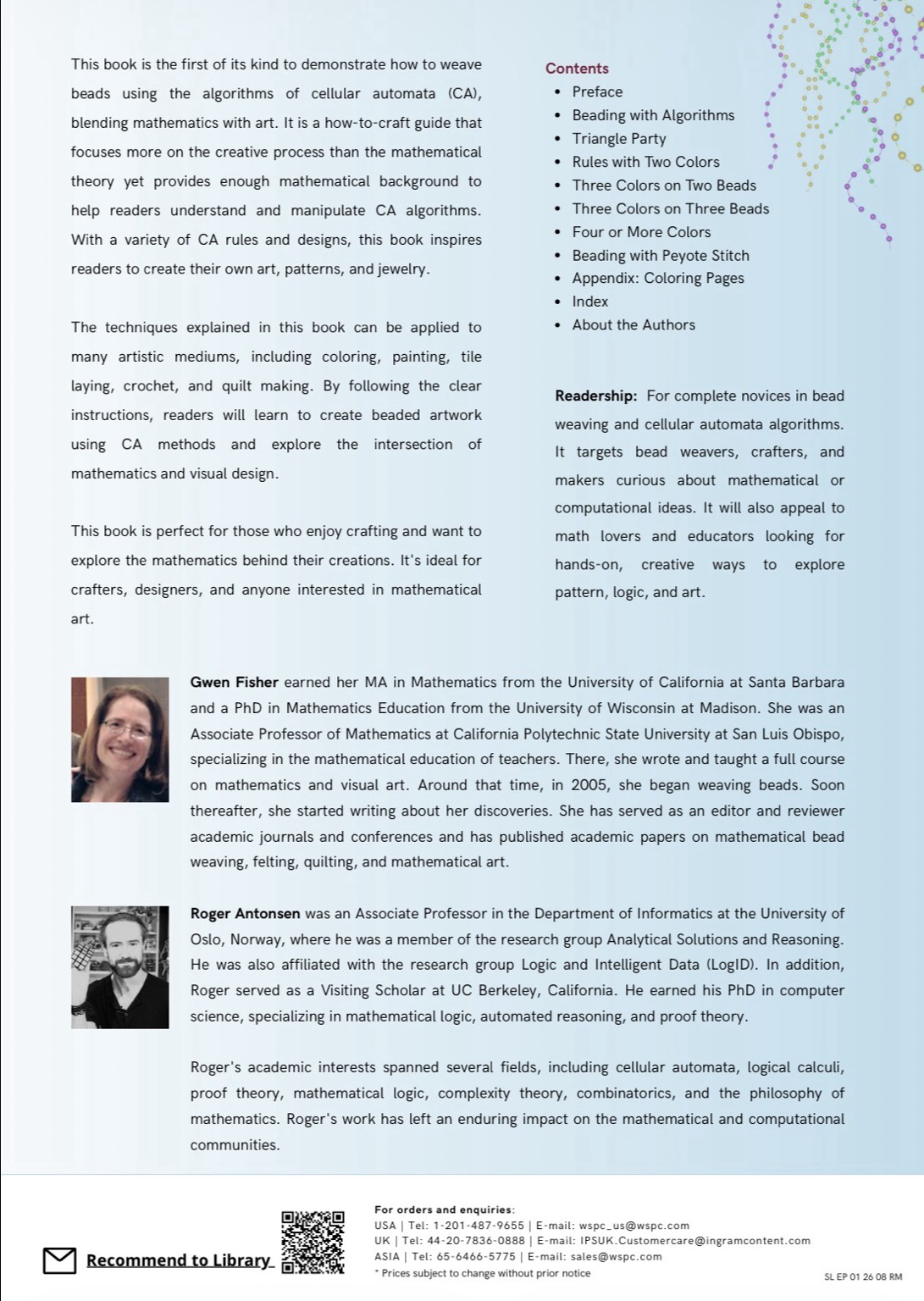
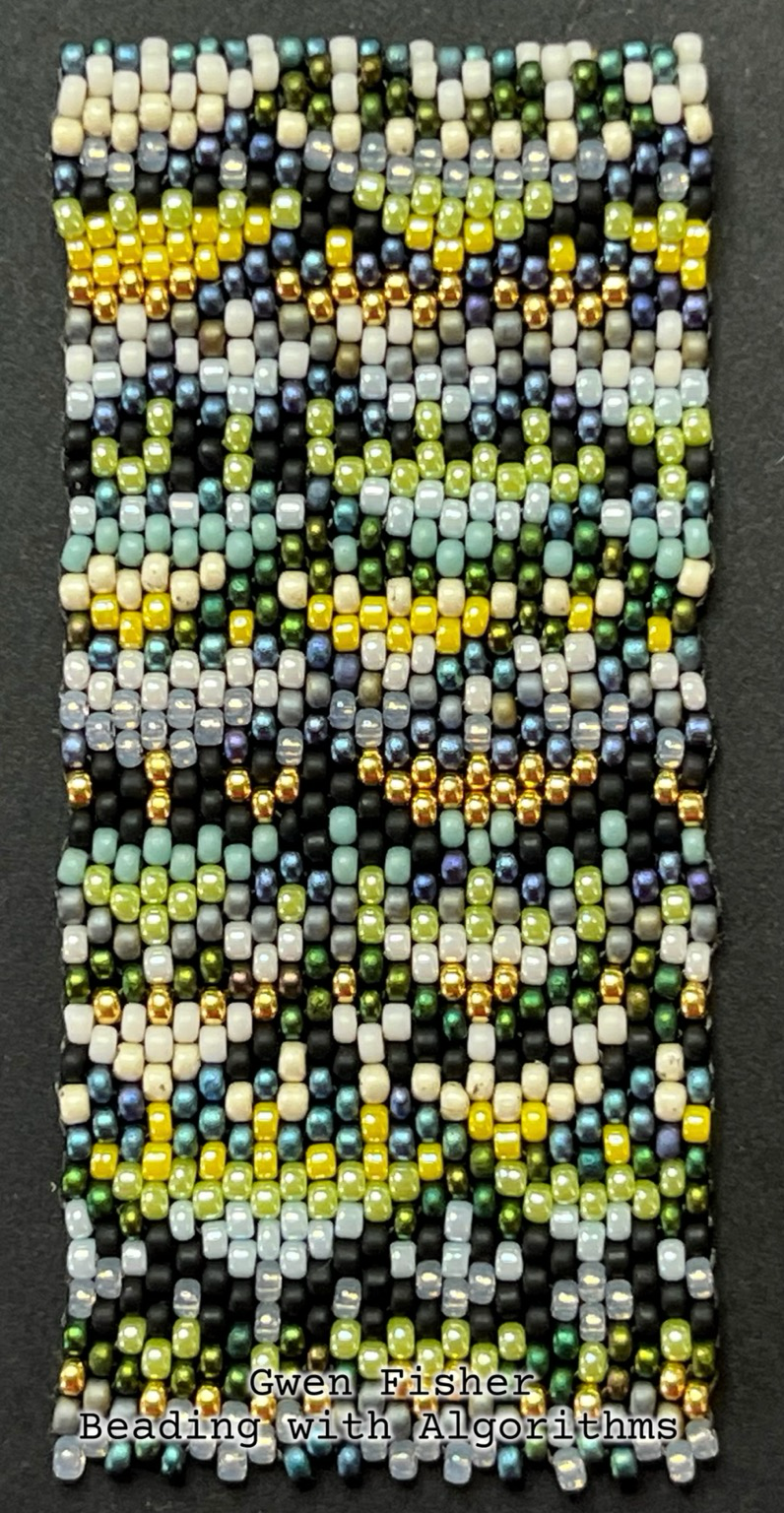
Book cover for Beading with Algorithms: Cellular Automata in Peyote Stitch by Gwen Fisher and Roger Antonsen, World Scientific Publishers Promotional page for the book including a brief summary, readership, and about the authors with their photos Patch of colorful peyote stitch beadwork
0
0
0

Communication, entertainment, everything in between - another great post by @ploum that will inspire you, offend you, educate you- all the things great writing should do. It'll make you think, challenge your assumptions- there are too many great quotable parts of this, I couldn't even pick one to use as a blurb here. Worth it to just read the full deal 🔥: ploum.net/2025-12-15-communica

0
0
0
0
1
0
0
1
0