Search results

Whatever we think of / mad hype cycle, we have to deal with its rushed and inhumane dumping of the technology into global human society.

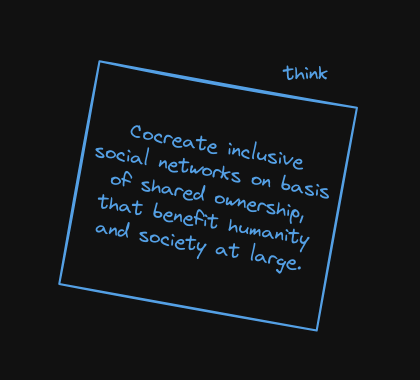
is a strategic approach to that allows activist voices to have the most impact in dealing with the dangers of disruptive technology introductions, and focuses beyond berating people and demanding sacrifice ("don't use, or else.."), to creating a process that helps win people over and work together on best outcomes and in direction of solutions.

stands for Constructive activism-led movements, such as Social coding commons. Coding is social, and the holistic approach to ensure that.

Social coding commons evolves Social experience design or , solution development for grassroots movements, supported by the .

In the thread below I copied a post to 's community with a suggestion to ponder about best outcomes from current and ongoing AI disruption, and deal with risks.

discuss.coding.social/t/calm-c

Even more than Gleam community the AS/AP based fediverse faces existential threats where it comes to the promise to lead us towards "the future of social networking", a peopleverse. And poses high danger risks that must be known, so we can anticipate and mitigate them timely.

But above all we have to find ways to constructively collaborate with each in this chaotic grassroots environment we are part of.

and at scale, organic growth and sustainable evolution are applied research areas of Social coding commons, where participants add value while working on their own solutions, following their self-interests in alignment with those of other people

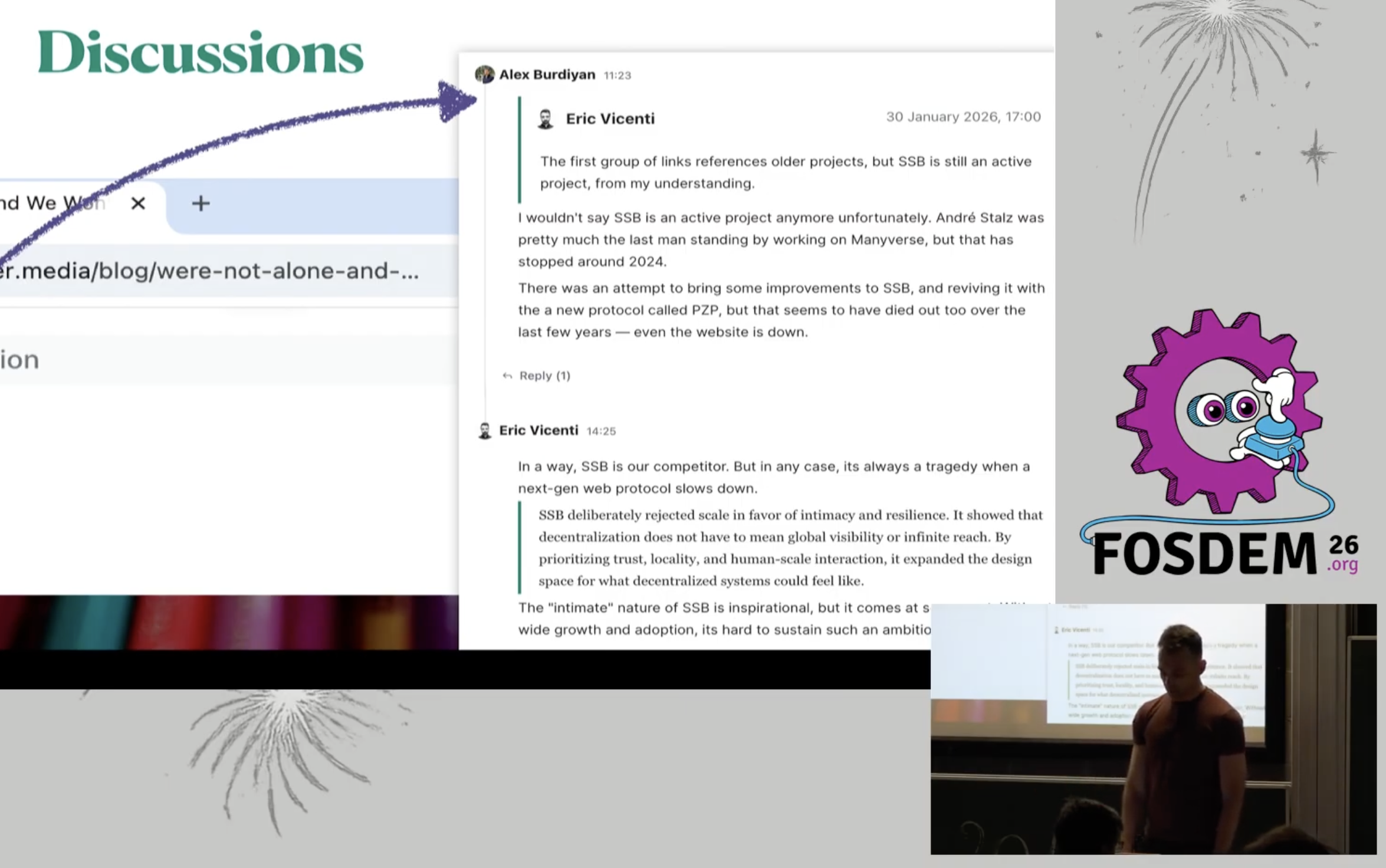
To folks who are interested in the general subject matter I addressed above, I recommend watching the talk given by Michiel Leenaars of @nlnet at last month:

"FOSS in times of war, scarcity and (adversarial) AI" by @michielMichiel Leenaars

fosdem.org/2026/schedule/event

0

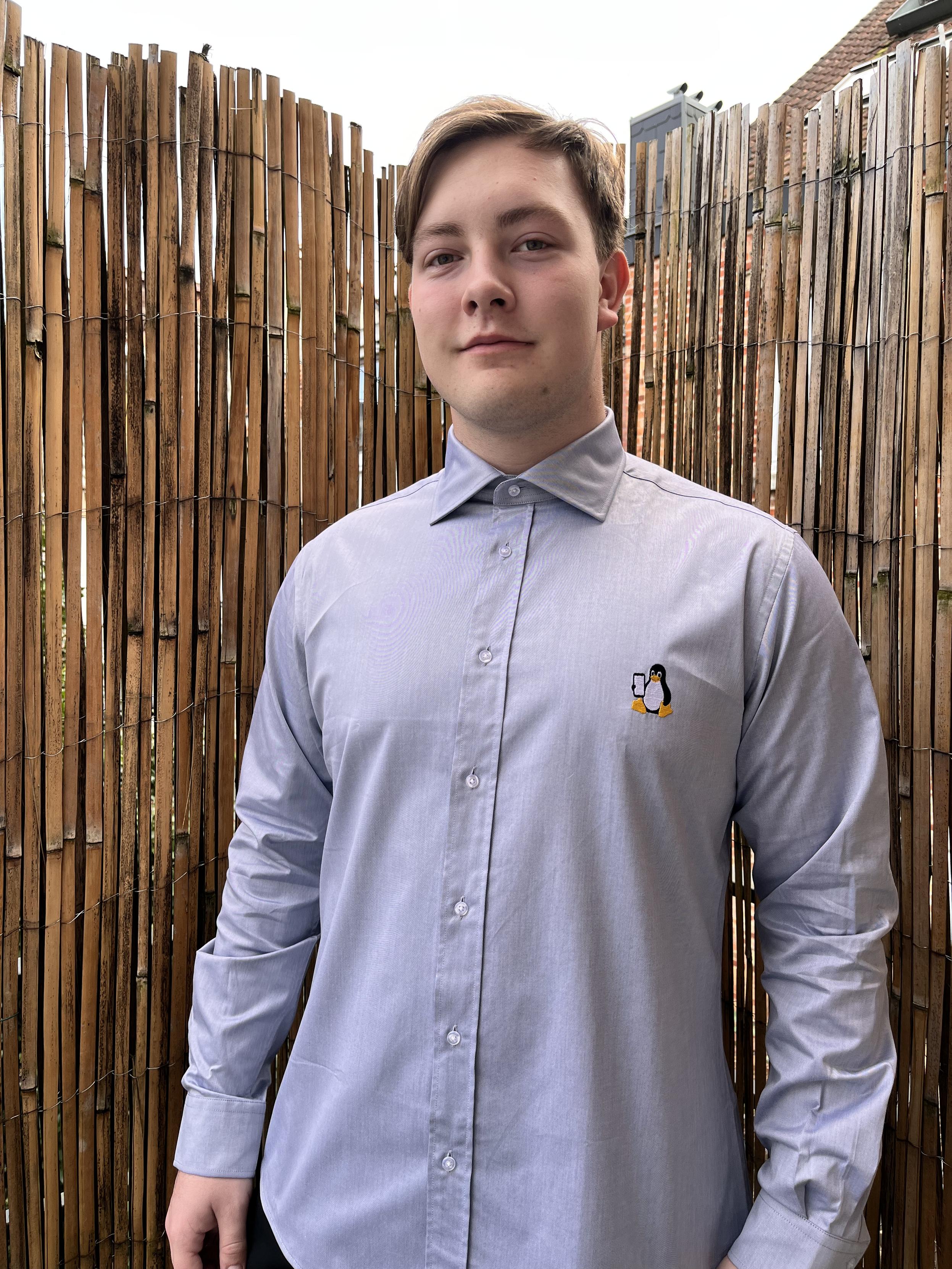
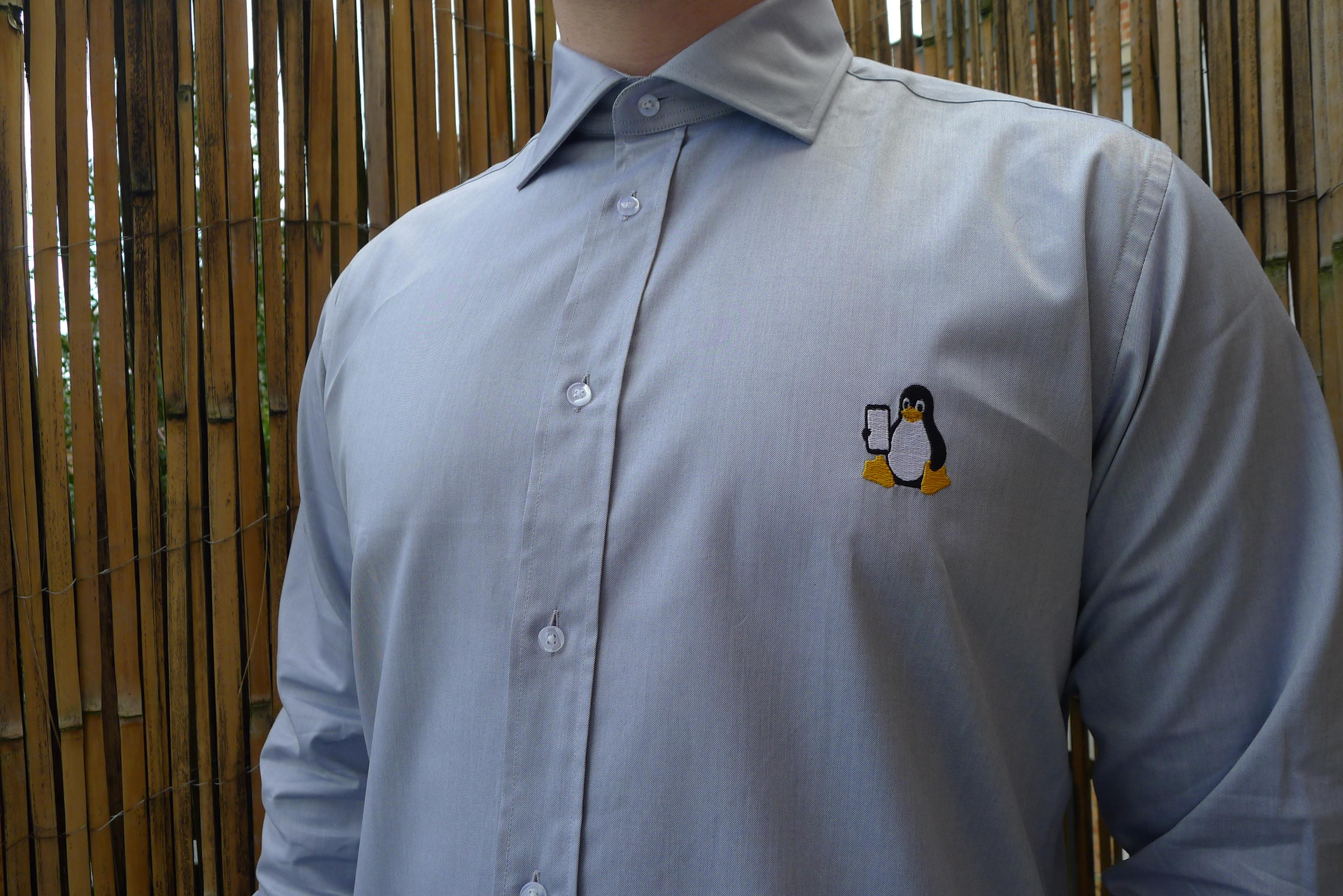
Some folks at tried to buy the makeshift hats one of our team members brought, so I arranged for this prototype of an official hat to be made. It's a fisherman beanie with our logo embroidered. I'm trying to gauge interest here. Is this something you'd buy? (Poll in follow-up post)

A beautiful woman with dark hair and two braids, wearing a grey wool sweater and a blue fisherman beanie with the Mastodon logo embroidered on the front.A beautiful woman with dark hair and two braids, wearing a grey wool sweater and a blue fisherman beanie with the Mastodon logo embroidered on the front.
0
32
0
0

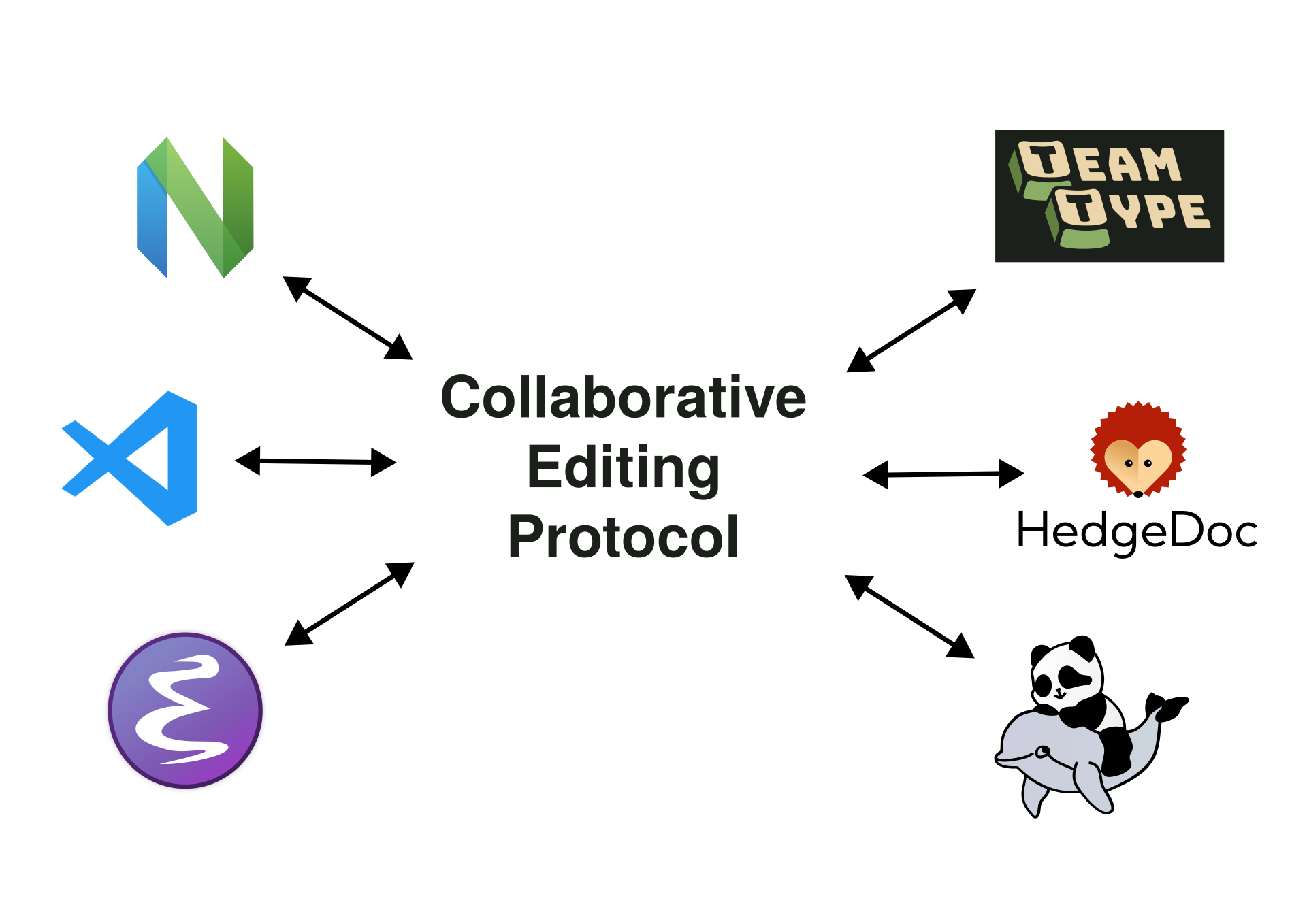
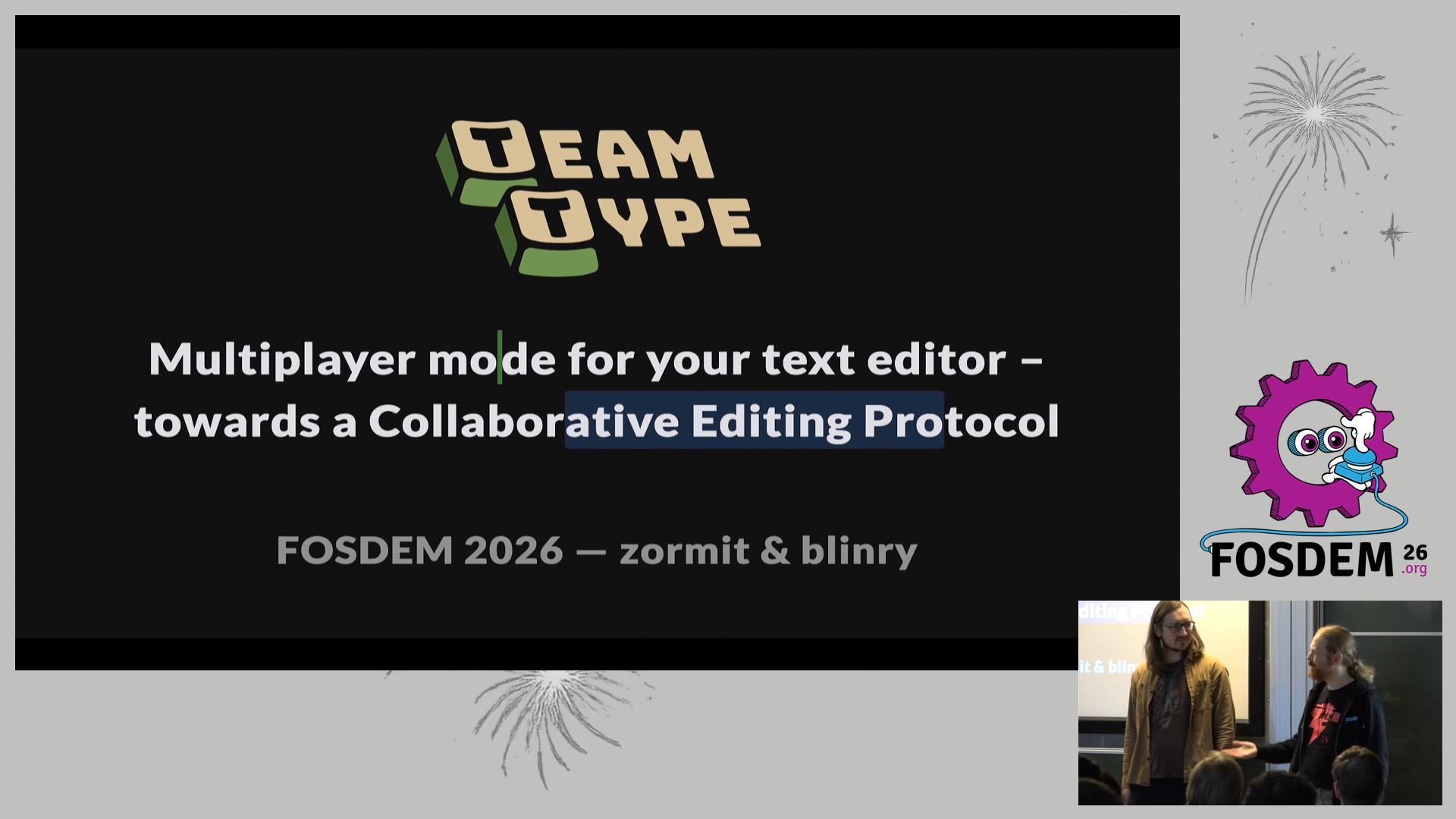
Imagine a protocol like , but for adding real-time collaboration to existing text editors. It would allow to edit a , or peer-to-peer pair programming between and !

We've come up with our own little protocol like that (for Teamtype), but we'd like to open up the discussion:

That's why we're inviting everyone interested to an initial online gathering on Feb 26, 19:00 UTC, to gauge interest for working on a protocol like this together!

md.ha.si/collaborative-editing

A diagram that connects text editors on the left to collaborative applications on the right, using a common, shared protocol, labelled the "Collaborative Editing Protocol".
0
0
0

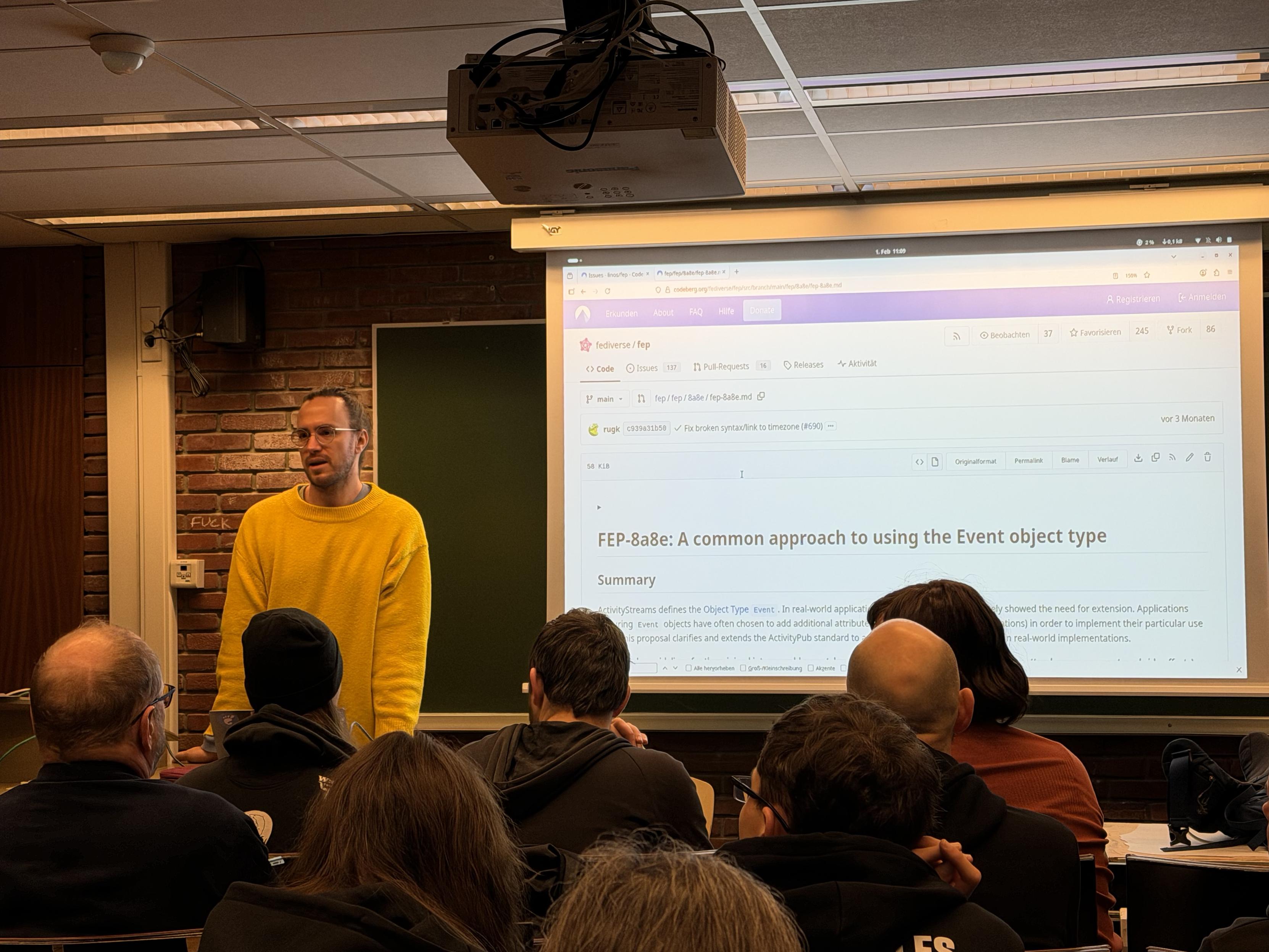
Ein Event braucht mindestens Zeit und Ort. Und vor allem über „Location“ haben wir bei der diskutiert. Wie definiert man einen Ort? Über Längen/Breitengrad? Mit IDs in OpenStreetMap? Mit Namen? Haben Orte Umfang oder sind sie Punkt? Was ist mit Orten in Orten, wie z.B. Saal 118 im Trakt D des Campus Solbusch der Uni Brüssel. Oder: Raum FOSDEM?

@sl007Sebastian Lasse @clemensg habt ihr nicht auch mit einem Projekt an Geo-Daten in ActivityPub gearbeitet?
media.fsfe.org/w/p/s1FdPaxD2aH

Update: YT-Link ersetzt

0
0
0

@django @evanEvan Prodromou @liaizonwakest ⁂

Hey, this is great. It is so nice to see the uptick of interest in the part of . Very uplifting and gives me hope for the future of .

I really liked your presentation, and thank you for mentioning my humble list. They are just notes atm, but I will try to keep them up-to-date. I just made a bunch of updates..

codeberg.org/fediverse/delight

Would love to hear more on what are the particular plans and goals for your project in the near future?

@django @evanEvan Prodromou @liaizonwakest ⁂

Hey, this is great. It is so nice to see the uptick of interest in the part of . Very uplifting and gives me hope for the future of .

I really liked your presentation, and thank you for mentioning my humble list. They are just notes atm, but I will try to keep them up-to-date. I just made a bunch of updates..

codeberg.org/fediverse/delight

Would love to hear more on what are the particular plans and goals for your project in the near future?

0

@virtualpierogi @sriSriram "sri" Ramkrishna - 😼 @jsalvadorJuanjo Salvador @benBen Werdmuller @nlnet

It needs concerted effort, as argued in my blog post, to set all of this up. Things can start small and pragmatic, and then gradually evolve and mature, but we should take care it evolves in the proper direction.

There are trade-offs to consider every step of the way. If there'd more capabilities to introspect the functionality that an actor offers, it would diminish the need for an upfront design-by-consensus process, but it would increase the complexity of the specifications.

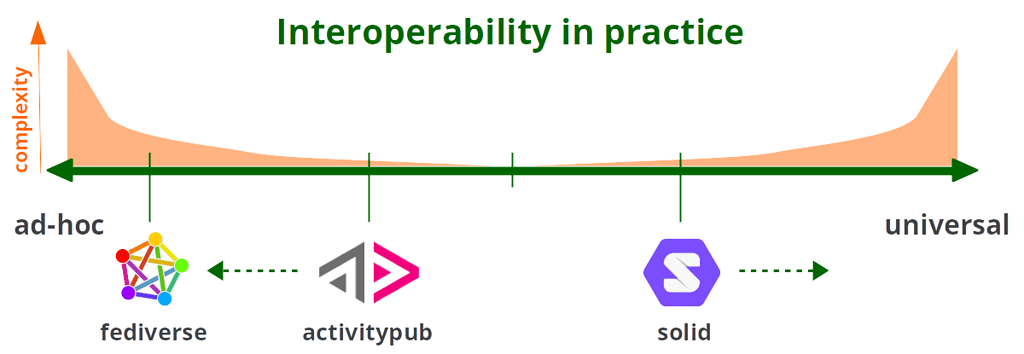
I drew this in a diagram a couple years ago, and transferred it to our social coding forum at: discuss.coding.social/t/wiki-g

Here you see the fediverse devolve into non-interoperable app-by-app whack-a-mole development, keeping track of all the moving-target projects one took a dependency on. Versus the that tries to hammer out full-blown specs upfront, which became a huge package to deal with, with high complexity to implement.

@virtualpierogi @sriSriram "sri" Ramkrishna - 😼 @jsalvadorJuanjo Salvador @benBen Werdmuller

Unfortunately there's a new threat, and it was addressed in the keynote speech by @michielMichiel Leenaars of @nlnet .. and that is the mad dash to incorporate into everything and vibe-code stuff together in a heartbeat.

I think this is particular bad for the fediverse still lacking its robust foundations. The 's will have no problem figuring out how to mix'n mash the existing protocol decay and tech debt into new applications that are rushed into production. Finally non-protocol-experts are enable on the ecosystem and can onboard themselves without involving themselves in endless plumbing of the most low-level technical implemention details of devs.

But the ecosystem will rot and decay as a result of it. Furthermore if a slew of AI-generated fedi apps are launched in quick succession and some of them find good uptake (until they break in unexpected ways), it will serve to attract unwanted corporate attention I'm afraid.

0

@benBen Werdmuller wrote a good article "Growing the open social web" for FediForum.

It poses this *essential* question: Why do we want to grow the open social web and for whom?

While the question is crucial when considering the future of social networking and the role of online technologies in society, it is not a question that is being addressed in any significant way. Our social web and fediverse "just happens", emerging from this chaotic cauldron of mostly technical discussions about which features to put in apps, how to connect one app to the next, and which social web technology or app is better than others.

Ben makes an appeal for creating good protocols, where the real value is, but only if we can share ownership of them. I 100% agree with the points in the article.

But how do we get there? What is this ownership? How do we achieve it, and subsequently retain it? I wrote down some some thoughts in a blog post.

coding.social/blog/shared-owne

Btw, this is a good opportunity to once more thank @nlnet for their years-long hard work and support of the social web, and the fediverse in particular. I counted 86 fine social web R&D projects who have received @NGIZeroNGI Zero open source funding and other @ngiNGI Outreach Office support from the over the past couple of years.

At the bottom of the article I mention the urgent talk and call-to-action by @michielMichiel Leenaars and also the 2019 keynote given by @dariusDarius Kazemi at the Conference in Prague on "How to play and win our own game" independent of and corporate hypercapitalist shenanigans.

@benBen Werdmuller

0
0
0

@T_X @axxαxel simon ↙︎↙︎↙︎ I made the switch to -only on the default network of 13(?) years ago. It broke So. Much. Stuff.

I knew the former maintainer of the network tooling from the Linux Kernel Summit, and ran into him by chance that year. was completely broken on NAT64-only, it did not even bring up the network interfaces, and we sent people who came to the NOC to their booth.

I also sent that former maintainer over there.

They fixed things very quickly.

0

@T_X @axxαxel simon ↙︎↙︎↙︎ I made the switch to -only on the default network of 13(?) years ago. It broke So. Much. Stuff.

I knew the former maintainer of the network tooling from the Linux Kernel Summit, and ran into him by chance that year. was completely broken on NAT64-only, it did not even bring up the network interfaces, and we sent people who came to the NOC to their booth.

I also sent that former maintainer over there.

They fixed things very quickly.

0
0

Hey, --

We totally forgot to publish the availability of the `hachyderm.general` collection we announced at a few weeks ago!

We started by publishing our roles that we use to keep the Hachyderm database servers happy and healthy. Included are modules to:

- build postgresql servers in both primary and replica configurations
- configure pgbackrest for full and incremental backups
- publish metrics for consumption by prometheus

Modules are available on Ansible Galaxy at galaxy.ansible.com/ui/repo/pub.

Happy Hachyderming (and Ansible-ing and postgresql-ing)!

0
0
0
0
0
0
0
0
0

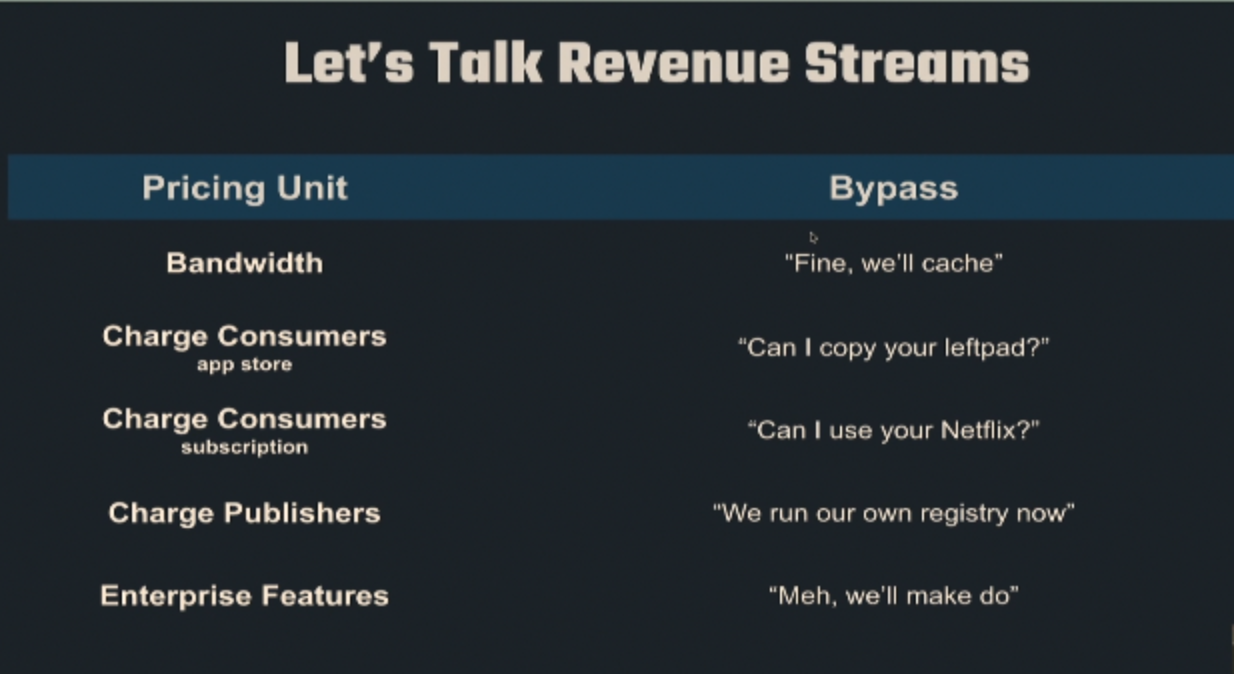
Another great talk from Michael Winser at @openssf / about the terrible economics of package registries like

fosdem.org/2026/schedule/event

Some charts from different registries are at go.xwind.io/registry-research-

The slide below is a take on some of the common "solutions" that people come up with for funding registries (also applicable to non-registry products with large numbers of downloads) and what might happen if you choose them

Can we price per download? Bandwidth? Charge publishers? Offter chargeable enterprise features?
0
0
0
0

Here are some other talks I recommend:

Wastrel: WebAssembly Without the Runtime by @wingoAndy Wingo (Wastrel uses Hoot!) fosdem.org/2026/schedule/event

Willow - Protocols for an uncertain future (wins "Christine's award for most charming presentation") by @gwilsammy g fosdem.org/2026/schedule/event

Automerge + Keyhive Design Overview by @expedeBrooklyn Zelenka fosdem.org/2026/schedule/event

BLUE - A generic build-system crafted entirely in Guile by @shepherdSergio Pastor Pérez fosdem.org/2026/schedule/event

raylib: a 12-year adventure as a solo-maintainer fosdem.org/2026/schedule/event

Too many other good talks to list of course (and I haven't gotten through all of them) but all of the above talks totally rule

0

Wanted to see me speak at but couldn't make it? Here's the two talks I gave!

How to Level Up the Fediverse
(co-presented with ActivityPub co-author @tsyesikaJessica Tallon !) fosdem.org/2026/schedule/event

Lisp is Clay: the Power of Composable DSLs fosdem.org/2026/schedule/event

Can't get enough? Need more talks? We gave a bunch... 🧵

Wanted to see me speak at but couldn't make it? Here's the two talks I gave!

How to Level Up the Fediverse
(co-presented with ActivityPub co-author @tsyesikaJessica Tallon !) fosdem.org/2026/schedule/event

Lisp is Clay: the Power of Composable DSLs fosdem.org/2026/schedule/event

Can't get enough? Need more talks? We gave a bunch... 🧵

0

FOSDEM 2026: The Kid Who Dreamed of Hackers Found Them in Brussels

Summary: A kid from a small Mexican town dreamed of finding real-life hackers. Two decades later, he flew his family to Brussels and spoke at one of the world’s largest open-source conferences. This is that story.

“We reject: kings, presidents and voting. We believe in: rough consensus and running code.” – David D. Clark

The Dream

When I was a young hacker—yeah, believe it or not—my dream was to find other hackers in real life and just hang out together. That’s it. That was the whole dream.

It sounds modest now, but you have to understand the context. I come from a very small town in Mexico, the kind of place where internet was a luxury, Linux was a word nobody recognized, and “Windows” was mostly what you opened to let the heat out. The idea of attending a tech conference was absurd. Attending one in English? In another country? That was pure science fiction—like telling my block friends about Dragon Ball Z spoilers I’d read online, except even less believable.

But with time, and a painfully slow DSL connection, I found my people. I stumbled into the local Linux user group—fewer than ten of us in a city of thousands—and we built something from nothing. A hackerspace. Community events. Workshops with maybe a dozen attendees if we were lucky. Eventually, I found my way to national conferences and even talked at a few of them. Each one felt like a small victory, a tiny crack in the wall between where I was and where I wanted to be.

A duck seats in top of coffee

The Shot

So when the opportunity to submit a talk to FOSDEM 2026 appeared, I just shot my shot.

I did it almost by instinct, without overthinking it. FOSDEM—the Free and Open Source Software Developers’ European Meeting—is one of the largest open-source conferences in the world. Thousands of developers, hundreds of talks, legendary project booths. It had always been a place that existed on the other side of a dream for me. But here’s the thing: I’m more financially stable now, I’ve traveled to Europe for both leisure and work, and I speak comfortable (but still heavily accented) English. I’ve made peace with my accent—it’s part of the package, take it or leave it.

So, why not? The real surprise was that I hadn’t applied before.

The Logistics of Madness

When my proposed talk was accepted, my first reaction wasn’t joy—it was panic. The kind of panic you feel when you push to main and then read the diff. The real problem was logistics.

I already had a trip to Mexico planned for personal reasons. Going to FOSDEM meant extending the family travel by a week, rerouting flights, and solving the kind of logistical puzzle that makes your brain hurt. Tepic, a small city in the mountains of western Mexico → Mexico City → London → Brussels. With a seven-year-old. And a month’s worth of luggage packed for both the scorching Mexican beach and a freezing European winter—flip-flops sharing suitcase space with thermal jackets, sunscreen next to wool scarves. And sanity (debatable).

After my wife—bless her patience—said “just go for it,” and after numerous conversations with both AI and non-AI advisors about how to make it less stressful, we committed. At the end of January, I found myself at the tiny airport of Tepic, eating the most amazing torta de pierna, beginning an absurd journey to Belgium.

A duck explores cold Brussels streets

We crossed through London, hopped on the Eurostar to Brussels, and somewhere between countries, we lost a pillow—a bear-shaped one my kid had shamelessly stolen from his grandma. Rest in peace, little bear pillow. You survived a Mexican grandmother’s house only to perish somewhere in the English Channel.

The Candy Store

And then, there I was. At FOSDEM. With my kid. In Brussels.

The place was electric. People from every imaginable background wandered through the halls of the Université libre de Bruxelles. I’ll be honest—there’s still a noticeable lack of diversity, especially in gender representation—but the energy was undeniable. It felt like a living, breathing monument to what open source can be.

Seeing the project booths was like being a kid in a candy store—except I literally had a kid with me in this candy store. Mozilla, Thunderbird, Let’s Encrypt, SUSE, and of course Mastodon, to name a few. I couldn’t help myself; I told my son that when I was young, one of my first dreams was to work for SUSE. He listened carefully, the way seven-year-olds do when they’re filing away information for later use (probably to embarrass me at dinner).

SUSE booth at FOSDEM

Keeping a seven-year-old entertained at a developer conference is its own extreme sport. Thankfully, a friend I hadn’t seen in over a decade was there—with his kid. He’s a no-gringo, a Dutchman who happens to have worked at Innox in Mexico. Our kids hit it off, and suddenly the conference had a parallel track: unsupervised children’s chaos edition.

The Talk

When the time came for my talk, I walked in, set up, and delivered something far from perfect—but unmistakably mine. I stumbled on a couple of words, my accent was thick, and I’m sure I made at least one joke that only landed for me. But that’s the style. That’s always been the style.

Just before stepping up, Elena handed me the most fabulous FOSDEM sweater in existence. People noticed. People asked where to get one. But no—only I could have it. Exclusive distribution, zero units available. (Okay fine, I was just lucky, but let me have this moment.)

Friends in Sweaters

If I have one regret, it’s not spending more time in other talks. It’s not that I didn’t try—I did—but balancing a seven-year-old’s attention span with a conference schedule is a negotiation no diplomacy course prepares you for. I caught fragments, glimpses, enough to know I was missing incredible stuff. But that’s the thing about FOSDEM: it’s not a one-time event. I’ll be back. And next time, I want to do more than speak—I want to listen, linger, and actually have those hallway conversations that everyone says are the best part of any conference.

Friends enjoying FOSDEM

The Kid and the Dream

Here’s what got me, though. The part I didn’t expect.

My kid watched me speak at FOSDEM. He didn’t fully understand the content—he’s seven, and ActivityPub isn’t exactly bedtime story material—but he saw his dad on a stage, in front of a room full of people, in another continent, talking about something he built. When the Q&A started, he wanted to raise his hand. He got shy, though, and didn’t. Later, visibly upset about his missed opportunity, he told me what he wanted to ask: “Do you play Minecraft?” In front of an auditorium full of open-source developers discussing federation protocols, my kid’s burning question was about Minecraft. I love this human being more than I can express.

Maho speaking at FOSDEM

He asked questions the entire trip back: “What does SUSE do?” “Will you talk at another one?” “Can I have my own desk computer?”

He saw the booths, the projects, the people. He kept posing for photos with each open-source mascot like a tiny celebrity on a press tour. His favorite was the PostgreSQL elephant, though we were genuinely concerned about its health. Based on the state of that costume, I think he might be right—PostgreSQL could use your donations, folks. That elephant has seen better days.

The PostgreSQL elephant mascot at FOSDEM

And the trip back was no less insane than the trip there. Brussels → Iceland → Seattle. Because apparently, when you’re already doing something absurd, you might as well add a layover near the Arctic Circle. We landed in Reykjavík with our beach-and-winter Frankenstein luggage, stepped outside into wind that felt personally offended by our existence, and my kid asked if the land was actually made of ice. Close enough, kid. Close enough.

Reykjavik, Iceland landscape

A week later, during a conversation with his teacher, my son was asked about the most memorable thing from the trip. He didn’t say the beach in Mexico, or the train through Europe, or the wind in Iceland, or even the lost bear pillow. He said the most memorable thing was seeing his dad talk at a university. That it made him proud (I’m not going to pretend I didn’t need a moment after hearing that).

I thought about my own childhood. About the kid who couldn’t find a single hacker in his town. About the dusty streets and half-built houses. About how representation works in mysterious ways—how seeing someone like you doing something impossible makes it feel possible. My son doesn’t know what it’s like to not see a path. For him, this is just what dad does. And maybe that’s the whole point.

Full Circle

Maho at FOSDEM

Twenty years ago, I was a teenager in a small Mexican town, writing code in paper notebooks and dreaming of a world I could barely imagine. Today, I stood in Brussels and spoke to a room full of open-source developers about a project I created.

The path from there to here wasn’t straight. It was messy, full of detours, broken English, lost pillows, and more coffee than any doctor would recommend. But every step—every hackerspace meetup with eight people, every local conference talk, every late night wrestling with code—was a brick in the road that led to that stage.

And yeah, I get it, talking for half an hour at a conference with hundreds of talks may seem like a small feat. One slot among many. But it wasn’t small to me. For the kid who couldn’t find a single hacker in his hometown, standing in front of that room was enormous.

FOSDEM wasn’t just a conference for me. It was proof that the kid from Tepic who dreamed of finding hackers in real life finally did. They were in Brussels all along, waiting for him to show up.

And he brought his kid.

Also readable in: https://maho.dev/2026/02/fosdem-2026-the-kid-who-dreamed-of-hackers-found-them-in-brussels/ by @mapacheMaho 🦝🍻:
@mapacheMaho 🦝🍻 such a good read, TY! Perhaps it’s my attention, perhaps how good your writing is (I am quite sure it’s the latter!), but I added your blog’s RSS feed to my reader before even finishing the post.

This resonates so much with me: getting to know my bunch of fellow hackers was so instrumental to my growth and, ultimately, my own identity.

I love but now I hate that I missed you there... I wanted to talk riddles with you! But I’ll make up for it, oh I will! 😆

0
0

Your Home Feed is the inbox of an ActivityPub actor — in particular YOUR ActivityPub actor.

There could be an actor for each hash-tag, too.

You could even do Del.icio.us like things — and have actors for intersections of hash-tags, too.

These hash-tag actors' inboxes would need to be readable by anyone.

...

This could be a more ActivityPub like API alternative to Mastodon's "GET /API/v1/tags/{name}" API.

0
0
0
0

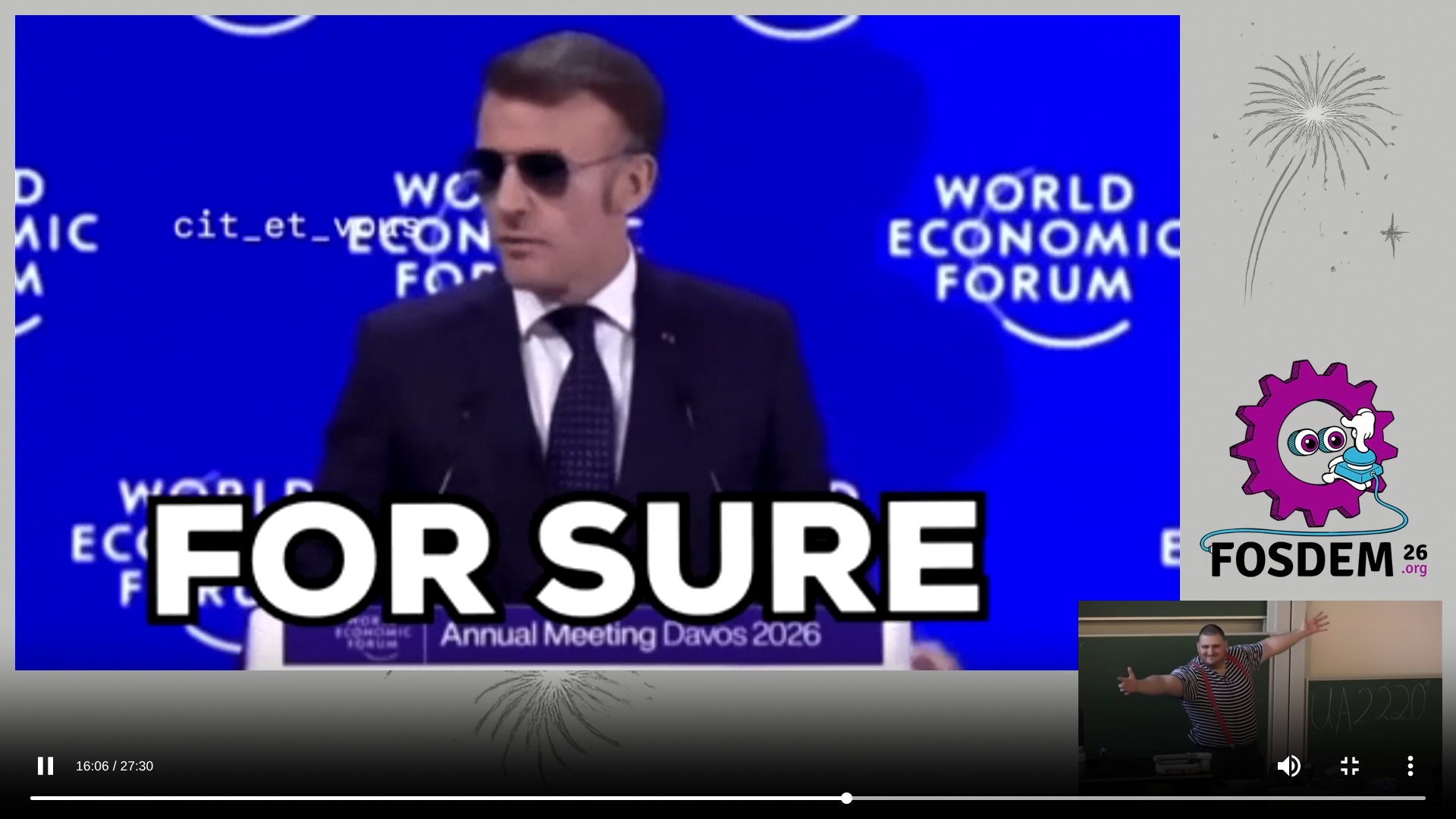
I'm going through 2026 videos and I need to point out the good work with the files themselves. We have the option of downloading .mp4 videos with older coded for old devices, but we have everything also encoded in modern av1 (using webm as container) which makes for very small files with good quality. I'm saving them directly to my jellyfin instance and watching one by one at my tv, popcorn in hand. Good job fosdem people!

0
0
0
0
0
0

RE: not-brain.d.on-t.work/notes/ai

Glad to get a reminder that @gwilsammy g's Willow presentation from is up! This was a talk I tried to go to with @hongminhee洪 民憙 (Hong Minhee) :nonbinary: and @2chanhaeng초무 but we made it there right at the last 2 minutes cause it took too soo to find it in the maze of the campus.

0
0

FOSDEM audio recordings are so bad they are basically disrespectful to the speakers.

It's been years, nothing is happening. If you ever give a talk at , I highly recommend you taking care of a backup recording with your phone - so many good talks lost in inaudible bad sound.

0
0