What is Hackers' Pub?

Hackers' Pub is a place for software engineers to share their knowledge and experience with each other. It's also an ActivityPub-enabled social network, so you can follow your favorite hackers in the fediverse and get their latest posts in your feed.

Babiš brečí, jak je hrozně nefér, že banky spekulujou s emisníma povolenkama, protože to znečišťovatelé mají kvůli tomu dražší. Bitch, s bydlením se spekuluje mnohem víc, závisí na tom přímo životy tvých vlastních voličů, ale to miliardáře prostě nezajímá.

0
0
0
0

Google Cloud’s customer chief returns to Microsoft as head of security. Hayete Gallot previously spent nearly 16 years at Microsoft. She's taking over from Charlie Bell, who Satya Nadella has asked to take on a new role. Details 👇 www.theverge.com/news/873930/...

Google Cloud’s customer chief ...

0
0
0

Mojeek here with our updated

We're on a mission to build the world's alternative search engine; a search engine that does what's right, that values and respects your privacy, whilst providing results from its own index, ordered with its own ranking algorithm: mojeek.com/about/

We're here to toot about new functionality, pictures of servers, peertube-hosted explainers, and the spiciest anti-big-tech memes we can come up with. If anyone asks, Mojeekat is our admin 🐱

0
0
0
0
0
0
0
0
0

Since DuckDuckGo has decided to regionalize all my search results even when no region is selected (why?!? 😩),

Making my work impossible (I don't spend my day writing about Canada DuckDuckGo! 🙄),

I have started to use @MojeekMojeek Search Engine and I must say that it is a real joy. I find what I'm looking for much quicker, no patronizing regionalization based on IP, and no AI pollution. It feels like I found back the 2010s web and I'm here for it.

Thank you Mojeek 💚

0
0
0
0
0

We've teamed up with Automattic to fight link rot on the open web. Check out the new Internet Archive Wayback Machine Link Fixer for WordPress. The free plugin preserves pages, redirects broken links to archived versions, and helps ensure the web keeps its memory.

“It’s very important that websites have a memory," said Alexander Rose of Automattic. "When links go dead, in effect, the truth goes dead—especially in the age of AI,”

Learn more ➡️ blog.archive.org/2026/02/04/in

Logos of Internet Archive Wayback Machine and Automattic with a plus sign between them, indicating a partnership or collaboration on a blue background.
0

Dérégulation de l’IA ? Pas vraiment !

"La politique américaine en matière d’IA n’est pas du laisser-faire. Il s’agit d’un choix stratégique quant à l’endroit où intervenir. Bien qu’opportun politiquement, le mythe de la déréglementation relève davantage de la fiction que de la réalité"

danslesalgorithmes.net/stream/

0
0
0
0
0
0
0
0
0

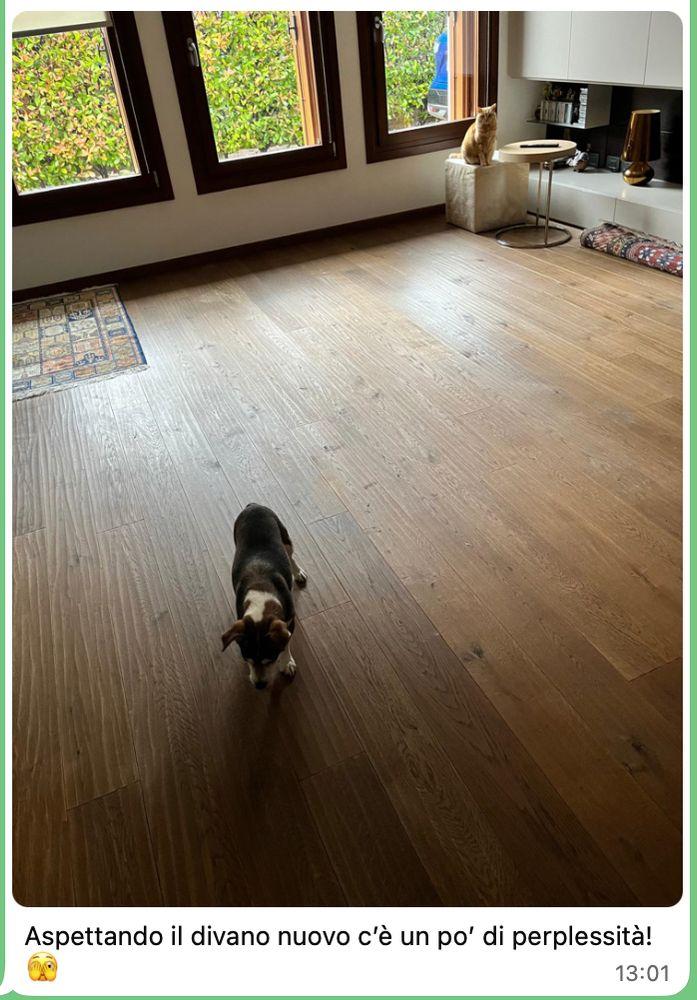
This morning my mother sent me this photo. They took away the old sofa and in a few days the new one will arrive. The cat and the blind little dog are perplexed 😂
Luna (the dog) is probably thinking “why don't I bang my head anymore?”

0
0
0
0
0
0
0

The time is probably right.

Back in 2022, when I was still using iOS, I wasn’t completely happy with the Fediverse apps that were available. I was mostly using Akkoma, and the interface I liked the most was actually its web UI, even on mobile. So I started playing with Xcode and put together the foundations of an app tailored to my needs.

A lot has changed since then and today we have great alternatives like IceCubes, Mona, Ivory, etc. Each one has strengths and weaknesses though, so I picked up my old project again and kept pushing it forward.

So I’m happy to announce that my app will finally see the light: I’ve been using it for the past few days and, in my spare time, I’m fixing bugs and adding missing features. I’m building it around my own needs, so it doesn’t have to “appeal to everyone”. I wouldn’t call it opinionated, but it’s definitely targeted.

The app will have one key trait: support will be a first-class feature, not an incidental one. Many apps, especially on iOS, support snac as a side effect, but the experience is often not optimal. In this case, the choice is deliberate and it strictly follows the Mastodon API support implemented by snac. So snac will work properly (within the limits of the platform, of course).

Among the features already implemented: the app is minimal and lightweight (under 10 MB, including debug code), easy on RAM, and privacy-first (for example it strips EXIF data from media before posting, so the server will never see it). On snac it also cleans up the "Boosted by Aoderelay" messages that appear when using a relay, removes the character limit, and supports posting in Markdown.

I also added support for Apple Intelligence to generate alt text, both for the media I post and for media posted by others that is missing alt text.

Everything is processed locally through Apple APIs and only on supported devices. The results aren't amazing, Apple Intelligence is extremely limited, but in my opinion it's the only privacy-friendly and ethical way to approach it. And of course, you can disable it.

On Mastodon it supports all the main features: lists, quote posts, granular notifications (you can choose what you want for each category), notification grouping, multi-account support, and it works.

It's still missing a few things (block, etc.) and has some bugs, which I’m spotting as I keep using it.
As soon as it's stable enough, I'll invite a few people to test it. I still haven't fully decided how I'll distribute it: an Apple Developer account has a yearly cost, and I hope to reuse it for other projects too. So this app might be paid, with a trial period, but if possible (I still need to check what’s feasible) I'd like it to be free if you connect to one of the BSD Cafe instances, illumos Cafe, or any snac instance, including your own.

I don't know how long it will take before it's ready... but I can already tell you what it will be called.
It already has a name, and it's... MastoBlaster.

This name was chosen for personal reasons, and also because of its similarity to Master Blaster by Stevie Wonder, which even today feels relevant and fitting for the Fediverse.

Stay tuned!

MastoBlaster, showing my profile on my phone
0
0
0

ちょっと何言ってるかわからないアニメの話

いい感じのアニメないか適当にLLMに投げてみてるけど最初にわたなれとかリコリコを例に出したせいで真島が恋愛テロリストになった…… :blobcatsurprise:

1
0
0
0
0
1
0
絵文字表示されなくなって悩みまくってたんだけど、原因これだったっぽい
mfm-renderer、コード読んだ感じComposition APIで書かれてそうだったから全然気付かなかった
ビルド時にViteにやられてるのかな
1
0

This study—from Anthropic, no less—is rather damning of the entire generative AI project. In code creation, the realm where it should shine, not only were the time gains marginal, but developers understood their code far, far less. And they didn't even have more fun doing the work!

But to me the most concerning part of this study is the fact that Anthropic could not get the control (non-AI) group to comply. Up to 35% of the "control" in the initial studies used AI tools despite instructions not to. What kind of behavior does that sound like?

UPDATE: See below for important counterpoints as to the validity of the study.

arxiv.org/html/2601.20245v2#S5

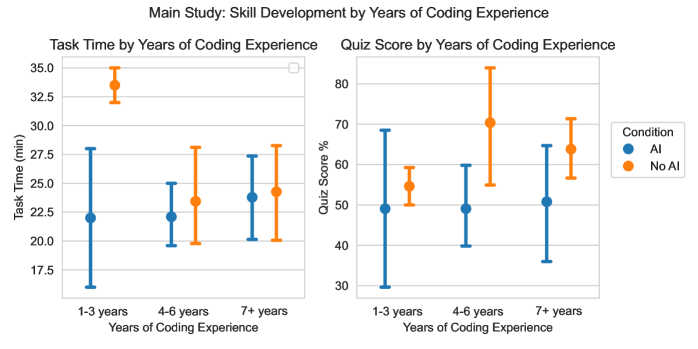
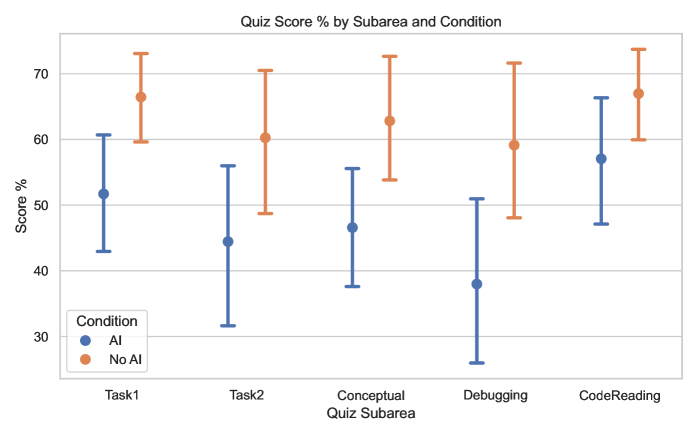
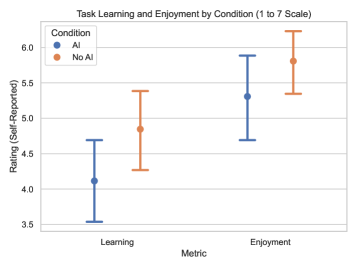
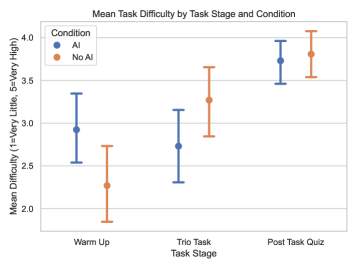
Figure 6 shows that while using AI to complete our coding task did not significantly improve task completion time, the level of skill formation gained by completing the task, measured by our quiz, is significantly reduced (Cohen d=0.738, p=0.01). There is a 4.15 point difference between the means of the treatment and control groups. For a 27-point quiz, this translates into a 17% score difference or 2 grade points. Controlling for warm-up task time as a covariate, the treatment effect remains significant (Cohen’s d=0.725, p=0.016).In exploratory data analysis (not pre-registered), the quiz score was decomposed into subareas and question types (Figure  8). Each question in the quiz belonged to exactly one task (e.g., Task 1 or Task 2) and exactly one question type (e.g., Conceptual, Debugging, or Code Reading). For both tasks, there is a gap between the quiz scores between the treatment and control groups. Among the different types of questions, the largest score gap occurs in the debugging questions and the smallest score gap in the code reading questions. This outcome is expected since treatment and control groups may have similar exposure to reading code through the task, but the control group with no access to AI assistance encountered more errors during the task and became more capable at debugging.Task Experience In further exploratory data analysis, we also find differences in the way participants’ experience of completing the study. The control group (No AI) reported higher self-reported learning (on a 7-point scale), while both groups reported high levels of enjoyment in completing the task (Figure 10). In terms of difficulty of the task, Figure 10 shows that although participants in the treatment group (AI Assistance) found the task easier than the control group, both groups found the post-task quiz similarly challenging.
0
0
0
0
0

inspired by CLAUDE.md, I’ve started putting markdown files named after coworkers into work code repos so I can remind them to stop doing shit to the codebase that annoys me

for some reason they’re all mad at me now, which means ill be adding commands to JEREMY.md for an attitude adjustment

0
0
0

mildly upsetting quote from Agner's optimization manual

-fno-math-errno. Mathematical functions such as sqrt and log are setting a variable named errno in case of errors. This way of detecting errors is inefficient and should be avoided. The option -fno-math-errno is necessary for vectorization of loops containing mathematical functions.

0

This study—from Anthropic, no less—is rather damning of the entire generative AI project. In code creation, the realm where it should shine, not only were the time gains marginal, but developers understood their code far, far less. And they didn't even have more fun doing the work!

But to me the most concerning part of this study is the fact that Anthropic could not get the control (non-AI) group to comply. Up to 35% of the "control" in the initial studies used AI tools despite instructions not to. What kind of behavior does that sound like?

UPDATE: See below for important counterpoints as to the validity of the study.

arxiv.org/html/2601.20245v2#S5

Figure 6 shows that while using AI to complete our coding task did not significantly improve task completion time, the level of skill formation gained by completing the task, measured by our quiz, is significantly reduced (Cohen d=0.738, p=0.01). There is a 4.15 point difference between the means of the treatment and control groups. For a 27-point quiz, this translates into a 17% score difference or 2 grade points. Controlling for warm-up task time as a covariate, the treatment effect remains significant (Cohen’s d=0.725, p=0.016).In exploratory data analysis (not pre-registered), the quiz score was decomposed into subareas and question types (Figure  8). Each question in the quiz belonged to exactly one task (e.g., Task 1 or Task 2) and exactly one question type (e.g., Conceptual, Debugging, or Code Reading). For both tasks, there is a gap between the quiz scores between the treatment and control groups. Among the different types of questions, the largest score gap occurs in the debugging questions and the smallest score gap in the code reading questions. This outcome is expected since treatment and control groups may have similar exposure to reading code through the task, but the control group with no access to AI assistance encountered more errors during the task and became more capable at debugging.Task Experience In further exploratory data analysis, we also find differences in the way participants’ experience of completing the study. The control group (No AI) reported higher self-reported learning (on a 7-point scale), while both groups reported high levels of enjoyment in completing the task (Figure 10). In terms of difficulty of the task, Figure 10 shows that although participants in the treatment group (AI Assistance) found the task easier than the control group, both groups found the post-task quiz similarly challenging.
0
0
0
0

The time is probably right.

Back in 2022, when I was still using iOS, I wasn’t completely happy with the Fediverse apps that were available. I was mostly using Akkoma, and the interface I liked the most was actually its web UI, even on mobile. So I started playing with Xcode and put together the foundations of an app tailored to my needs.

A lot has changed since then and today we have great alternatives like IceCubes, Mona, Ivory, etc. Each one has strengths and weaknesses though, so I picked up my old project again and kept pushing it forward.

So I’m happy to announce that my app will finally see the light: I’ve been using it for the past few days and, in my spare time, I’m fixing bugs and adding missing features. I’m building it around my own needs, so it doesn’t have to “appeal to everyone”. I wouldn’t call it opinionated, but it’s definitely targeted.

The app will have one key trait: support will be a first-class feature, not an incidental one. Many apps, especially on iOS, support snac as a side effect, but the experience is often not optimal. In this case, the choice is deliberate and it strictly follows the Mastodon API support implemented by snac. So snac will work properly (within the limits of the platform, of course).

Among the features already implemented: the app is minimal and lightweight (under 10 MB, including debug code), easy on RAM, and privacy-first (for example it strips EXIF data from media before posting, so the server will never see it). On snac it also cleans up the "Boosted by Aoderelay" messages that appear when using a relay, removes the character limit, and supports posting in Markdown.

I also added support for Apple Intelligence to generate alt text, both for the media I post and for media posted by others that is missing alt text.

Everything is processed locally through Apple APIs and only on supported devices. The results aren't amazing, Apple Intelligence is extremely limited, but in my opinion it's the only privacy-friendly and ethical way to approach it. And of course, you can disable it.

On Mastodon it supports all the main features: lists, quote posts, granular notifications (you can choose what you want for each category), notification grouping, multi-account support, and it works.

It's still missing a few things (block, etc.) and has some bugs, which I’m spotting as I keep using it.
As soon as it's stable enough, I'll invite a few people to test it. I still haven't fully decided how I'll distribute it: an Apple Developer account has a yearly cost, and I hope to reuse it for other projects too. So this app might be paid, with a trial period, but if possible (I still need to check what’s feasible) I'd like it to be free if you connect to one of the BSD Cafe instances, illumos Cafe, or any snac instance, including your own.

I don't know how long it will take before it's ready... but I can already tell you what it will be called.
It already has a name, and it's... MastoBlaster.

This name was chosen for personal reasons, and also because of its similarity to Master Blaster by Stevie Wonder, which even today feels relevant and fitting for the Fediverse.

Stay tuned!

MastoBlaster, showing my profile on my phone
0
0
0
1
0