What is Hackers' Pub?

Hackers' Pub is a place for software engineers to share their knowledge and experience with each other. It's also an ActivityPub-enabled social network, so you can follow your favorite hackers in the fediverse and get their latest posts in your feed.

1
1
1
0
50
0
0

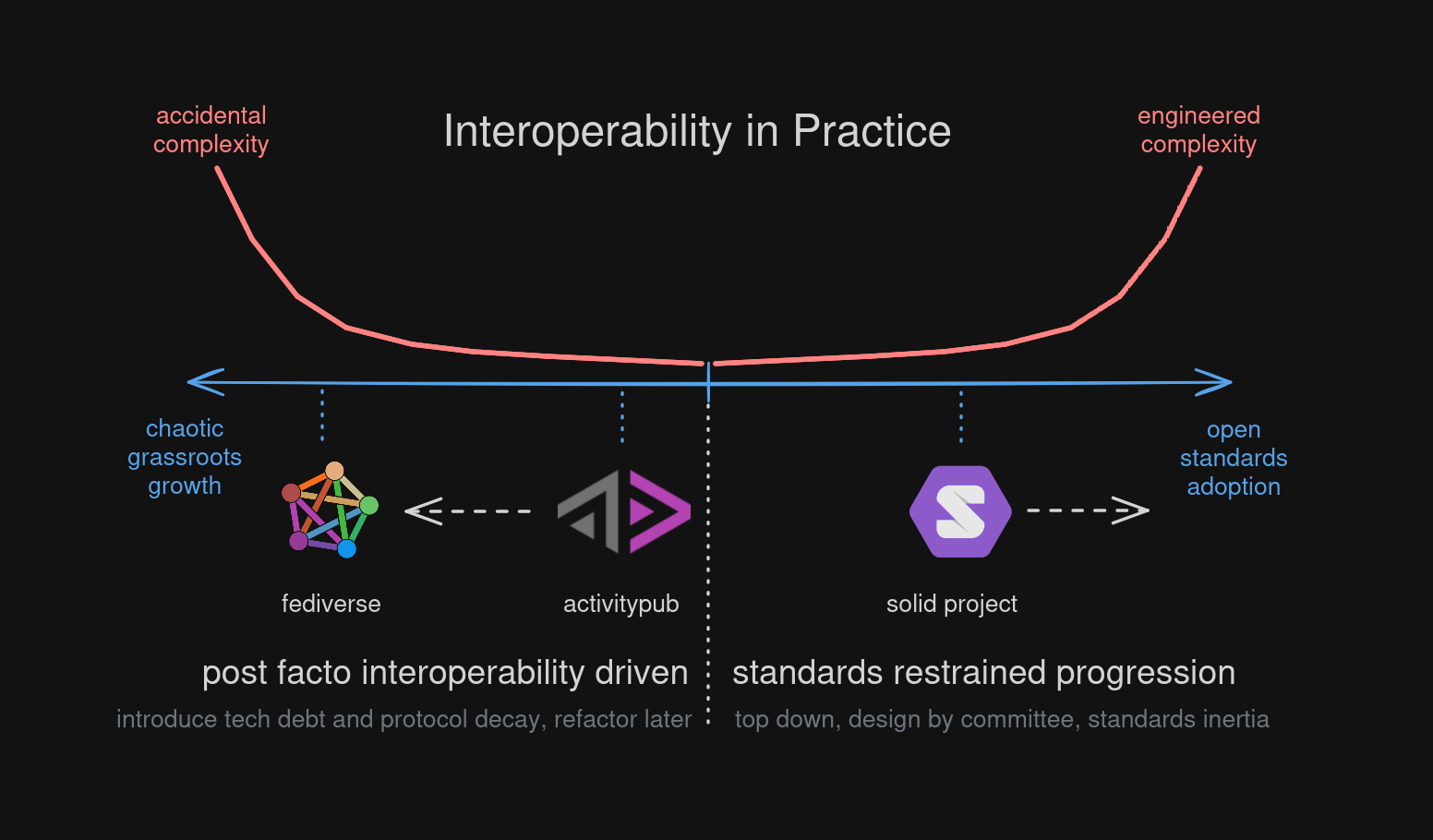
I recreated an old diagram in Excalidraw that I spread about a couple years ago, and made it a bit more informative. Explanation can be found in the

See also and for discussion: discuss.coding.social/t/diagra

Or join the Social experience design chatroom at: matrix.to/#/#socialcoding-foun

Also posted to at: socialhub.activitypub.rocks/t/

@benBen Werdmuller

Diagram. Interoperability in practice. A chart with a horizontal axis that goes in 2 directions. On the left it moves towards chaotic grassroots growth, and on the right side towards open standards adoption. The Y-axis indicates level of complexity. The center indicates a low level of complexity.

On the left side of the axis we first find the ActivityPub open standard, with a relatively low complexity level. However the prevailing method to evolving the ecosystem is driven by post facto interoperability, where tech debt and protocol decay is introduced and accepted, which must be refactored and evolve alongside the open standard. Since this doesn’t happen, the fediverse grassroots environment is shifting more to the left into non-lineary increasing accidental complexity. Deviating more and more from the ActivityPub standard and the promise that it holds to offer the Future of Social networking.

On the right side, to contrast against fediverse, we find the Solid Project led by Sir Tim Berners-Lee, which is based on a whole range of W3C Linked Data related open standards and draft documents. There is no grassroots movement that drives progress, but a steering committee. Progress is restrained by open standards adoption and support. Higher levels of interoperability require more rigour and formal standardization, and this also leads to non-linear growth of, in this case, engineered complexity. Solution developers have to wait for many standards to mature, leading to inertia.
0
1
0
0
0
1
0
6
0
2
0
0

it's consistently remarkable to me just how much difference it makes to have a very dry 3D printer filament

PCTG at ~30% RH (the measurement may be wrong but it spent about 24 hours in a relatively dry room after being taken out of the factory packaging) would popcorn so much that pieces of it would break off, get stuck to the nozzle, and foul the print

PCTG at ~18% RH (the measurement is probably closer since the heated chamber had time to equilibrate) has zero of these problems in much more print time than the above

0
1
1

Fedify 2.0.0 is here!

This is the biggest release in Fedify's history. Here are the highlights:

  • Modular architecture — The monolithic @fedify/fedify package has been broken up into focused, independent packages: @fedify/vocab, @fedify/vocab-runtime, @fedify/vocab-tools, @fedify/webfinger, and more. Smaller bundles, cleaner imports, and the ability to extend ActivityPub with custom vocabulary types.
  • Real-time debug dashboard — The new @fedify/debugger package gives you a live dashboard at /__debug__/ showing all your federation traffic: traces, activity details, signature verification, and correlated logs. Just wrap your Federation object and you're done.
  • ActivityPub relay support — First-class relay support via @fedify/relay and the fedify relay CLI command. Supports both Mastodon-style and LitePub-style relay protocols (FEP-ae0c).
  • Ordered message delivery — The new orderingKey option solves the “zombie post” problem where a Delete arrives before its Create. Activities sharing the same key are guaranteed to be delivered in FIFO order.
  • Permanent failure handlingsetOutboxPermanentFailureHandler() lets you react when a remote inbox returns 404 or 410, so you can clean up unreachable followers instead of retrying forever.

Other changes include content negotiation at the middleware level, @fedify/lint for shared linting rules, @fedify/create for quick project scaffolding, CLI config files, native Node.js/Bun CLI support, and many bug fixes.

This release includes significant contributions from Korea's OSSCA participants. Huge thanks to everyone involved!

This is a major release with breaking changes—please check the migration guide before upgrading.

Full release notes: https://github.com/fedify-dev/fedify/discussions/580

4
6
0
1

Super Fun für Sprach-Nerds, Weird Fiction-Fans und alle, die gerne neue Sachen lernen: Diese Geschichte wird jeden Absatz 100 Jahre älter (& gruseliger), am Schluss sind wir um 1.000 sprachlich angelangt. Bis wann könnt Ihr verstehen, was da steht? Danach erklärt ein Sprachhistoriker die Veränderungen, die ihr da rückwärts mitgemacht habt.

deadlanguagesociety.com/p/how-

0
3
0
0
1
0
0
1
0
2
0
0
0
1
0
1
0
0
1
0
0
0
0
0
0
9
0
0
2

Fedify 2.0.0 is here!

This is the biggest release in Fedify's history. Here are the highlights:

  • Modular architecture — The monolithic @fedify/fedify package has been broken up into focused, independent packages: @fedify/vocab, @fedify/vocab-runtime, @fedify/vocab-tools, @fedify/webfinger, and more. Smaller bundles, cleaner imports, and the ability to extend ActivityPub with custom vocabulary types.
  • Real-time debug dashboard — The new @fedify/debugger package gives you a live dashboard at /__debug__/ showing all your federation traffic: traces, activity details, signature verification, and correlated logs. Just wrap your Federation object and you're done.
  • ActivityPub relay support — First-class relay support via @fedify/relay and the fedify relay CLI command. Supports both Mastodon-style and LitePub-style relay protocols (FEP-ae0c).
  • Ordered message delivery — The new orderingKey option solves the “zombie post” problem where a Delete arrives before its Create. Activities sharing the same key are guaranteed to be delivered in FIFO order.
  • Permanent failure handlingsetOutboxPermanentFailureHandler() lets you react when a remote inbox returns 404 or 410, so you can clean up unreachable followers instead of retrying forever.

Other changes include content negotiation at the middleware level, @fedify/lint for shared linting rules, @fedify/create for quick project scaffolding, CLI config files, native Node.js/Bun CLI support, and many bug fixes.

This release includes significant contributions from Korea's OSSCA participants. Huge thanks to everyone involved!

This is a major release with breaking changes—please check the migration guide before upgrading.

Full release notes: https://github.com/fedify-dev/fedify/discussions/580

4
6
0
2
0
0
0
9
0

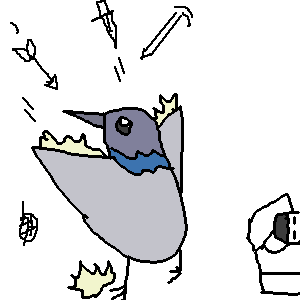
나를지켜주는비둘

https://kre.pe/CKwN 커미션 신청자 분의 허락 하에 커미션 작업물을 올립니다. 커미션 신청은 위 링크에서 받고 있습니다.

나를지켜주는비둘
0
0
4
1
0

Ihr kennt ja sicherlich diese Übersicht von Congress (u.a. vom ): designs.events.ccc.de/
Oder auch die Collection: mwarning.github.io/chaos-stick

Wir haben auch ein paar Designs gemacht und wollen von euch unbedingt Feedback dazu haben. Wie findet ihr die Designs? (Es kommen in den nächsten Tagen noch mehr) Würdet ihr was daran ändern? Würdet ihr solche Sticker haben wollen?

Das Bild ist dem Club Mate Logo nachempfunden: Gelber Hintergrund. Dunkelblaue fettgedruckte Schrift über und unter einem roten stacheligen Kreis. Die Schrift enthält den Text: "GENERAL STRIKE-MATE". Das innere des Kreises ist in Dunkelblau und Rot gehalten und zeigt eine monochrome Katze mit fokussiertem offenen Blick und angedeuteten Eckzähnen. Die Katze ist eine Grafik die von der historischen syndikalitischen Gewerkschaft IWW stammt und sonst nur den Aufruf zum "General Strike" enthält.Selbe Bildbeschreibung wie bei dem ersten Bild nur diesmal in schwarz-rot gehalten.
0
2
0
1
0
0
0