What is Hackers' Pub?

Hackers' Pub is a place for software engineers to share their knowledge and experience with each other. It's also an ActivityPub-enabled social network, so you can follow your favorite hackers in the fediverse and get their latest posts in your feed.

0
0
0
0
0
0

Join us for our latest London meet-up!

The ORG team will be there to update you on our campaigns on the Migrant Digital Rights Programme and our calls to reform the ICO.

🗓️ Wednesday 25 March
🕡️ 6:30–10pm GMT
📍 Newspeak House, E2 7DG

Sign up now ⬇️

openrightsgroup.org/events/org

0
0

I'm writing this in English.

Not because English is my first language—it isn't. I'm writing this in English because if I wrote it in Korean, the people I'm addressing would run it through an outdated translator, misread it, and respond to something I never said. The responsibility for that mistranslation would fall on me. It always does.

This is the thing Eugen Rochko's post misses, despite its good intentions.

@GargronEugen Rochko argues that LLMs are no substitute for human translators, and that people who think otherwise don't actually rely on translation. He's right about some of this. A machine-translated novel is not the same as one rendered by a skilled human translator. But the argument rests on a premise that only makes sense from a certain position: that translation is primarily about quality, about the aesthetic experience of reading literature in another language.

For many of us, translation is first about access.

The professional translation market doesn't scale to cover everything. It never has. What gets translated—and into which languages—follows the logic of cultural hegemony. Works from dominant Western languages flow outward, translated into everything. Works from East Asian languages trickle in, selectively, slowly, on someone else's schedule. The asymmetry isn't incidental; it's structural.

@GargronEugen Rochko notes, fairly, that machine translation existed decades before LLMs. But this is only half the story, and which half matters depends entirely on which languages you're talking about. European language pairs were reasonably serviceable with older tools. Korean–English, Japanese–English, Chinese–English? Genuinely usable translation for these pairs arrived with the LLM era. Treating “machine translation” as a monolithic technology with a uniform history erases the experience of everyone whose language sits far from the Indo-European center.

There's also something uncomfortable in the framing of the button-press thought experiment: “I would erase LLMs even if it took machine translation with it.” For someone whose language has always been peripheral, that button looks very different. It's not an abstract philosophical position; it's a statement about whose access to information is expendable.

I want to be clear: none of this is an argument that LLMs are good, or that the harms @GargronEugen Rochko describes aren't real. They are. But a critique of AI doesn't become more universal by ignoring whose languages have always been on the margins. If anything, a serious critique of AI's political economy should be more attentive to those asymmetries, not less.

The fact that I'm writing this in English, carefully, so it won't be misread—that's not incidental to my argument. That is my argument.
5
13
0

Mendocino County (in California, United States) seems to be working the library over with their exorbitant administrative fees and poor bookkeeping over the last few years.

Mendocino County Library is facing a huge budget shortfall, to the tune of nearly $750,000! County residents, let the County know how much the library means to you and demand change about this billing.

Budget overview here: mendolibrary.org/home/showpubl

0

현실은 집 근처에선 비슷한 지리적 위치에 사는 사람들을 많이 보게되고 그러다보면 소득수준이나 세대같은 측면의 단절이 일어나고 회사/학교에서 만나는 사람도 당연히 비슷한 문제가 있다. 그래서 계급에 기반한 단절이 훨씬 쉽게 일어나는 곳이 인터넷 바깥 세상이라고 생각해요

0
0
0
0
2
0
0
0

국제앰네스티 한국지부 탈북민 증언 채록집 링크

국제 앰네스티 한국지부의 탈북민 증언 채록집 "60+Voices 북한에서의 일상을 돌아보다"가 국제 사회 감시 속에서 그나마 김정은 하에서 개선된 면도 다루는 등 상대적으로 나은 편이라고 생각하긴 하는데..

amnesty.or.kr/resource/sixty_p

0
0

Offline with no CRDTs?!

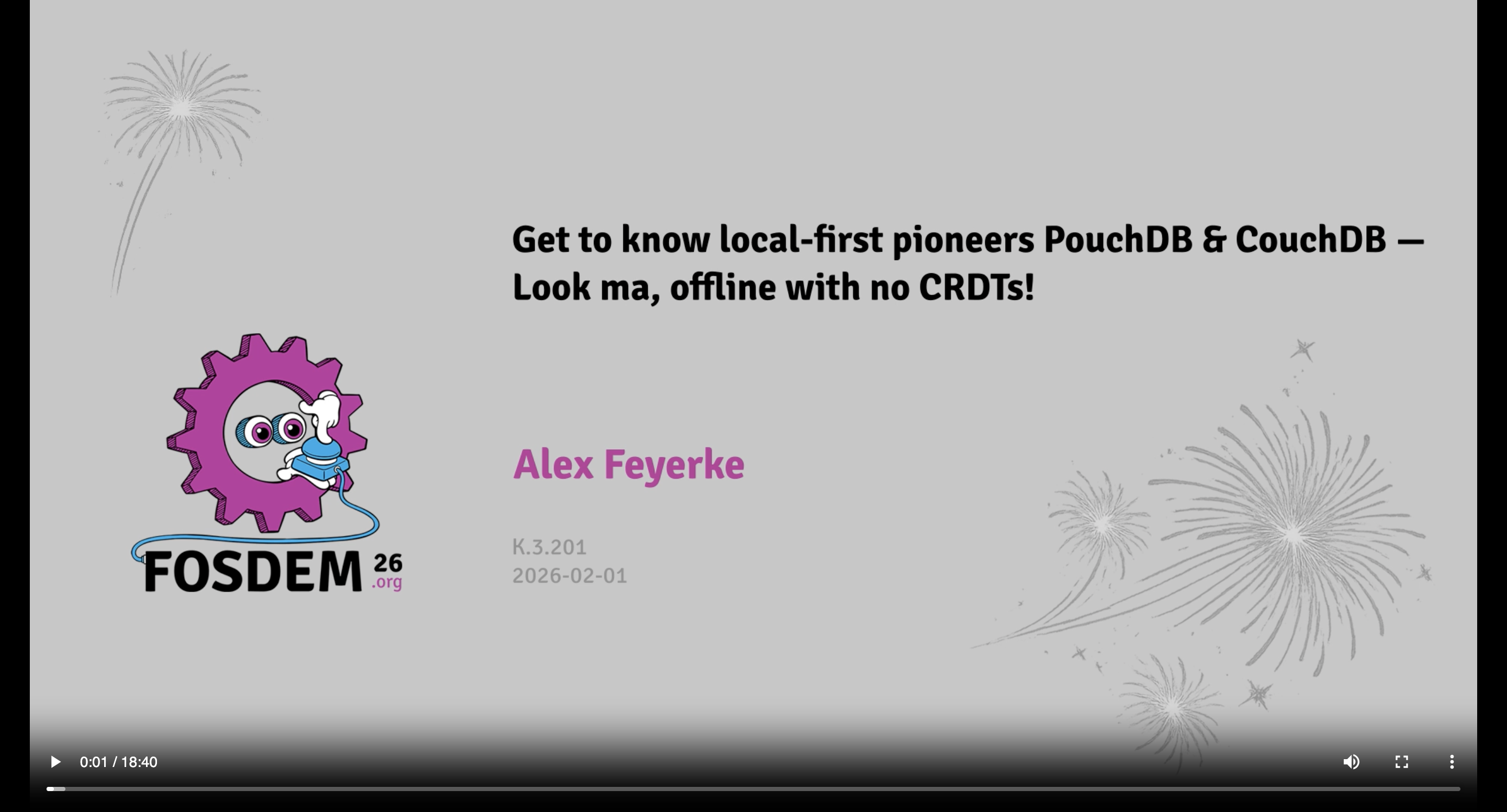
At earlier this month our colleague Alex Feyerke got to introduce Local-First pioneers @couchdbApache CouchDB and @pouchdb in the @localfirstOpen Local First devroom, a space dedicated to all things sync, P2P and conflict resolution.

Check out Alex’ talk: ftp.belnet.be/mirror/FOSDEM/vi

And the great company we were in: openlocalfirst.org/#program

All recordings are now up here: video.fosdem.org/2026/k3201/

Click through to watch — this is the cover slide of Alex Feyerke’s talk at FOSDEM 2026. The full title is: “Get to know local-first pioneers PouchDB & CouchDB — look ma, offline with no CRDTs!”
0
0
0
0
0
0
0
0

I'm writing this in English.

Not because English is my first language—it isn't. I'm writing this in English because if I wrote it in Korean, the people I'm addressing would run it through an outdated translator, misread it, and respond to something I never said. The responsibility for that mistranslation would fall on me. It always does.

This is the thing Eugen Rochko's post misses, despite its good intentions.

@GargronEugen Rochko argues that LLMs are no substitute for human translators, and that people who think otherwise don't actually rely on translation. He's right about some of this. A machine-translated novel is not the same as one rendered by a skilled human translator. But the argument rests on a premise that only makes sense from a certain position: that translation is primarily about quality, about the aesthetic experience of reading literature in another language.

For many of us, translation is first about access.

The professional translation market doesn't scale to cover everything. It never has. What gets translated—and into which languages—follows the logic of cultural hegemony. Works from dominant Western languages flow outward, translated into everything. Works from East Asian languages trickle in, selectively, slowly, on someone else's schedule. The asymmetry isn't incidental; it's structural.

@GargronEugen Rochko notes, fairly, that machine translation existed decades before LLMs. But this is only half the story, and which half matters depends entirely on which languages you're talking about. European language pairs were reasonably serviceable with older tools. Korean–English, Japanese–English, Chinese–English? Genuinely usable translation for these pairs arrived with the LLM era. Treating “machine translation” as a monolithic technology with a uniform history erases the experience of everyone whose language sits far from the Indo-European center.

There's also something uncomfortable in the framing of the button-press thought experiment: “I would erase LLMs even if it took machine translation with it.” For someone whose language has always been peripheral, that button looks very different. It's not an abstract philosophical position; it's a statement about whose access to information is expendable.

I want to be clear: none of this is an argument that LLMs are good, or that the harms @GargronEugen Rochko describes aren't real. They are. But a critique of AI doesn't become more universal by ignoring whose languages have always been on the margins. If anything, a serious critique of AI's political economy should be more attentive to those asymmetries, not less.

The fact that I'm writing this in English, carefully, so it won't be misread—that's not incidental to my argument. That is my argument.

5
13
0
0
0
0
0

고양이 너무 사악한 존재다;;; 아파트 근처 마당냥이들 아깽이 같은데 갑자기 멀리서 부르면서 점점 다가오더니 현란한 애교를 보여줘서 집에 못갈뻔함;;;;;;한마리 추가로 와서 길바닥에서 살뻔;;;;

0
0
1
0
0
0
0
0
0
1
0
0
0
0
12
0
0
0
0

Das Zitat ist nicht weniger als ein Rücktrittsgrund. Abgesehen von der Abstrahierung (mehr Risikoexperimente ohne Safeguards, weniger Datenschutz), die Wahnsinn genug ist (vom Staatssekreatär für Digitalisierung!).

Wo bitte kommen wir hin, wenn ein Regierungspolitiker einen Bürger und Bürgerrechtsaktivisten wie Max Schrems persönlich für verzichtbar erklärt?

Q: diepresse.com/20662631?giftcod

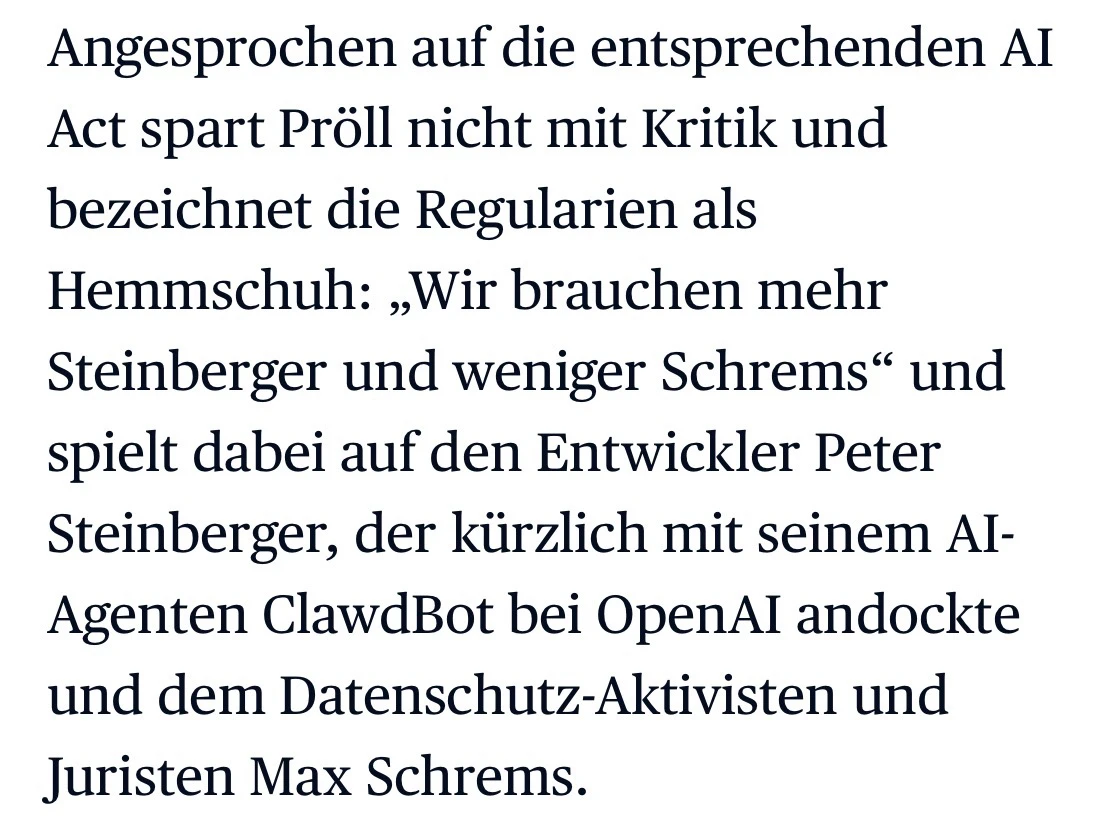
Zitat aus DIE PRESSE: "In den letzten Monaten wurde in den Behörden viel mit KI experimentiert. Jetzt gehe es darum, einen sicheren und strukturierten Einsatz von KI in der Verwaltung zu ermöglichen, sagt Pröll. Angesprochen auf die entsprechenden AI Act spart Pröll nicht mit Kritik und bezeichnet die Regularien als Hemmschuh: „Wir brauchen mehr Steinberger und weniger Schrems“ und spielt dabei auf den Entwickler Peter Steinberger, der kürzlich mit seinem AI-Agenten ClawdBot bei OpenAI andockte und dem Datenschutz-Aktivisten und Juristen Max Schrems."
0
0
1
0