What is Hackers' Pub?

Hackers' Pub is a place for software engineers to share their knowledge and experience with each other. It's also an ActivityPub-enabled social network, so you can follow your favorite hackers in the fediverse and get their latest posts in your feed.


Post to Mastodon for actual engagement. People read. They have ideas. They tell you those ideas. You can discuss them.

Post to BlueSky and some dude who knows nothing about your field informs you boldly that "you are overthinking this" and presents his pop-psychology view instead. ::smh::

0
0
0
1

Post to Mastodon for actual engagement. People read. They have ideas. They tell you those ideas. You can discuss them.

Post to BlueSky and some dude who knows nothing about your field informs you boldly that "you are overthinking this" and presents his pop-psychology view instead. ::smh::

0
0
0
0
4
0
0

It took me about two weeks to become reasonably effective at “agentic coding”.

It took me years to become a good software engineer and I’m still learning how to be a computer scientist. I think about that a lot when people tell me we should radically change our curriculum to get “up to date” with industrial practice of AI in software engineering.

We should teach the thing that is hard to learn on your own. Anyone with £200 and a couple weeks on their hands can become an expert in agentic coding, if they happen to know something about coding in the first place.

0
1
0
0

청소년 SNS 자동추천 알고리즘 제한 추진 국회 성평등가족위 이연희 의원 발의 온라인 보호장치 의무화 등 과몰입 방지 www.hangyo.com/mobile/artic...

청소년 SNS 자동추천 알고리즘 제한 추진

청소년 SNS 자동추천 알고리즘 제한 추진

청소년의 온라인 과몰입을 막기 위해 사회관계망서비스(SNS)의 자동 추천 알고리즘을 제한하는 법안이 국회에 제출됐다. 청소년에게 반복적으로 자극적 콘텐츠를 노출하는 플랫폼 알고리즘을 규제하고 청소년 보호 장치를 강화하겠다는 취지다. 국회 성평등가족위원회 소속 이연희 의원(더불어민주당)은 청소년 대상 맞춤형 추천 알고리즘 적용을 제한하는 내용을 담은 ‘정보통신망 이용촉진 및 정보보호 등에 관한 법률 일부개정법률안’을 대표발의했다고 11일 밝혔다. 최근 SNS와 숏폼 콘텐츠 이용이 급증하면서 청소년 온라인 과몰입 문제가 심각해지고 있다는 지적이 제기돼 왔다. 과학기술정보통신부의 ‘스마트폰 과의존 실태조사’에 따르면 청소년의 스마트폰 과의존 위험군 비율은 42.6에 달하는 것으로 나타났다. 특히 이용자의 체류시간을 늘리기 위해 설계된 자동 추천 알고리즘이 자극적 콘텐츠를 반복적으로 노출시키며 청소년의 과몰입을 심화시키고 있다는 우려도 이어지고 있다. 그러나 현행 ‘정보통신망 이용촉진 및 정보보호 등에 관한 법률’에는 청소년에게 적용되는 정보 추천 알고리즘을 직접 제한하는 규정이 없고, 플랫폼 사업자의 청소년 보호 책임을 명확히 규정한 장치도 부족하다는 지적이 나온다. 이번 개정안은 이러한 문제를 해소하기 위해 19세 미만 청소년에게 자동 추천 알고리즘 적용을 금지하도록 했다. 또 SNS 가입 시 연령 확인 절차를 의무화하고, 14세 미만 가입자의 경우 보호자 동의를 받도록 하는 규정도 명확히 했다. 아울러 플랫폼 사업자가 알고리즘 제한 규정을 위반할 경우 처벌 규정을 적용하도록 하는 내용도 포함했다. 법안이 통과될 경우 청소년에게 과도한 맞춤형 콘텐츠를 반복적으로 노출하는 플랫폼 알고리즘을 제한해 온라인 과몰입을 예방하고, 청소년 보호를 위한 플랫폼 책임도 강화될 것으로 기대된다. 이 의원은 “이번 법안은 플랫폼 산업을 규제하기 위한 것이 아니라 청소년을 알고리즘 기반 과몰입으로부터 보호하기 위한 최소한의 안전장치”라며 “청소년이 건강한 디지털 환경에서 성장할 수 있도록 플랫폼의 책임을 강화할 필요가 있다”고 밝혔다. 이어 “세계적으로도 플랫폼 책임 강화와 알고리즘 규제가 확대되는 흐름인 만큼 우리 사회도 청소년 보호를 위한 제도적 대응을 서둘러야 한다”고 강조했다.

www.hangyo.com

0
0
0
17
0
0

キャリア経由でサブスク契約したほうが安いなのねぇ。
割とそうゆうサブスク増えた(Google One など)なのでメリットがありそうな物は移動しておいた。

0

これからエネルギー危機が来るとなるとAIテックの生存競争が一気に最終局面になってAIバブルが思ったより早く終わる可能性もあるなぁ。
高性能モデルをコンパクトに蒸留した中華勢が独り勝ちって可能性すらある。
どこの株にも手を出してないから中立な視点で見れるよ。

0
0

体力が無いもんで、睡眠は十分に取らんといけない。労働時間が長くなると働いて寝るしか出来なくなってしまう。

故に労働はくそなのである。

0
4
1
0

I've been thinking about adding federation health monitoring to —not as a separate data store or custom API, but by extending the existing integration. The idea is to expose delivery outcomes, signature verification failures, and per-remote-host error rates as OpenTelemetry metrics alongside the spans Fedify already emits. If you already have a Prometheus or Grafana setup, you'd get federation observability basically for free. Circuit breaker behavior (temporarily skipping a remote server that's been consistently unreachable) could surface as OpenTelemetry events, keeping everything in the same trace context rather than scattered across separate logs.

Does this sound useful to you? I'm curious whether people building on Fedify—or running federated servers in general—would actually reach for this, and what kinds of things you'd most want to observe. Happy to hear any thoughts.

0
1
0
1
0
2

これからエネルギー危機が来るとなるとAIテックの生存競争が一気に最終局面になってAIバブルが思ったより早く終わる可能性もあるなぁ。
高性能モデルをコンパクトに蒸留した中華勢が独り勝ちって可能性すらある。
どこの株にも手を出してないから中立な視点で見れるよ。

0
0
0
0
1
0
1
0
0
0
1

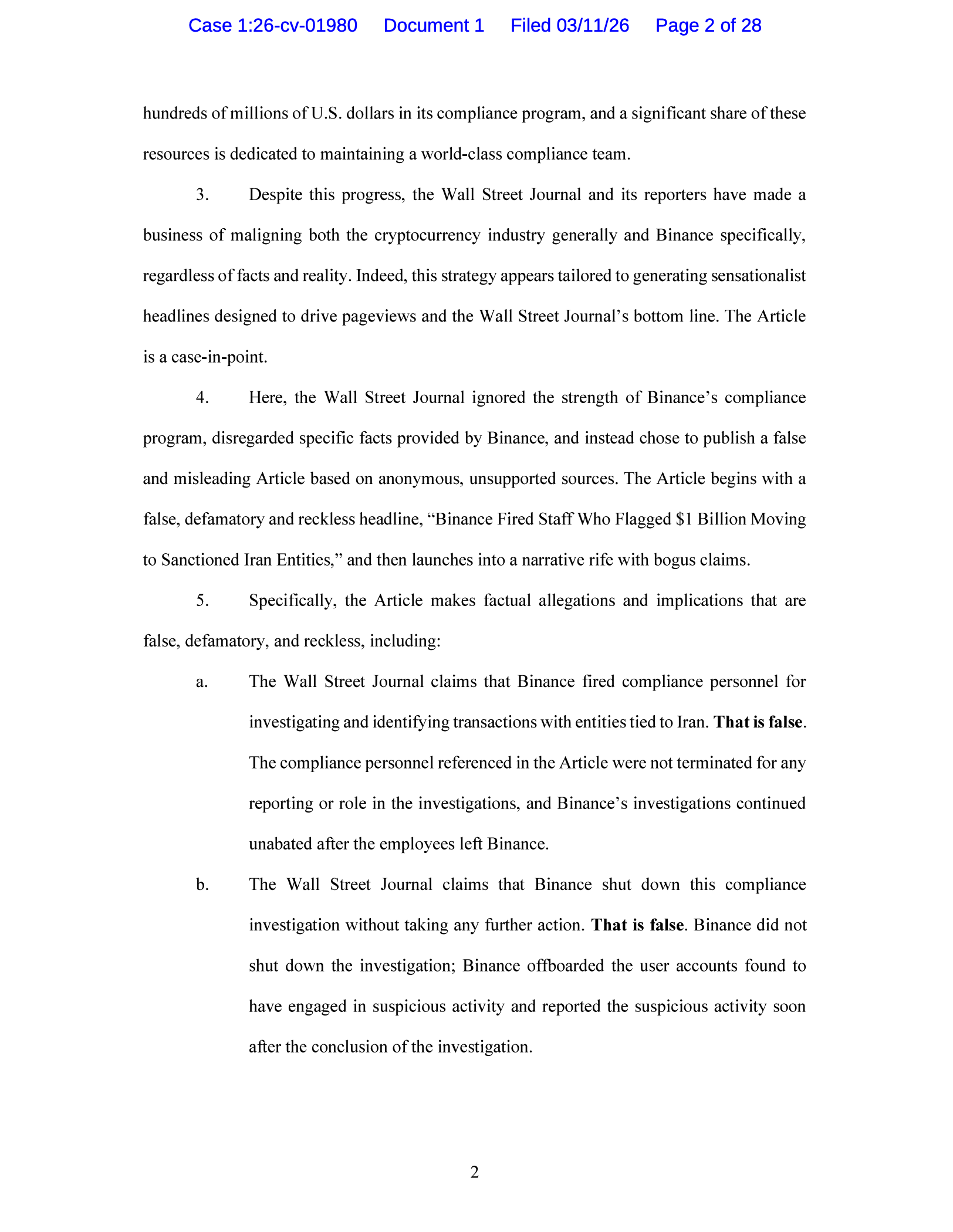
The Binance crypto exchange has just filed a defamation lawsuit against the Wall Street Journal over its article reporting that Binance's own compliance investigators had found $1 billion in transfers to Iran-backed terror groups, and then were fired.

Complaint: courtlistener.com/docket/72409

WSJ report: wsj.com/finance/currencies/bin

Binance Holdings Limited ("Binance" or "Plaintiff'), as and for its Complaint against Dow Jones & Company, Inc. d/b/a The Wall Street Journal ("Dow Jones" or "Wall Street Journal"), alleges as follows: INTRODUCTION 1. Binance brings this action against the Wall Street Journal for publishing a false and defamatory article on February 23, 2026, which is the subject of this complaint (the "Article"). In the Article, the Wall Street Journal made numerous false and disparaging statements about Binance, and did so knowingly, recklessly, or negligently, and despite the fact that Binance provided factual corrections prior to publication, which the Wall Street Journal disregarded. 2. Binance is the world's largest cryptocurrency exchange by trading volume and users. In addition to holding licenses, registrations, and authorizations in more than 20 jurisdictions, Binance is the first cryptocurrency exchange to have secured full authorization under the Financial Services Regulatory Authority of the Abu Dhabi Global Market's regulatory framework. Binance has built one of the largest and most robust compliance programs in the digital asset industry, dedicating more than 1,500 individuals, nearly a quarter of its global workforce, to compliance, investigative, and risk functions. Binance investshundreds of millions of U.S. dollars in its compliance program, and a significant share of these resources is dedicated to maintaining a world-class compliance team. 3. Despite this progress, the Wall Street Journal and its reporters have made a business of maligning both the cryptocurrency industry generally and Binance specifically, regardless of facts and reality. Indeed, this strategy appears tailored to generating sensationalist headlines designed to drive pageviews and the Wall Street Journal's bottom line. The Article is a case-in-point. 4. Here, the Wall Street Journal ignored the strength of Binance's compliance program, disregarded specific facts provided by Binance, and instead chose to publish a false and misleading Article based on anonymous, unsupported sources. The Article begins with a false, defamatory and reckless headline, "Binance Fired Staff Who Flagged $1 Billion Moving to Sanctioned Iran Entities," and then launches into a narrative rife with bogus claims. 5. Specifically, the Article makes factual allegations and implications that are false, defamatory, and reckless, including: a. The Wall Street Journal claims that Binance fired compliance personnel for investigating and identifying transactions with entities tied to Iran. That is false. The compliance personnel referenced in the Article were not terminated for any reporting or role in the investigationc. The Wall Street Journal claims that Binance diminished its compliance with law enforcement requests. That is false. The compliance investigation started as a result of law enforcement requests seeking information about transactions, and Binance complied with those requests and cooperated with law enforcement, while also conducting an independent investigation that resulted in Binance oflboarding user accounts it identified that were engaged in suspicious activity. d. The Wall Street Journal claims that Binance knowingly registered customers with false documentation and provided preferential treatment to those customers. That is false. Identity verification is mandatory for all customers. 6. The Wall Street Journal contacted Binance at the eleventh hour seeking any comment Binance had on identified points and questions related to the Article, and refused to grant a good-faith extension for Binance to respond. Binance nevertheless worked with all haste to get factual corrections to the Wall Street Journal, but unfortunately, the Wall Street Journal then disregarded those corrections and refused an immediate request for correction. While it is incumbent upon a responsible publisher to seek to understand the true position prior to publication, it is apparent that the Wall Street Journal had already drafted the Article to conform to its own pre-existing agenda without regard to t
0
0
5
0
1
1
1
0
1
0
0