What is Hackers' Pub?

Hackers' Pub is a place for software engineers to share their knowledge and experience with each other. It's also an ActivityPub-enabled social network, so you can follow your favorite hackers in the fediverse and get their latest posts in your feed.

0
0
0
0
0
0

언제까지 (a:number, b:number) => a + b, (a:string, b:string) => a + b, <T>(a: T, b: T) => a + b 를 해줘야 하나고
그냥 대충 눈치껏 (a, b) => a + b 하면 'ba 와 더할 수 있어야 하는 타입이고 a 는 무언가와 더할 수 있는 타입이구나' 하고 추론할 수 있는 분석기가 달린 언어가 필요함

3

On old Twitter, there used to be a pretty vocal and thriving community of academics in various disciplines, as well as people who were learning from them and current grad students when it comes to applying for grad school & prep programs.

Things seem more silent here (with the exception of EECS and physics, perhaps).

Unscientific poll: How many of y'all grad school seekers are here?

0
0
0
0

✨ Meet Shrinivass, a Sr Full Stack Engineer from USA, contributing for over a year—improving docs like :has() and DOMContentLoaded.

He says, “I contribute because it’s mentorship at scale. Each improvement helps thousands of devs.”

Huge thanks! 🙌
developer.mozilla.org/en-US/co

0
0
1
0
1
1
1
0

사진달력 월향 ver.2026; 달의 향기를 품다
구매하실수 있는 폼입니다!
그러나 링크 내 구매폼은 로그인하셔야 이용 가능하기에,
여기 이 먀스토돈 계정의 멘션이나 디엠으로도 주문 받겠습니다.

가격 : 15000
배송 : 우체국택배 (일반으로 보내며 무료배송이나, 빠른등기 이용하실 시 배송비 2000추가)

재고소진시 판매 종료하겠습니다! 감사합니다 :D
구매폼은 아래 링크 !!

witchform.com/deposit_form/951

0
0
0
0
3
0
0
1
1
1
0
1
0
1
0

Here's an unbelievable fun fact:

The legendary creator of Linux and git, Linus Torvalds, once admitted in an interview that he had never used Debian. Why? Because he found it too difficult to install!

To this day, he reportedly still hasn't switched. Linus famously uses Fedora as his primary Linux distro. He further clarified that he is not the system’s guy i.e. IT professional who knows how to deal with different OSes. At least he is honest and wanted something that allowed him to do his job.

0
0
0
0
1
1
1
0

h12o's Advent Calendar 2025 15日目

クリスマスで降誕を祝われるイエスは羊にたとえられるが、Mastodonになぜか羊が多いのはたぶんまったく関係がないはず。

ところでこれは、新橋で見た、Mastodonにいそうな羊。

ジンギスカン食べたい……(今日の夕食は定食)

3F TORICO ジンギスカン
0
2
0
1

絶対野菜とかニンニクとか自分で追加したほうがいいですね とにかく物足りなさしかない

1

"In the last 100 years, Russia has attacked at least 19 countries - some as many as three or four times.
None of those countries has ever attacked Russia.
So (Russia) doesn't need security guarantees.
The Security guarantees are needed for everybody else."
- Kaja Kallas, Fmr. PM of Estonia

0
0
0

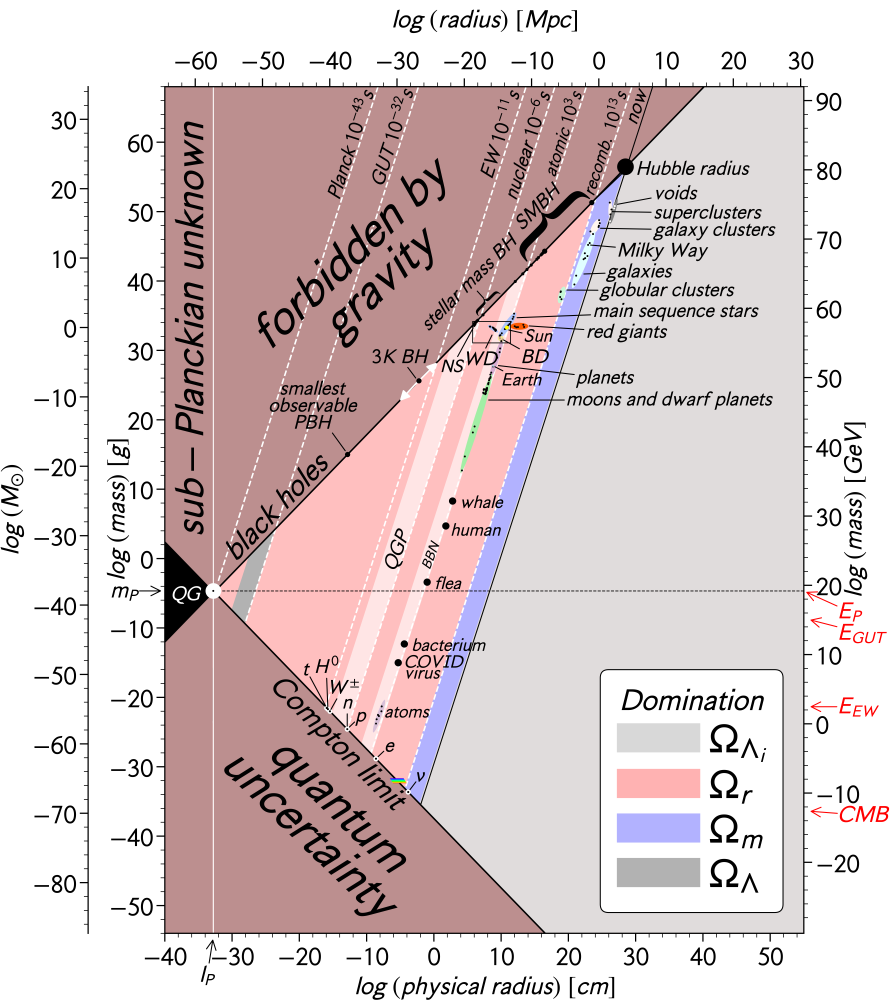
This chart shows all objects in the Universe, arranged by mass (vertical) and radius (horizontal).

The edge of the upper left corner is the "Schwarzschild radius" - anything along this edge becomes a black hole, so we don't expect stuff above and to the left of that.

The edge of the lower left corner is the "Compton wavelength" - anything here has a size so small that measuring its position that accurately would require enough energy to create a new one.

These two corners intersect in a white dot. This would be a black hole so small that it's heavily affected by quantum mechanics. By definition its mass would be the Planck mass, and its radius the Planck length. Nobody has seen such a thing.

The black region to the left of that dot, labeled "QG", contains imaginary objects that are more compressed than black holes, yet also ruled out by the uncertainty principle. So they're doubly impossible - unless Quantum Gravity, which we don't understand, changes the rules.

The pink strips of slope 3 are lines of constant density. For example "QGP" is the density of quark-gluon plasma, "BBN" is the density of the universe when Big Bang nucleosynthesis was going on, and so on.

The Earth is only slightly more dense than a flea.

The black dot labeled "Hubble radius" is the whole observable universe.

I like this chart a lot. It's from here:

C. H. Lineweaver and V. M. Patel, “All objects and some questions”, American Journal of Physics 91 (2023), 819-825. Free at pubs.aip.org/aapt/ajp/article-

A higher-resolution version is on Wikicommons:

commons.wikimedia.org/wiki/Fil

See the alt text for more!

Masses, sizes, and relative densities of objects in our Universe. The diagonal white dashed lines are lines of equal density. Gravity and quantum uncertainty prevent objects of a given mass from being smaller than their corresponding Schwarzschild radius or Compton wavelength. Schwarzschild black holes lie on the black m / r = 1 diagonal line which is the lower boundary of the “forbidden by gravity” region. The masses and Compton wavelengths of the top quark (t), Higgs boson (H), proton (p), electron (e), and neutrinos are plotted along the Compton (mr = 1) diagonal line. Among these, the top quark has the smallest Compton wavelength, because it has the largest mass: 173 GeV c^2. The smallest possible object is a Planck-mass black hole indicated by the white dot labeled “instanton”.  The smallest observable (not yet evaporated) primordial black hole (PBH) that could have survived until today has approximately the same size as a proton. The large low-mass black dot in the SMBH (supermassive black hole) range is the 4 x 10^6 solar mass black hole at the center of our galaxy, while the more massive large black dot is the black hole Ton 618. The dashed horizontal line emphasizes the orthogonal symmetry of black holes (m / r = 1) and particles (mr = 1). Our Universe is represented by the “Hubble radius” and has a mass and size that places it on the black hole line.
0
0
0

アマノフーズのフリーズドライの食品群はお湯をかけるだけで相当レベルの高い食品が出来上がるから非常食としてはもちろん、しゅいろ氏みたいなディストピア飯一歩手前の人にもおすすめ

1
0

ICYMI: The 30% off PyCharm promotion from JetBrains has been extended until December 19th!

Already have PyCharm? Use discount code PYCHARM4PYTHON to renew your subscription at 30% off!

All proceeds go to the PSF 💝

lp.jetbrains.com/support-pytho

lp.jetbrains.com/support-pytho

0
0
0