What is Hackers' Pub?

Hackers' Pub is a place for software engineers to share their knowledge and experience with each other. It's also an ActivityPub-enabled social network, so you can follow your favorite hackers in the fediverse and get their latest posts in your feed.

0
0
13
0
0
1
0
0

I'm writing this in English.

Not because English is my first language—it isn't. I'm writing this in English because if I wrote it in Korean, the people I'm addressing would run it through an outdated translator, misread it, and respond to something I never said. The responsibility for that mistranslation would fall on me. It always does.

This is the thing Eugen Rochko's post misses, despite its good intentions.

@GargronEugen Rochko argues that LLMs are no substitute for human translators, and that people who think otherwise don't actually rely on translation. He's right about some of this. A machine-translated novel is not the same as one rendered by a skilled human translator. But the argument rests on a premise that only makes sense from a certain position: that translation is primarily about quality, about the aesthetic experience of reading literature in another language.

For many of us, translation is first about access.

The professional translation market doesn't scale to cover everything. It never has. What gets translated—and into which languages—follows the logic of cultural hegemony. Works from dominant Western languages flow outward, translated into everything. Works from East Asian languages trickle in, selectively, slowly, on someone else's schedule. The asymmetry isn't incidental; it's structural.

@GargronEugen Rochko notes, fairly, that machine translation existed decades before LLMs. But this is only half the story, and which half matters depends entirely on which languages you're talking about. European language pairs were reasonably serviceable with older tools. Korean–English, Japanese–English, Chinese–English? Genuinely usable translation for these pairs arrived with the LLM era. Treating “machine translation” as a monolithic technology with a uniform history erases the experience of everyone whose language sits far from the Indo-European center.

There's also something uncomfortable in the framing of the button-press thought experiment: “I would erase LLMs even if it took machine translation with it.” For someone whose language has always been peripheral, that button looks very different. It's not an abstract philosophical position; it's a statement about whose access to information is expendable.

I want to be clear: none of this is an argument that LLMs are good, or that the harms @GargronEugen Rochko describes aren't real. They are. But a critique of AI doesn't become more universal by ignoring whose languages have always been on the margins. If anything, a serious critique of AI's political economy should be more attentive to those asymmetries, not less.

The fact that I'm writing this in English, carefully, so it won't be misread—that's not incidental to my argument. That is my argument.


5
13
0
0

이번 이스라엘과 미국의 삽질로 인해서 식량 가격 높아져서 아랍의 봄 시즌2 같은 사태가 다시 일어날것이라 생각함다 어디가 다음에 무너질지 모르지만... 이런건 계산이나 예측이 어렵죠 허허 한국도 이번에 중동 지역에 대한 의존도를 줄이거나 그러면 좋겠는데요 듣기론 뭐 UAE에 우회 파이프라인 이런건 지어놓긴했다던데 그래도 가능하면 저렇게 매번 불나는 동네보단 다른 동네 알아보는것도 좋겠죠 (먼산)

0
0

“팔로워 10명당 1마당개 챙겨주기”···‘도파민’ 대신 ‘도움’, 그들의 선행 알고리즘 www.khan.co.kr/article/2026... "‘선행 릴스’를 올리는 사람들은 선행이 또 다른 행동을 끌어내는 효과가 있다고 입을 모았다. 싸클의 영상을 보고 마당개를 챙기기 시작했다는 김씨는 “‘이 영상을 보고 집 앞 강아지 보호자에게 말을 건넸고 강아지를 더 잘 챙겨주기로 했다’는 메시지를 받기도 했다”며 “내 작은 행동이 다른 사람에게도 계기가 될 수 있다는 걸 느꼈다”고 했다."

“팔로워 10명당 1마당개 챙겨주기”···‘도파민’ 대...

0

Mastodon has a new human-over-AI contribution policy.

tl;dr:

- The human contributor is the sole party responsible for the contribution.

- If AI was used to generate a significant portion of your contribution (i.e. beyond simple autocomplete), we require you to disclose it in the Pull Request description.

- If you cannot guarantee the provenance and legal safety of the AI-generated code, do not submit it.

- Cases of repeated violations of these ... guidelines could result in a ban from our repositories.

github.com/mastodon/.github/bl

0
17
0

🍝 날아다니는 스파게티 괴물 님께서 여러분과 함께.
😋 또한 주교의 면발과 함께 하소서.
🍝 기도합시다.

저의 주님, 날아다니는 스파게티 괴물 님 🍝,
제가 주님 앞에 나아가 봉사하기에 합당치 못하오나
첫 조상의 타락으로 잃은 불사불멸의 면대를 제게 도로 주시어
영원한 즐거움을 누리게 하소서 😋.

2026-03-11T16:16:25+09:00


0
0
0

Last year I got PSVR2, and immediately felt like PSVR2 was the only way to play GT7. But plying in VR was mentally straining, especially crashes/spins. So, many days I just didn’t feel up to it, and I quickly stopped playing at all. I just restarted playing, on the TV, a few weeks ago. I just tried PSVR2 last night; then playing on the TV tonight just felt bad. History repeating. I kinda wish I had never tried PSVR2. I wouldn’t be surprised if Sony regretted releasing it.

0
0
0
2
0

Niemand führt mehr Krieg, nur noch „Spezialoperationen”, niemand wird mehr ausgebeutet, sondern es gibt nur noch „Scheinselbstständigkeit”, niemand will gegen Queere hetzen, sondern steht lediglich für die „traditionelle Familie” ein. Doch wenn der Euphemismus stirbt, erkennt auch jeder, dass der Faschismus plötzlich da ist.

0

@django @liaizonwakest ⁂ @voboda

Thank you, I really like the article. It describes a whole bunch of activities and consideration where Social experience design evolves methodical solution development practices.

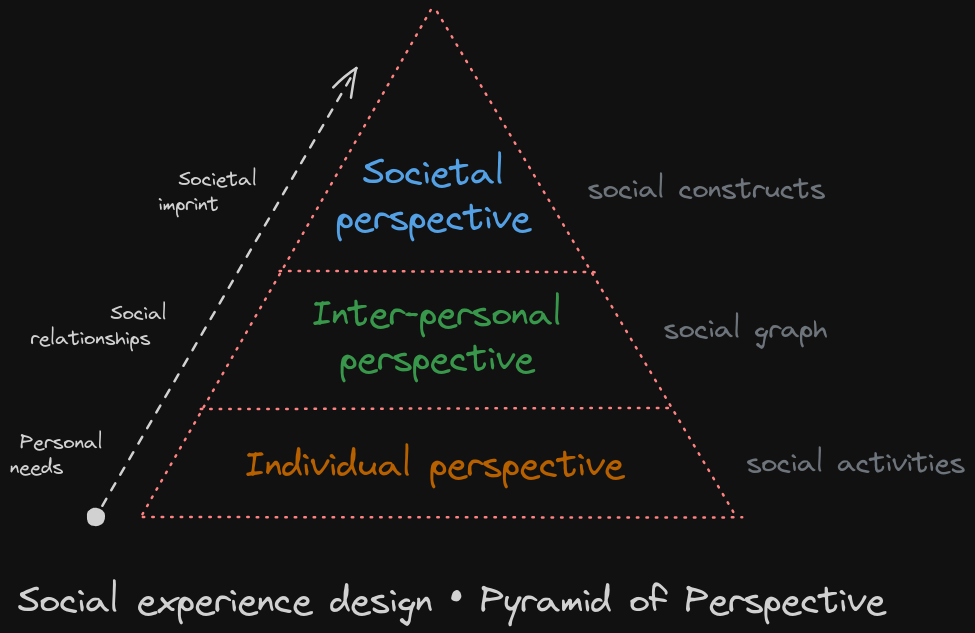
A social experience can be seen as "how people experience a solution" and this includes how that solution interacts with other solutions these people were already exposed to i.e. it accounts for the externalities of technology introduction. Social experiences work at different scales which design perspectives account for:

coding.social/blog/reimagine-s

An issue on the app-centric fedi is that app devs have a technical view of the fediverse, while 'fedizens' have a social one, leading to expectation mismatches. Apps are typically developed for 2 stakeholders: "Users" and the devs themselves (the de-facto owners of 'app-space').

While feature driven app-focused design may improve social experience for app users, it pays insufficient attention to the overall experience of the fediverse.

SX Pyramid of Perspective has 3 layers. The bottom layer starts with the individual perspective where personal needs are satisfied as social activities take place. The layer above focuses on inter-personal perspective where social relationship are formed into a social graph. The top of the pyramid shows the societal perspective where solutions are designed to have societal imprint and may affect entire societal constructs.

@django @liaizonwakest ⁂ @voboda

When looking through the lens of Social experience design we can say that the fediverse-we-have and the social network promise in the W3C specs, have become diverged to the extent they are hard forks.

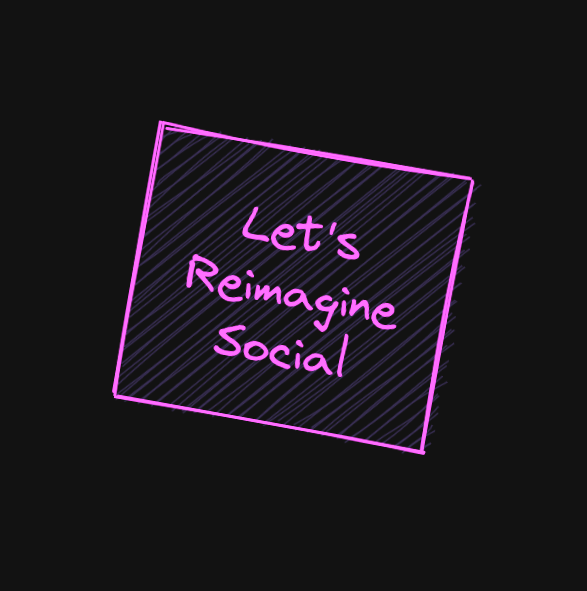
A solution is said to exist as soon as you can write it down on a sticky note in the form of a vision, need, objective, or solution.

The AS/AP fediverse sticky note reads: "The future of social networking is decentralized".

The fediverse-we-have note reads: "Decentralized microblogging"

Besides that both sticky notes express a tech focus, exist in the technosphere not sociosphere, they express no vision.. A place where we want to be, and why. There is complete misconception both on technical, let alone social direction, and that leads to endless confusion and again those mismatched expectations.

App devs now try to hammer their apps onto "Decentralized microblogging" in hopes "future of social networking" somehow emerges. That is unlikely.

0
0
1

I'm thinking of proposing a /social web community track at @COSCUP 2026 (Aug 8–9, Taipei)—think FOSDEM's Social Web devroom, but in East Asia. Before I submit the CFP, I'd love to get a sense of what to call it. What do you think?

(Boosts appreciated!)

@hongminhee洪 民憙 (Hong Minhee) :nonbinary: @COSCUP

As you know I am proponent to emphasize the social aspects more, to drive healthy evolution of the .

The app-centric is a pure technosphere, where a tech-first approach deals with getting app features to the next app, and the protocol matures via post-facto 'follow-the-leader' . What happens in the sociosphere between people using the tech is de-facto of secondary concern, and apps are tweaked to try to deal with externalities. The resulting social landscape has become one of neighboring app kingdoms with guarded borders separating them. Everyone speaks microblog to each other, albeit with thick accents, hard to understand. The fediverse is social *because* of the people, and despite of the tech, that still severely restrains them.

It would be nice if the track name not just indicated a technology name. E.g. coding.social uses:

- Fediverse, a peopleverse
-
-

0
0
0
3
0
0
1

I'm writing this in English.

Not because English is my first language—it isn't. I'm writing this in English because if I wrote it in Korean, the people I'm addressing would run it through an outdated translator, misread it, and respond to something I never said. The responsibility for that mistranslation would fall on me. It always does.

This is the thing Eugen Rochko's post misses, despite its good intentions.

@GargronEugen Rochko argues that LLMs are no substitute for human translators, and that people who think otherwise don't actually rely on translation. He's right about some of this. A machine-translated novel is not the same as one rendered by a skilled human translator. But the argument rests on a premise that only makes sense from a certain position: that translation is primarily about quality, about the aesthetic experience of reading literature in another language.

For many of us, translation is first about access.

The professional translation market doesn't scale to cover everything. It never has. What gets translated—and into which languages—follows the logic of cultural hegemony. Works from dominant Western languages flow outward, translated into everything. Works from East Asian languages trickle in, selectively, slowly, on someone else's schedule. The asymmetry isn't incidental; it's structural.

@GargronEugen Rochko notes, fairly, that machine translation existed decades before LLMs. But this is only half the story, and which half matters depends entirely on which languages you're talking about. European language pairs were reasonably serviceable with older tools. Korean–English, Japanese–English, Chinese–English? Genuinely usable translation for these pairs arrived with the LLM era. Treating “machine translation” as a monolithic technology with a uniform history erases the experience of everyone whose language sits far from the Indo-European center.

There's also something uncomfortable in the framing of the button-press thought experiment: “I would erase LLMs even if it took machine translation with it.” For someone whose language has always been peripheral, that button looks very different. It's not an abstract philosophical position; it's a statement about whose access to information is expendable.

I want to be clear: none of this is an argument that LLMs are good, or that the harms @GargronEugen Rochko describes aren't real. They are. But a critique of AI doesn't become more universal by ignoring whose languages have always been on the margins. If anything, a serious critique of AI's political economy should be more attentive to those asymmetries, not less.

The fact that I'm writing this in English, carefully, so it won't be misread—that's not incidental to my argument. That is my argument.

5
13
0
0
0
0
0
0
0
0
0
0
0
0
0

10일 중국중앙(CC)TV·신경보 등 중국매체에 따르면 중국인민정치협상회의(정협) 위원인 중국촨메이대학 랴오샹중 당서기는 양회 기간 인터뷰를 통해 "지난해 번역·촬영 등 학부 전공 16개를 한 번에 폐지했다"고 말했다. 등록 2026-03-10 16:52

10일 중국중앙(CC)TV·신경보 등 중국매체에 따르면...

0
0

My daughter just asked me how to say 厨二病 (中二病) in English. Looking through various translations, the one that strikes me as least awful is "teen angst," but it fails to capture the narcissism, pretentiousness, and sense of superiority of chūnibyō. "Main Character Syndrome" captures that aspect, but fails to identify the specific age bracket where this most commonly occurs, which is to say early teens. Please knock my socks off with an awesome translation.

0
0

„Představa, že člověk je ve svém životě protagonistou a ostatní hrají jen vedlejší role, se ze sociálních sítí přelévá do reality. Kromě ekonomického bohatství jsou tyto postoje podpořeny terapeutickou kulturou, která lidem vtiskla představu, že všechny jejich pocity jsou za jakýchkoliv okolností plně validní. K tomu je navíc vybavila pojmy, jako jsou _hranice_ nebo _potřeby_, jež často napomáhají zaměňování toho, co člověk skutečně potřebuje, s tím, co jednoduše chce.“ denikalarm.cz/2026/03/zlato-z-

0

I'm writing this in English.

Not because English is my first language—it isn't. I'm writing this in English because if I wrote it in Korean, the people I'm addressing would run it through an outdated translator, misread it, and respond to something I never said. The responsibility for that mistranslation would fall on me. It always does.

This is the thing Eugen Rochko's post misses, despite its good intentions.

@GargronEugen Rochko argues that LLMs are no substitute for human translators, and that people who think otherwise don't actually rely on translation. He's right about some of this. A machine-translated novel is not the same as one rendered by a skilled human translator. But the argument rests on a premise that only makes sense from a certain position: that translation is primarily about quality, about the aesthetic experience of reading literature in another language.

For many of us, translation is first about access.

The professional translation market doesn't scale to cover everything. It never has. What gets translated—and into which languages—follows the logic of cultural hegemony. Works from dominant Western languages flow outward, translated into everything. Works from East Asian languages trickle in, selectively, slowly, on someone else's schedule. The asymmetry isn't incidental; it's structural.

@GargronEugen Rochko notes, fairly, that machine translation existed decades before LLMs. But this is only half the story, and which half matters depends entirely on which languages you're talking about. European language pairs were reasonably serviceable with older tools. Korean–English, Japanese–English, Chinese–English? Genuinely usable translation for these pairs arrived with the LLM era. Treating “machine translation” as a monolithic technology with a uniform history erases the experience of everyone whose language sits far from the Indo-European center.

There's also something uncomfortable in the framing of the button-press thought experiment: “I would erase LLMs even if it took machine translation with it.” For someone whose language has always been peripheral, that button looks very different. It's not an abstract philosophical position; it's a statement about whose access to information is expendable.

I want to be clear: none of this is an argument that LLMs are good, or that the harms @GargronEugen Rochko describes aren't real. They are. But a critique of AI doesn't become more universal by ignoring whose languages have always been on the margins. If anything, a serious critique of AI's political economy should be more attentive to those asymmetries, not less.

The fact that I'm writing this in English, carefully, so it won't be misread—that's not incidental to my argument. That is my argument.

5
13
0
0
1
0
0