In my quest of solving #AdventOfCode problems in interesting ways, this time I solved the 2020 problem "Seating System" with comonads and stencils in #Haskell. Read my latest #blog post about it: https://abhinavsarkar.net/posts/solving-aoc20-seating-system/
Search results


merry christmas everyone 🧑🎄
dear santa,
can i get a free and open source advent of code this year? 🎁
if i was extra good, put some nostr/fediverse integration in my stocking 🧦
and santa, don't forget to give coal to that proprietary website 👎
I'm solving #AdventOfCode this year in #Janet #Lisp. See my solutions for the days 5–8: https://abhinavsarkar.net/notes/2025-aoc-2/

I solved #AdventOfCode day 7 in #Haskell with #parsers, #zippers and #interpreters, and wrote a note about it: https://notes.abhinavsarkar.net/2022/aoc-7

quicktipp #108: Creating an empty Docker container image and running it by bind-mounting essential paths from the host to the container.
Inspired as an alternative solution to Advent of Sysadmin, DAY 5 to get privileged access to the host root filesystem as an unprivileged user on an airgapped machine.
#linux #docker #adventofsysadmin #adventofcode  @sadservers #containers #sysadmin


I'm still on day 4 of #AdventOfCode. Part1 is done, but it took about an hour on my #Ti92 calculator...
Part 2 will therefore take days if I don't implement some kind of trimming feature that removes already cleared-out areas from the search-space. Even with proper trimming I do expect it to take over a day... Not sure if the calculator's batteries last that long 😉.
Solved #AdventOfCode day 6 part 2 in #Janet with this consice PEG parser and some math. #programming
```janet
{:main (sequence :num-rows :op-row -1)
:num-rows (group (some :num-row))
:num-row (group (sequence (some :num-entry) "\n"))
:num-entry (sequence :blank (some (number :d)) :blank)))
:blank (any (replace " " 0))
:op-row (group (some (sequence :op (opt (some :s)))))
:op (choice (replace "*" :mult) (replace "+" :add))}
```
A little peek at the bullshit I got up to yesterday.

More Python solutions!  @marcoshuerta writes very nice and readable Python and our solutions seem to often be on a very similar path.

A completely new language to me is Janet with which  @abnvAbhinav 🌏 commands with elegance to solve these problems.
It's so cool to see completely new languages and learn from different ways of solving problems.

Another Python developer @eeentropyyy also writes great posts at https://christopherhimes.com/blog/
More Python solutions! @marcoshuerta writes very nice and readable Python and our solutions seem to often be on a very similar path.
A fellow Pythonista  @brass75Dan (he/him)
  has excellent posts on these puzzles at https://brassnet.biz/blog
Blog
brassnet.biz
Link author: Dan (he/him) @brass75@twit.social
Another Python developer @eeentropyyy also writes great posts at https://christopherhimes.com/blog/
I don't know if Antti is in Mastodon but he solves this year's puzzles with SQL and writes about them in Finnish.
https://www.ohjelmointiputka.net/keskustelu/32619-sql-advent-of-code-2025-sqlite
A fellow Pythonista @brass75Dan (he/him) has excellent posts on these puzzles at https://brassnet.biz/blog
Blog
brassnet.biz
Link author: Dan (he/him) @brass75@twit.social
Problem solving is a shared language despite of which programming or human languages they are done.
 @AFoucartAdrien Foucart solves the puzzles in Python and writes about them in French but thanks to the magic of translation technology, I've been learning a ton from them.
I don't know if Antti is in Mastodon but he solves this year's puzzles with SQL and writes about them in Finnish.
https://www.ohjelmointiputka.net/keskustelu/32619-sql-advent-of-code-2025-sqlite
Haskell feels like ancient magic to me but I've learned so much from  @neilnjaeDr Neil Smith 's explanations at https://work.njae.me.uk/

Problem solving is a shared language despite of which programming or human languages they are done.
@AFoucartAdrien Foucart solves the puzzles in Python and writes about them in French but thanks to the magic of translation technology, I've been learning a ton from them.
Paul solves these puzzles with Go and writes about his thought process that goes into turning the puzzles into code solutions.
Haskell feels like ancient magic to me but I've learned so much from @neilnjaeDr Neil Smith 's explanations at https://work.njae.me.uk/
First up,  @mina who is solving puzzles with Perl and while my Perl is rusty at best, I really enjoy learning about the power of the language: https://blog.minaspace.org/

Paul solves these puzzles with Go and writes about his thought process that goes into turning the puzzles into code solutions.
We're at the halfway point of #AdventOfCode and I've been having a blast.
For me, one the best parts is getting to learn from other people as there are so many ways to solve these puzzles.
Here's a thread of some wonderful people whose solutions and explanations I enjoy reading.
First up, @mina who is solving puzzles with Perl and while my Perl is rusty at best, I really enjoy learning about the power of the language: https://blog.minaspace.org/
We're at the halfway point of #AdventOfCode and I've been having a blast.
For me, one the best parts is getting to learn from other people as there are so many ways to solve these puzzles.
Here's a thread of some wonderful people whose solutions and explanations I enjoy reading.

I'm proud of my #adventofcode achievement today: I stopped when the debugging session wasn't fun. I have a silver star.

#adventOfCode day 4 in #LuaLang
https://gitlab.cs.washington.edu/fidelp/advent-of-code-2025/-/blob/main/04.lua
- PC - 28 ms
- Raspberry Pi 2: 884 ms
Unfortunately, it will not fit in the TI-92's RAM due to how I'm representing the grid. Unless it can be optimized more....

#adventOfCode day 4 rewritten in C
https://gitlab.cs.washington.edu/fidelp/advent-of-code-2025/-/blob/main/04.c
This is a very simpleminded solution with no algorithmic fanciness: it's performing lots of repeated work in Part B.
- PC - 1 ms
- Raspberry Pi 2: 23 ms
- #ti92 Plus: 10 seconds
It was stunning to see a result returned in just 10 seconds on the #ticalc, rather than minutes for previous days. The performance difference between an interpreter and an optimizing compiler is stark! Also, the TI-92 doesn't have a floating-point coprocessor, which makes Lua in particular struggle to run at speed.

#adventOfCode day 3 in #LuaLang
https://gitlab.cs.washington.edu/fidelp/advent-of-code-2025/-/blob/main/03.lua
- PC - 5.4 ms
- Raspberry Pi 2: 156 ms
- #ti92 Plus: ??? minutes (still running)
The program runs successfully in TiEmu with the emulation speed multiplier unlocked. It has yet to be seen how long it'll take on the real calc...

#adventOfCode day 4 in #LuaLang
https://gitlab.cs.washington.edu/fidelp/advent-of-code-2025/-/blob/main/04.lua
- PC - 28 ms
- Raspberry Pi 2: 884 ms
Unfortunately, it will not fit in the TI-92's RAM due to how I'm representing the grid. Unless it can be optimized more....
Adapted #adventOfCode 2025 day 2 in #LuaLang to use a much more efficient algorithm to fit on #ti92 Plus.
https://gitlab.cs.washington.edu/fidelp/advent-of-code-2025/-/blob/main/02fast.lua
- Desktop: 1.1 ms
- Raspberry Pi 2B: 20 ms
This also found a bug in my port of Lua: math.huge was the wrong value, so a particular loop was never running.

#adventOfCode day 3 in #LuaLang
https://gitlab.cs.washington.edu/fidelp/advent-of-code-2025/-/blob/main/03.lua
- PC - 5.4 ms
- Raspberry Pi 2: 156 ms
- #ti92 Plus: ??? minutes (still running)
The program runs successfully in TiEmu with the emulation speed multiplier unlocked. It has yet to be seen how long it'll take on the real calc...
#adventOfCode day 2,
- in #LuaLang, https://gitlab.cs.washington.edu/fidelp/advent-of-code-2025/-/blob/main/02.lua
- Desktop: 365 ms
- Raspberry Pi 2B: 18.5 sec
- in C, https://gitlab.cs.washington.edu/fidelp/advent-of-code-2025/-/blob/main/02.c
- Desktop: 46 ms
- Raspberry Pi 2B: 2.2 sec
Implementing a naive algorithm was fine, albeit a little slow on the Pi. Retro platforms will struggle with this one unless I come up with a better solution using numerical methods. Maybe I'll have something for the TI-92+ tomorrow. I'm sure it could handle the example input in Lua, but I want to do better than that.
The Raspberry Pi 2B uses a quad-core Cortex-A7 at 900 MHz. In 2016 this was my all-purpose "desktop" machine used for all tasks. The same Pi is still in service as my web server hosting my website and music. http://edlinfan.duckdns.org/music.html
[~] time ./02
Part A, B = 19219508902, 27180728081

real    0m2.188s
user    0m2.180s
sys 0m0.000s

[~] cat /sys/firmware/devicetree/base/model
Raspberry Pi 2 Model B Rev 1.2

[~] head -n 4 /proc/cpuinfo
processor   : 0
model name  : ARMv7 Processor rev 4 (v7l)
BogoMIPS    : 57.60
Features    : half thumb fastmult vfp edsp neon vfpv3 tls vfpv4 idiva idivt vfpd32 lpae evtstrm crc32
Adapted #adventOfCode 2025 day 2 in #LuaLang to use a much more efficient algorithm to fit on #ti92 Plus.
https://gitlab.cs.washington.edu/fidelp/advent-of-code-2025/-/blob/main/02fast.lua
- Desktop: 1.1 ms
- Raspberry Pi 2B: 20 ms
This also found a bug in my port of Lua: math.huge was the wrong value, so a particular loop was never running.
#adventOfCode day 1 in #LuaLang
https://gitlab.cs.washington.edu/fidelp/advent-of-code-2025/-/blob/main/01.lua
- PC: 1 ms
- Raspberry Pi 2: 70 ms
- #hp200lx: Error after 2 minutes. I wonder if the garbage collector settings need to be tuned to avoid memory exhaustion.

#adventOfCode day 2,
- in #LuaLang, https://gitlab.cs.washington.edu/fidelp/advent-of-code-2025/-/blob/main/02.lua
- Desktop: 365 ms
- Raspberry Pi 2B: 18.5 sec
- in C, https://gitlab.cs.washington.edu/fidelp/advent-of-code-2025/-/blob/main/02.c
- Desktop: 46 ms
- Raspberry Pi 2B: 2.2 sec
Implementing a naive algorithm was fine, albeit a little slow on the Pi. Retro platforms will struggle with this one unless I come up with a better solution using numerical methods. Maybe I'll have something for the TI-92+ tomorrow. I'm sure it could handle the example input in Lua, but I want to do better than that.
The Raspberry Pi 2B uses a quad-core Cortex-A7 at 900 MHz. In 2016 this was my all-purpose "desktop" machine used for all tasks. The same Pi is still in service as my web server hosting my website and music. http://edlinfan.duckdns.org/music.html
[~] time ./02
Part A, B = 19219508902, 27180728081

real    0m2.188s
user    0m2.180s
sys 0m0.000s

[~] cat /sys/firmware/devicetree/base/model
Raspberry Pi 2 Model B Rev 1.2

[~] head -n 4 /proc/cpuinfo
processor   : 0
model name  : ARMv7 Processor rev 4 (v7l)
BogoMIPS    : 57.60
Features    : half thumb fastmult vfp edsp neon vfpv3 tls vfpv4 idiva idivt vfpd32 lpae evtstrm crc32
I'm solving #AdventOfCode this year in #Janet #Lisp. See my solutions for the first four days: https://abhinavsarkar.net/notes/2025-aoc-1/.


New #AdventOfCode objects! (and new shipping options!) https://adventofcode.com/2025/shop


🌟 #AdventOfCode is in full swing in Unison!
Our community has made full use of Unison's computable doc format, writing up their solutions and helpful explainers!
Here's one from the Discord about Day 3! Join us! 💌
https://share.unison-lang.org/@systemfw/aoc-2025/code/main/latest/terms/day03/doc?utm_source=mastodon

It’s time to catch up on my leetcode skills! What are some tips you have when doing a leetcode style interview? And any sites you’d recommend for practice, other than leetcode itself?
I was also thinking of doing #AdventOfCode , I haven’t done it in several years
If you're curious what it takes to run #AdventOfCode every year, I have a talk called Advent of Code: Behind the Scenes that you might enjoy: https://youtu.be/uZ8DcbhojOw

This time I'm solving #AdventOfCode in #Janet (I'll write about my solutions in my blog in batches) and I'm really pleased by the built-in #PEG parsers. This is how the grammar looks for day 2:
```janet
{:main (sequence :ranges -1)
:ranges (some :range)
:range (group (sequence (number :num) "-" (number :num) (opt ",")))
:num (some :d)}
```

this year my challenge for #AdventOfCode is to implement my own (statically typed) language and solve every task with it, adding features to the language as I go. basic implementation and first day are ready!
https://codeberg.org/goldstein/aoc2025
I kinda cheated by implementing System F typechecking a couple of days before the challenge starts, but this still means I had to implement parsing + ADTs and basic pattern matching + let-in + primitive types + builtins + typing for all that stuff + de Bruijn indexing + evaluation in the first day, which is the primary downside of this challenge. System F typing was mostly mechanical anyway, I was just following a paper (Complete and Easy Bidirectional Typechecking for Higher-Rank Polymorphism by Dunfield and Krishnaswami).
I spent last month preparing for this (reading TAPL and various papers, thinking about language design), so I’m pretty excited to actually attempt it.
#adventOfCode day 1 in #LuaLang
https://gitlab.cs.washington.edu/fidelp/advent-of-code-2025/-/blob/main/01.lua
- PC: 1 ms
- Raspberry Pi 2: 70 ms
- #hp200lx: Error after 2 minutes. I wonder if the garbage collector settings need to be tuned to avoid memory exhaustion.
Adapted #adventOfCode 2025 day 1 in #LuaLang to use less memory to fit on #ti92 Plus. Execution time: 2m 42s.
The TI-92+ has a 12 MHz 68000 and 188 KB RAM that is also used as the calculator's main ramdisk, meaning, the Lua interpreter, script, puzzle input, and all datastructures must fit in that size. The calculator runs on 4 AA batteries with a battery life of "well beyond a school year".
#adventOfCode day 1 in #LuaLang
https://gitlab.cs.washington.edu/fidelp/advent-of-code-2025/-/blob/main/01.lua
- PC: 1 ms
- Raspberry Pi 2: 70 ms
- #hp200lx: Error after 2 minutes. I wonder if the garbage collector settings need to be tuned to avoid memory exhaustion.

Something made me choose chaos today and attempt Advent of Code in C this year: https://github.com/agentultra/advent2025/tree/main
I setup my Haskell advent repo as well for this year in case I want to retreat to the ivory tower...

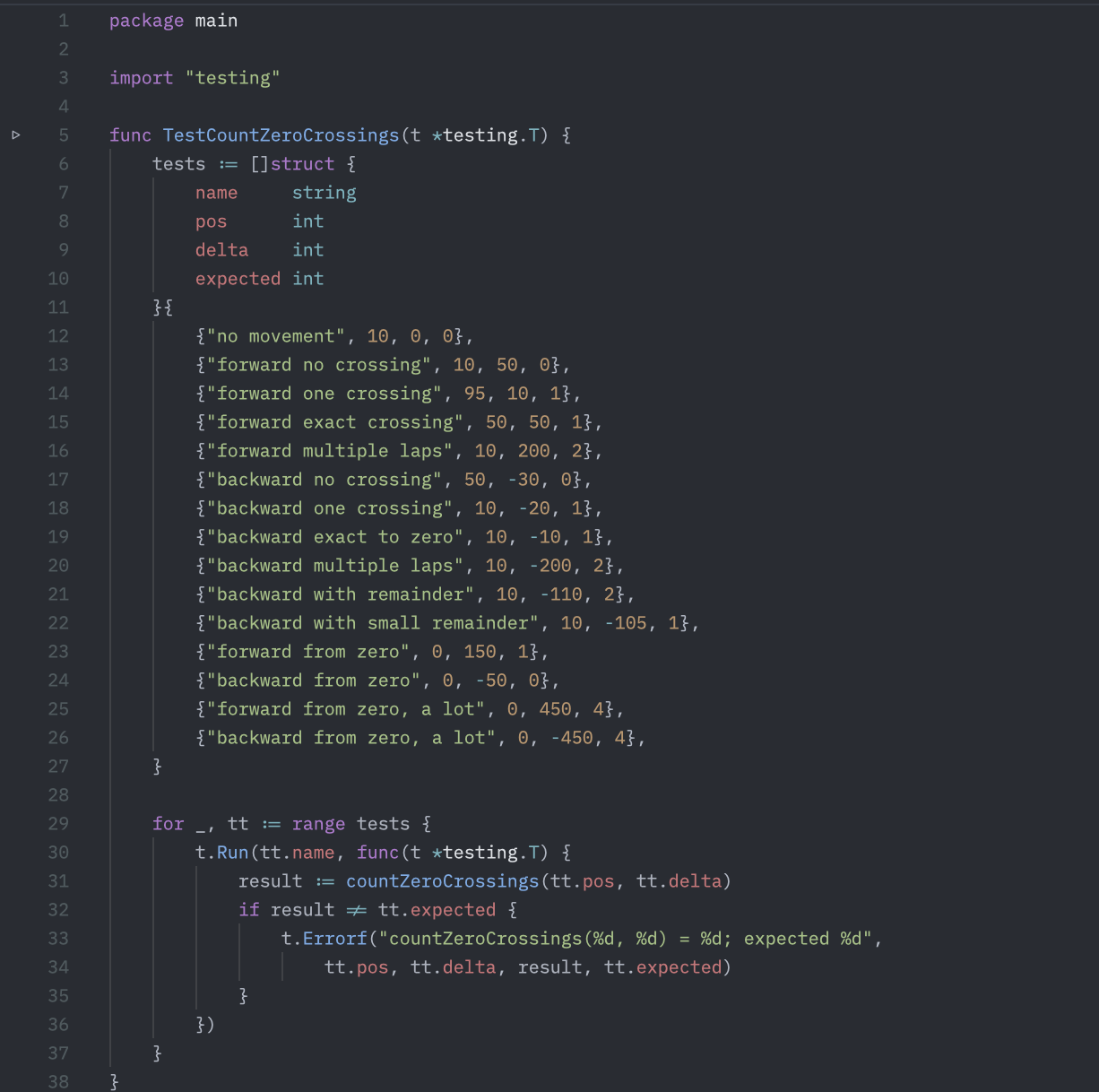
#AdventOfCode started. Using this as a chance to refresh my go since I hadn't used it in about 2-3 years.
Turns out: tests are still a good idea.
I spent forever on a tiny bug. Then I wrote tests and saw the bug just blazing straight into my eyeballs.
🌟 It's time for #AdventOfCode! That means it's a great month to pick up a new programming language! Try it in Unison this year! 🎁
https://share.unison-lang.org/@unison/advent-of-code?utm_source=mastodon

Took me 3 hours to solve day 1 and man, I made a lot of mistakes. You can watch my dumbass on stream trying to tackle it here: https://www.youtube.com/watch?v=QbmDmoC1PS0
Or be spoiled and see the solution. Do note that the code is now broken for Part 1 of Day 1. I might reorganize it to accommodate Part 1 and Part 2 solution in a single Python file. And looking at other people's code made me realize how overcomplicated my code is. Dammit. https://github.com/Qoyyuum/adventofcode/blob/2023/2023/01/trebuchet.py

Hello, friends! After 10(!) years of #AdventOfCode, I've made some changes to preserve my sanity: there will be 12 days of puzzles each December (still starting Dec 1) and there is no longer a global leaderboard. Read more:
https://adventofcode.com/2025/about#faq_num_days
https://adventofcode.com/2025/about#faq_leaderboard


Instead of doing relentless advent of code challenges I decided I’d work on something fun instead 😁

Last night at my local #Python user group, I shared 3 Christmas-themed puzzles I devised for the event ( in the style of #AdventOfCode ), I thought I'd share them here too in case anyone is interested. 🎄
They won't be as good as AoC of course but attendees seemed to enjoy these puzzles.

New instance, new introduction!
I'm a late (mostly self) diagnosed autistic in recovery from autistic burnout. In spring 2024 I left a career at Apple Retail and have been finding myself since. I'm deeply passionate about and experienced with Apple tech. I also love Sci-Fi and Fantasy, mostly TV and movies these days. I'm a gamer, mostly playing on Mac, iPad, and Switch. I was once a software engineer and still pursue it as a hobby, mostly developing small projects for the Apple ecosystem in Swift.
#Introduction #ActuallyAutistic #Apple #Mac #iPad #iPhone #AppleVisionPro #StarWars #Severance #Silo #Firefly #Babylon5 #TheExpanse #LordOfTheRings #Balatro #Shapez #ShapezIO #Wordle #Swift #AdventOfCode

Time for an #introduction !
I'm Anisse; husband, father, reader, gamer, developer living in France. I believe that everything is political, but what you'll find on this account is most likely to be tech-related: that's how I like to use social media. I've been closely or remotely interested in #Linux for about 25 years, and in the last 15, mostly the #kernel side. I post about my ongoing game gear emulator, in December about Advent of Code, and between the occasional shitpost, about interesting tech news. You'll find my longer articles on my blog: https://anisse.astier.eu/ (rarely), and how to reach me. I also do the live-blog for #KernelRecipes once a year: https://kernel-recipes.org/en/2022/category/live-blog/
It's been a few months on mastodon. Or many years, if you count the instance that shut down before I could migrate.
Here are a few interesting threads I wrote on a previous instance:
* #emulation debugging: https://octodon.social/@aissen/109214232614955675
* Live-posting a #CPU event: https://octodon.social/@aissen/109320752556345732
* #AdventOfCode impressions: https://octodon.social/@aissen/109437565515024519
* A bitmanip trick for #RustLang and other languages: https://octodon.social/@aissen/109431893754535969
* Top 7 #webtoons https://octodon.social/@aissen/109597203776360582
* My theory on GG etymology https://octodon.social/@aissen/109352920637602647
* Custom mastodon CSS icon https://octodon.social/@aissen/109344221434488129

#AdventOfCode 2023 has started ! I'll won't link to my solutions, but you'll be able to find them mirrored on my Github page a reasonable time after they are solved.
Let's go!


I’m really enjoying looking at everyone’s #AdventOfCode. The most interesting part for me is how each language can more easily/naturally solve different aspects of the daily problems. I’m curious to hear from others what they think the strengths/facilities of their chosen language lends to that day’s problem.