Search results

0

Why I Love freeBSD

freeBSD

Processing

I've only skimmed this nice post.
Thorough reading will follow later

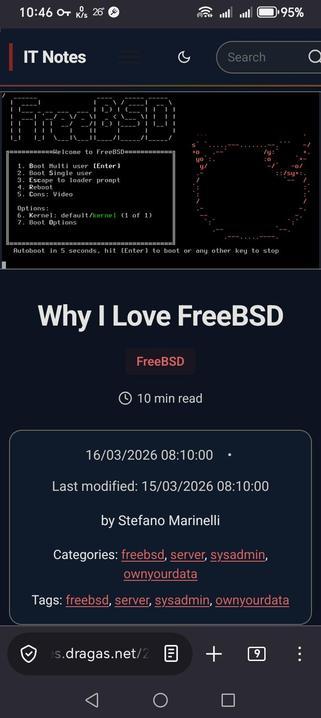
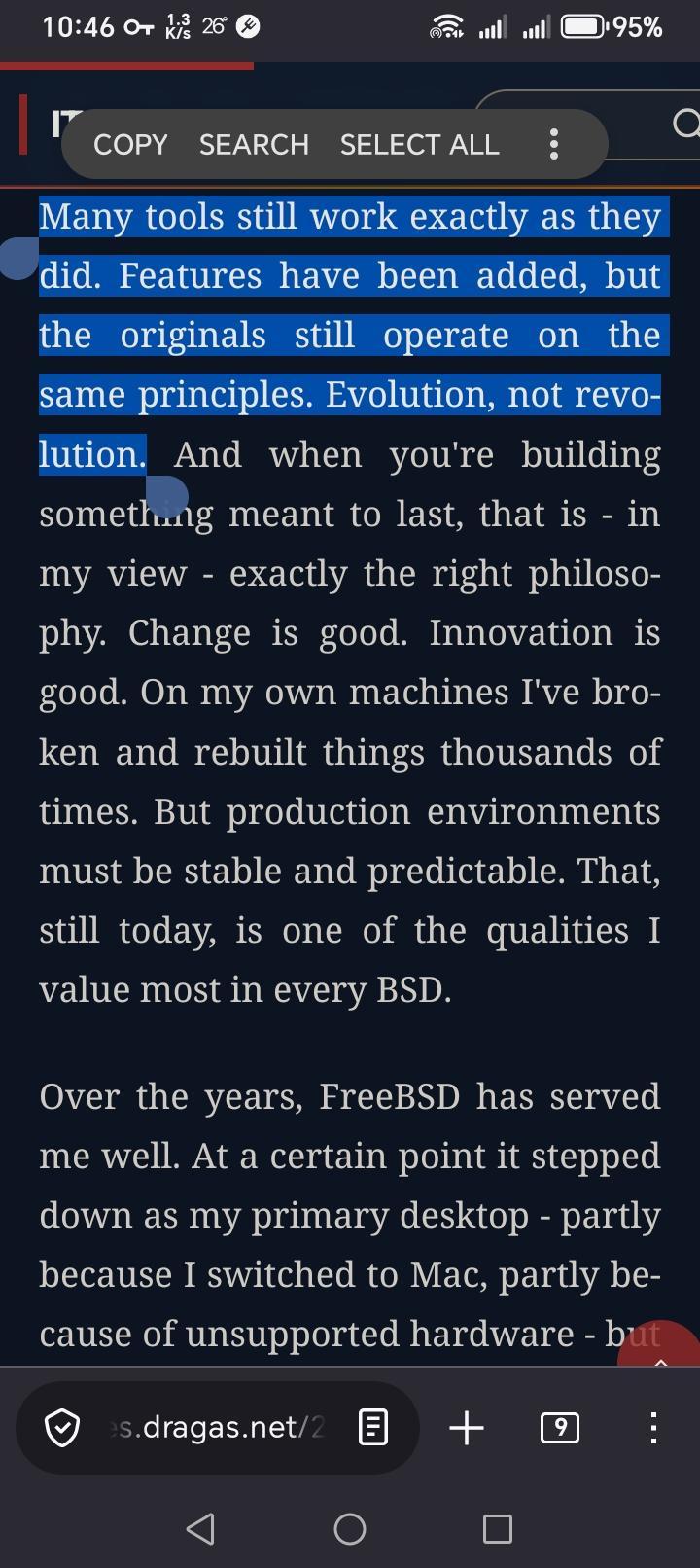
Some highlights which resonate with me *as flageolets on a string instrument* are captured here in screenshots I've made on an Android

  • Many tools still work exactly as they did (decades ago)

  • The feeBSD handbook taught me an enormous ammount, more than many of my University courses, including things that had nothing to do with freeBSD specifically

  • This is vital

  • The handbook taught me the right approach

    understand first, act second

This is a principle I use since I've been a peuter (NL).

  • Analyze what occured
  • understand why it occured
  • find out under what circumstances it can occur
  • close or limit those conditions
  • fix the problem by repairing, cooling, modifying the break
  • analyse the proposed fix before implementing
  • Only replace when all other methods fail or repair is more expensive than replacement

Sources

it-notes.dragas.net/2026/03/16

0

In an alternative timeline where is the norm instead of Object-oriented programming, and is the most popular instead of , there is a list of tutorials trying to explain what Objects are to programmers in terms of FP concepts, the most popular of which is, “Objects are Comonads”.

However, we don't live in that timeline, so we'll have to be content with the inverse article, “Comonads are Objects” haskellforall.com/2013/02/you- .

0

Might as well reintroduce myself!

Hi folks! I’m Ted, a games person with over a decade of and experience who currently works at Meta giving deep dive technical and design feedback to help make games great!

I also provide mentorship, give talks, and work to help us all grow powerful together!💜

Some Interests!

(I was a major!)
(my vocation is my avocation!)
/

(I play and , and used to play !)


‣ Other stuff but I have so it varies wildly from month to month!

I'm also a proud ( ) , happily married to my awesome partner @jennatar, who helps me take care of our family of 3 (Jezebel, Muffin, and Lucha) and a (Bobby!)

Looking forward to seeing folks' posts!

0
0
0

Today, I coded a calculator app in Python, and when I first tried the shebang, it didn't run, but I eventually found the problem.

It turns out line endings in files matter. I kept using windows line endings because that's how I end my txt files. I had to switch it to Linux/Unix for the shebang to work :blobfoxreinderp:

It's not the best-looking one, as the square root operator text just says "Sqrt".

0

I've created a PR in , a simple setup framework, to add support for easy building of statically-linked executables (github.com/pwm/nixkell/pull/50). I'd appreciate it if any Nixkell users gives it a try for their projects. I've been using this code for a couple of my projects, and it works fine for me, but I'd like to have more working examples.

0
0
0

I've been writing for about a month now, and even though I have to lookup the docs very very often, the hardest thing I find is to keep track of lifetimes of objects, references and (smart) pointers. Using references and smart pointers gives an illusion of almost having automatic garbage collection. But one mistake of not tracking the lifetime correctly, and the object disappears, causing null pointers and segmentation faults.

I don't know if I'm running into these issues because I'm a noob or because that's how C++ programming goes. Hopefully it will become more intuitive with time.

The second biggest problem that I have faced with writing a PL implementation in is the lack of immutable data structures. I keep modifying the AST by mistake while walking over it. This is made much worse by the fact that I'm trying to implement a with immutable data structures (much like ).

When I copy container data to preserve the old versions, I feel bad because of the performance implications. There is no easy way to share internal data between different versions of same data structures (AKA persistent data structures). Maybe there is a library that can help me all this.

0

I learned to escape the imperative programming languages, which in turn got me interested into and . Turns out, most of the real-world compilers are written in C and C++, so here I am back at square one.

After years of avoiding it for decades, I taught myself in the last couple of weeks. So anyway, does anyone want me to write a series of posts about making a (github.com/kanaka/mal) in C++?

I've been writing for about a month now, and even though I have to lookup the docs very very often, the hardest thing I find is to keep track of lifetimes of objects, references and (smart) pointers. Using references and smart pointers gives an illusion of almost having automatic garbage collection. But one mistake of not tracking the lifetime correctly, and the object disappears, causing null pointers and segmentation faults.

I don't know if I'm running into these issues because I'm a noob or because that's how C++ programming goes. Hopefully it will become more intuitive with time.

0

Every year I try to solve some problems from the competition in a not straightforward way. This year I solved the day 19 problem “Aplenty” by compiling the problem input to an executable file.

A new post: abhinavsarkar.net/posts/compil

0
0
0

Help for wanted:

That single file gets copied to several projects, not a package, not a library.

I could let it have its git repo, build process, etc and pull it in with the dependency mechanism. 😮‍💨

Is there a better way, like an "include" mechanism for git repos or whatnot?

My second best approach currently is to let the build system copy the file if the single file repo is available and commit the copy whenever it shows up as changed. Better ideas?

0
0

Hey code plugin devs, I'm releasing the code I use for my plugins to make & support a lot easier.

github.com/sbseltzer/VersionMa

Includes better macros for checking engine version and automatic prebuild scripts to work around the preprocessor limitations in UnrealHeaderTool, allowing you to `` out blocks of code that contain Unreal "magic macros". This allows you to maintain backwards compatibility without forsaking modern Unreal features. Includes installation instructions and examples of using it.

Feedback is appreciated! I'd also appreciate Linux users to verify it works for them.

0
0
0
0

My current thinking is that in order to make a resolution independent UI toolkit one must first have a resolution independent drawing library?

The things I've found on that were algorithms based on device independent pixels.

Is that still actually the state of the art?

My primary design constraint is that I want the scaling to be zero cost when there's no actual scaling happening.

Can anyone point me to some good books/posts on the subject?

0

Reflecting on all the times in my career as a software engineer I have been told that, yes, things were a bit unfair to me as a woman, but that I was being a trailblazer, I was the one discovering and establishing the path that would enable others to follow.

But you go back to the 70s and you see the same number of women programmers, being fed that exact same line
And in the 80s
and the 90s
and so on to today. The "trailblazer" narrative is a lie told by managers to make themselves feel better

0

Does anyone know of good tools or libraries for diagramming data structures? Like, boxes with contents inside of them and arrows between them. I want to make some diagrams for my blog post that I'd like to look nice.

Bonus points for something that outputs SVG, because I'm on netlify and I don't want scrapers to chew up my bandwidth.

0
0