What is Hackers' Pub?

Hackers' Pub is a place for software engineers to share their knowledge and experience with each other. It's also an ActivityPub-enabled social network, so you can follow your favorite hackers in the fediverse and get their latest posts in your feed.

0
0
0
0
0
0
0
0

There's been a lot of fretting recently—some of it from me—about there being Too Much Politics On Here, encouraging people to (A) stop posting so much about it and (B) post about other things. This is a valid concern but I want to take a moment to put a structural lens on this problem.

@glyph this is maybe orthogonal to your thread but a bit of a rhetorical puzzle I've been chewing on lately is how to concisely and memorably communicate "stress is literally physically painfully destroying my body, please, I'm begging you, stop posting misleading Headlines and panic speculation if you're going to talk about current events don't crowd source debunking misinformation please just put in the 30 minutes of rigor yourself" without it reading or reducing to "duh hur im apolitical"

0
0
0
0

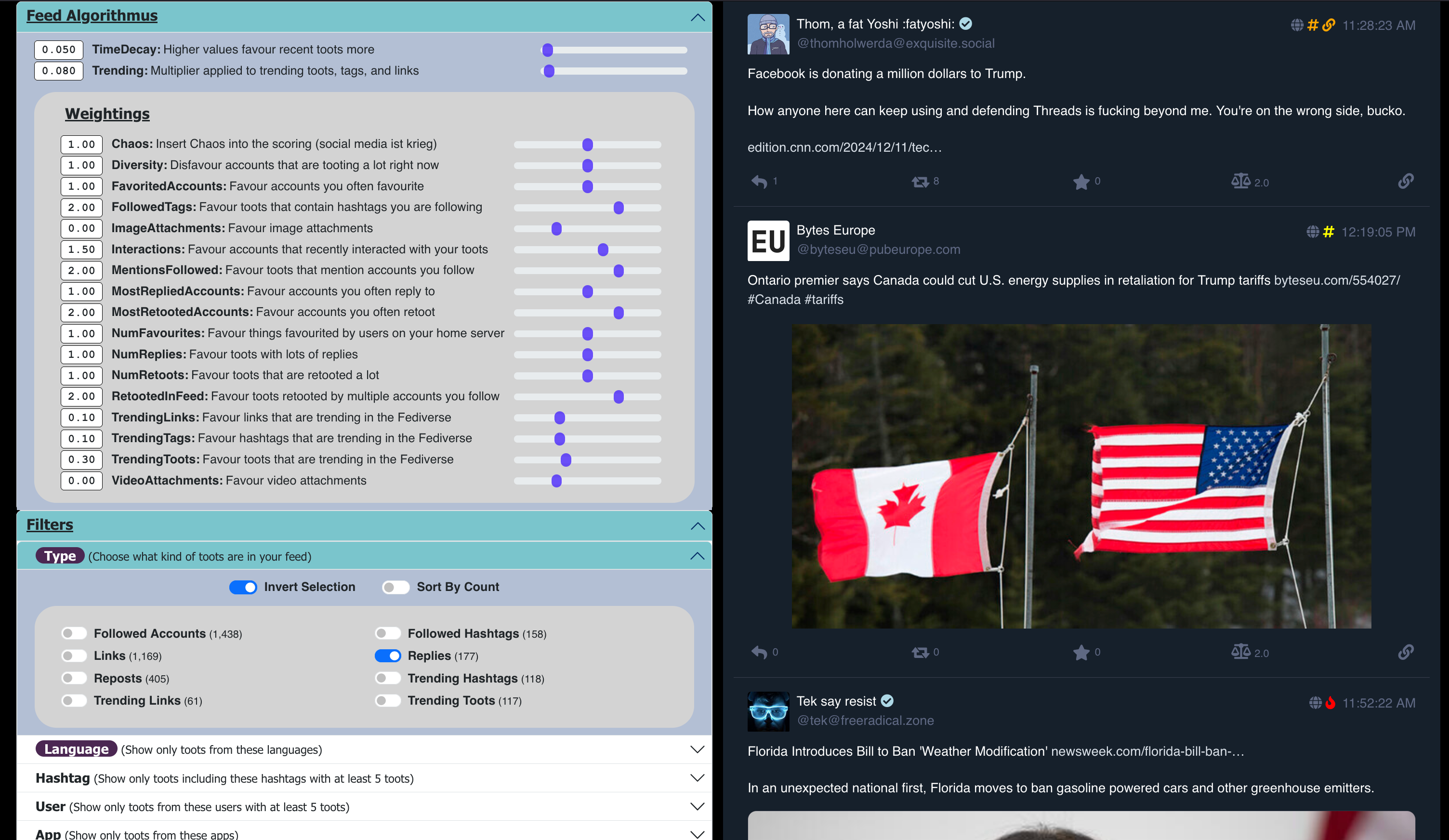
We talk a lot about the negative aspects of (sigh) "algorithms", but *this is a thing that "algorithms" can do too*, and in the absence of such a tool, we need to do it ourselves; it will not happen automatically, because there's no automation to do it.

Be the boost you want to see in the world.

0
1
0

This is a couple of days past, but I couldn't get my spoons together enough to write this till now.

Many of you know James Lopeman, mostly by the name of Meflin. He's a @ThePSFPython Software Foundation Fellow, been an Admin and Mentor for , and been around the open source world, quietly in the background as is his way, for many many a year.

Meflin passed somewhat suddenly on Wednesday the 16th.

It was natural causes nothing too crazy there.

He was the absolute pinnacle of why, we in the open source world, need to care more about the folks who don't code. Those that deal with infrastructure, or people, or anything else that isn't just the code. We are fundamentally better off with them in our communities.

So in his honor, go drink some tea, be a giant grump, and remind folks that "No. is a complete sentence".

In the words of Terry Pratchett:

GNU James "Meflin" Lopeman

Share around, because I think this is bigger than just him, but I think everyone needs to hear what he at least meant to me.

0
0
0
0
0
0
0
0
0
0
1
0
0
0
0
14
0
0
0
0
0
0
0
0
0

North County NUG #2
🗓 April 20, 2025 | ⏰ 18:00–20:00
📍 Windmill Food Hall, Carlsbad, CA
The North County Nix User Group is back! hether you're deep into NixOS or just curious about declarative development, you're warmly invited.

This is an open space for learning, tinkering, and sharing. Come as you are—curious, seasoned, or somewhere in between. Let’s build, break, and rebuild together.
northcounty.socal-nug.com/even

North Coubty NUG - April 20
0
0
0
0

보통 틱톡, 디시인사이드, X 등지에서 시작되거나 수입된 밈이 인스타그램 릴스로 넘어와서 전성기를 누리다가 인스타그램 일반 게시물, 유튜브로 넘어와서 노년기에 들어서고 방송에서 쓰이면서 죽임을 당한 다음에 정치인들이 장례를 치뤄주는 것 같음

0

As a first post on this account, I've decided to make an explanation on a compiler I'm writing. Please refer to my main account, @Giona_2, if you would like more information on it.

This post is meant to explain each module of my compiler (Optimizer, Tokenizer, Assembler). Each module will have a dedicated paragraph who were their originally their own posts, but I think it's a great way to kick off this first post

# Optimizer
The Optimizer is the most simplistic part of my compiler. It's job is to arrange the raw text file into a more readable format for the Tokenizer.

Essentially, it arranges the source code you wrote into an array where each word (keyword, number, symbol, etc) is it's own element. This allows the Tokenizer to iterate through each word more reliably than if it just read the raw text file verbatim.

# Tokenizer
The Tokenizer is arguably the most important module.

The Tokenizer takes the list generated from the Optimizer and iterates through each word. When it finds a keyword in the list, it goes through the following steps:
1. Finds the end of the declaration the keyword is indicating
2. Sends this full declaration to a function that'll parse it into a token

The final result is arranged as an array of tokens that emulates the steps the final executable must go through.

# Assembler
Finally, the Assembler is what's responsible for turning the token array generated by the Tokenizer and turning it into the final program.

All this does is iterate over each token in the array and translate it into its assembly-instruction equivalent.

This module, by far, is my favorite for one reason and one reason only: It's extremely volatile in the sense that it can turn the token array into pretty much anything you want Unimal to compile to.

0
0
0
0
0
0
0
2
1
1
0
0
0
0
0

There's been a lot of fretting recently—some of it from me—about there being Too Much Politics On Here, encouraging people to (A) stop posting so much about it and (B) post about other things. This is a valid concern but I want to take a moment to put a structural lens on this problem.

0
0

Nixers Newsletter is out!

Dive into topics like PulseAudioDB, OpenBSD routers, shell history improvements, and more.
It's a solid edition with a gem: “Get your own home bin”, something we probably all do already in our own special ways.

https://utcc.utoronto.ca/~cks/space/blog/sysadmin/MyPersonalProgramsSetup

→ Full issue: https://newsletter.nixers.net/entries.php#286

0
0