Motivation: Many games, especially RPGs, have a notion of "luck" which acts as a resource that players can draw from to modify die rolls. How can we make this "realistic"?
I'm fascinated by "plausible implausibility".
Stating things very informally:
Various theorems like Sanov's theorem tell you things like:
The probability that a bunch of draws from a distribution have an "extreme" empirical distribution different from the true distribution is given by the KL-divergence.
Similarly, if you know some truly preposterous sequence of draws lies in some extreme set it's most likely that the empirical distribution is at the point in the set closest to the original distribution - measured in the KL sense.
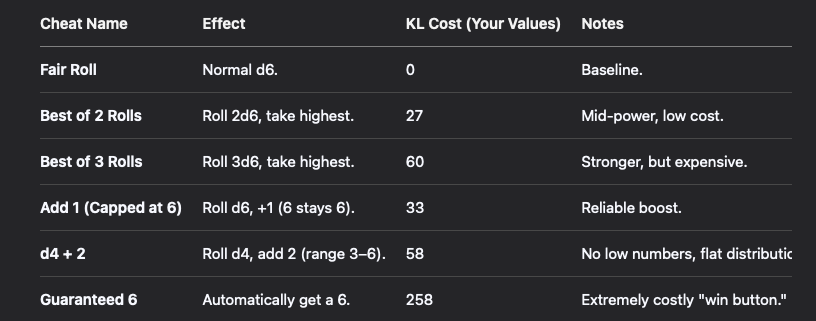
If you want to model "plausible luck" in a game you can make KL-divergence the resource. Here's the meta-rule you can apply to any game: give each player some "luck" at the start of the game, say 100. Any time they are about to roll (let's say d6) they're allowed to replace the uniform distribution with one of their choosing, but the price they pay will be 100 D(required distribution|uniform) (in bits).
Of course you don't make players calculate stuff. I've provided a convenient menu.
Choosing exactly 6 is expensive. Maybe they need to start with more points.
One interesting side effect of this is that if an observer is watching the die roll outcomes, but not the actual mechanics, it'll be hard to see that "luck" is being used.
There is, I think, some interesting non-trivial strategy for how best to use luck in any particular game. If the game is "get the highest sum of N dice" then you want to spread your luck out as much as possible.
(ChatGPT made the table but I did the computation myself.)

 GENKI
GENKI

 Evan Prodromou



 @reiver ⊼ (Charles)




 sublimer@あすてろいどん鯖管














 Emelia 👸🏻
 @
@
 Juntai Park









 12
12  : 4
: 4