What is Hackers' Pub?

Hackers' Pub is a place for software engineers to share their knowledge and experience with each other. It's also an ActivityPub-enabled social network, so you can follow your favorite hackers in the fediverse and get their latest posts in your feed.

9/

[Fediverse BackUp]

So, I think an (ActivityPub / ActivityStreams) Activity File COULD be a "good" format for backing-up a single post on the Fediverse, but —

Most (maybe all) extant Fediverse software would need to change a bit. Fediverse software would need to support embedding "everything" in a single Activity File (rather than referring to "everything" else by URLs).

.

0
0

"In the short term, a major collision is more akin to the Exxon Valdez oil spill disaster than a Hollywood-style immediate end of operations in orbit. Indeed, satellite operations could continue after a major collision, but would have different operating parameters, including a higher risk of collision damage."

This is why I did a poll here about name recognition for Exxon Valdez a few months ago! (You young'uns go read about it because many of you don't know)

One of the scariest parts of this project was learning more about Starlink's orbital operations. I had always assumed they had some kind of clever configuration of the satellites in the orbital shell that minimized conjunctions, and we would see the number of conjunctions grow over time in our simulations. But no! It's just random! There's no magic here, it's just avoiding collisions by moving a Starlink satellite every 2 minutes. This is bad.

0
0
0
0
0

How do you summarize how unsafe orbit is? This is where I get to tell you about my new favourite forced astronomy acronym, which I spent quite a while thinking about.

We needed a metric. I originally wanted to do something like "Kessler Countdown" or "Kessler Clock" but this isn't a countdown to Kessler Syndrome, it's just showing how bad things are in orbit, and how quickly they could get worse. So, our name for this metric is...

Collision Realization And Significant Harm: the CRASH Clock!

The CRASH Clock uses the current density in altitude bins (averaged over eccentric orbits) of satellites, rocket bodies, and tracked debris, assuming typical cross sections for each type and orbital speeds. This calculation tells us how long to a collision if all orbital maneuvers were to suddenly stop.

The CRASH Clock is currently* at 2.8 days.

In 2018 it was 121 days.

*This is actually for June 2025 because that's when we ran it. Will update soon!

0
0
0
0
0
0
0
0

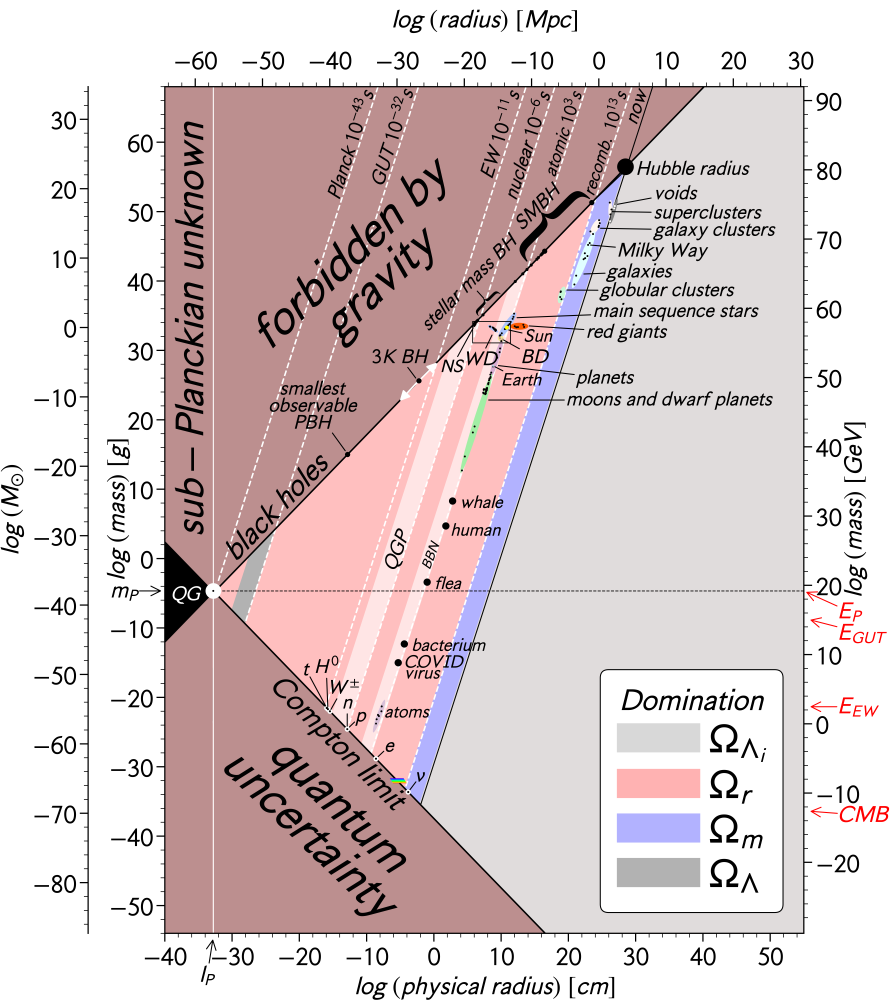
This chart shows all objects in the Universe, arranged by mass (vertical) and radius (horizontal).

The edge of the upper left corner is the "Schwarzschild radius" - anything along this edge becomes a black hole, so we don't expect stuff above and to the left of that.

The edge of the lower left corner is the "Compton wavelength" - anything here has a size so small that measuring its position that accurately would require enough energy to create a new one.

These two corners intersect in a white dot. This would be a black hole so small that it's heavily affected by quantum mechanics. By definition its mass would be the Planck mass, and its radius the Planck length. Nobody has seen such a thing.

The black region to the left of that dot, labeled "QG", contains imaginary objects that are more compressed than black holes, yet also ruled out by the uncertainty principle. So they're doubly impossible - unless Quantum Gravity, which we don't understand, changes the rules.

The pink strips of slope 3 are lines of constant density. For example "QGP" is the density of quark-gluon plasma, "BBN" is the density of the universe when Big Bang nucleosynthesis was going on, and so on.

The Earth is only slightly more dense than a flea.

The black dot labeled "Hubble radius" is the whole observable universe.

I like this chart a lot. It's from here:

C. H. Lineweaver and V. M. Patel, “All objects and some questions”, American Journal of Physics 91 (2023), 819-825. Free at pubs.aip.org/aapt/ajp/article-

A higher-resolution version is on Wikicommons:

commons.wikimedia.org/wiki/Fil

See the alt text for more!

Masses, sizes, and relative densities of objects in our Universe. The diagonal white dashed lines are lines of equal density. Gravity and quantum uncertainty prevent objects of a given mass from being smaller than their corresponding Schwarzschild radius or Compton wavelength. Schwarzschild black holes lie on the black m / r = 1 diagonal line which is the lower boundary of the “forbidden by gravity” region. The masses and Compton wavelengths of the top quark (t), Higgs boson (H), proton (p), electron (e), and neutrinos are plotted along the Compton (mr = 1) diagonal line. Among these, the top quark has the smallest Compton wavelength, because it has the largest mass: 173 GeV c^2. The smallest possible object is a Planck-mass black hole indicated by the white dot labeled “instanton”.  The smallest observable (not yet evaporated) primordial black hole (PBH) that could have survived until today has approximately the same size as a proton. The large low-mass black dot in the SMBH (supermassive black hole) range is the 4 x 10^6 solar mass black hole at the center of our galaxy, while the more massive large black dot is the black hole Ton 618. The dashed horizontal line emphasizes the orthogonal symmetry of black holes (m / r = 1) and particles (mr = 1). Our Universe is represented by the “Hubble radius” and has a mass and size that places it on the black hole line.
0
0
0

If you do not have jobs for juniors,

you won't have seniors for the jobs you need them for.

The use of llm-driven tools to eliminate junior-level jobs means you will not have senior-level candidates for the roles you need them for.

No llm is capable of the systemic understanding of projects that a senior developer needs to have.

If you are using llm tools instead of juniors and interns, you are shooting yourself in the foot.

restofworld.org/2025/engineeri

0
0
0
0
0
0
0

Dave Winer, @davewDave Winer ☕️ is basically the inventor of RSS and I take the chance to mention him as I am doing my best to be an RSS advocate with my own possibilities and limits, even with non-technical people who don't understand why I insist in "so complex things" when "commercial platforms give you everything in an instant".
I talked about ActivityPub and RSS during my last WordCamp, Pisa -Italy- 22nd November 2025. Italian, unfortunately; I'll share my talk when it's out on WordPress TV but I fear there won't be English subtitles.

But I limited what I wanted to say because a word could violate WordPress's code of conduct.
It's nothing obscene, it's the metaphoric name of an anchor-stone. But in Venice they call it "coion", like the vulgar word for testicle. It's basically a round stone structure which firmly anchors the arch of a bridge, to its vertical support. It's invisible to human eyes, people even don't know it exists. But it allows Venetian bridges to resist for centuries. It's fundamental. But if for a reason or another it becomes visible, it means that the bridge is damaged.
Same way of a linchpin for a wheel.

This word is even used for a person. When someone is essential for a community, determines its success too, but if they get attention or ask for visibility, they could even become an obstacle. Or they are treated as such. No idea if the word corresponding to "coion" for a person has the same idea in English. I have found "moron" but I don't know if it's the same.
Basically, when you are important and have not a very strong personality, so you let others treat you as invisible, they consider you as always available, always granted. And treat you badly if you raise your hand and say "I'm here too"; they immediately send you back to your place.

RSS is treated the same: many of commercial platform users don't even know about its existence but without RSS, no newspaper or whatever social pages sharing news automatically, could fetch contents.
I agree with Dave when he says that RSS is more important than ActivityPub. Simply RSS can work without ActivityPub but often not vice-versa.

0

@reiver@reiver ⊼ (Charles) :batman: @ezeno789ekZepp_Pf we do have the ability to moderate replies built into ActivityPub, though.

Every object has a `replies` collection that is owned and managed by the creator of the object. If you don't want someone's reply to appear in the list of replies, you can remove it.

Mastodon does not surface this feature. It also doesn't show the `replies` collection remotely. That's too bad; it would cover most of what people want from replies management.

0
0
0
0
0

Finally! After two days of work, I've managed to implement enough of MLS (Messaging Layer Security) to be able to create a new group with a single member, invite another member, then exchange an encrypted message.

I've worked on MLS two years ago, and at the time I got almost all of the test vectors working. This week-end I've fixed the remaining tests, implemented logic required to be an active client (generating groups and various messages), and wired everything up together.

A go-mls test passing with a successfully decrypted message
0
0
0
0

ok... I uploaded my one of my absolute favorite KISS100 mixes to my SoundCloud; it's chock full of warm chunky progressive house tracks, including the classic remix of Björk's "All Is Full of Love". Highly highly recommended...

soundcloud.com/quephird/osamu-

0
0

So, my polyfill for Translator API works quite well. But I don’t know how to reasonably make up-to-date, high quality language models easily available for users, without requiring gigabytes of disk storage to host, say, pl-fe. I don’t want to bring too much centralization by hosting a model registry in one place for all pl-fe/polyfill users or favoring a single pl-fe deployment.

RT: https://pl.fediverse.pl/objects/b0908627-8d73-4a15-babc-7d803866a523

0
0
0
0
0
0
0
0
0
0
0
0
0
8
0

folks, let's say I want to configure a CI build (perhaps a Github action) that uses the *MINIMUM* version of Python and dependencies specified in a pyproject.toml file for the test. I.E. to ensure that features not present in those versions aren't used in new code added to a library.

Is there already an easy way to do this?

0
0
0
0
0

Bondi Shooting

💔🗞️💔
"Police are investigating the people behind what is now one of Australia’s worst shootings with 12 people dead and dozens injured at Sydney’s Bondi Beach in a targeted attack on a Jewish event."
//
"A civilian has been labelled a hero after he snuck around a car to pounce on one of the shooters, wrangling the gun from his hands."
"The hero, since identified as Ahmed al Ahmed"
7news.com.au/news/bondi-beach-

0
0
0
0
0
0
0
0
0

"Ahmed al-Ahmad, a 43-year-old Muslim man identified by Australian media, tackled & disarmed one of the shooters in the Bondi Beach attack, in which 11 people were murdered at a Jewish holiday event on Sunday.

Ahmad, whose cousin told Australia's News 7 that he was shot once in the arm & once in the shoulder, is being hailed as a hero on social media.
....Ahmad is currently in surgery & expected to make a full recovery."

Jerusalem Post 14/12/25

A Muslim hero who risked his life saving Jews

0
0
0

Thinking about the conversation in the latest @djangochatDjango Chat Podcast about making it easier for people to test alpha versions of Django before they are released.

Test matrixes are normally how I've made sure that code works across multiple versions, via nox locally and in CI/CD (with a GitHub Action).

Creating a noxfile.py in django-new feels... presumptuous somehow? Also unsure about adding a GH Action for this…

Maybe circling the same thought process as I was thinking about for github.com/adamghill/troml/

0
0
0
0
0

@ezeno789ekZepp_Pf

Mastodon could become that. But, it would need to add some new features.

Mastodon has "editable posts". Which is great.

But Mastodon doesn't give you a "choice of home-feed algorithm" yet. Currently, Mastodon only support reverse-chron as its home-feed algorithm. (I.e., what some inaccurately call "no algorithm".)

And, Mastodon doesn't yet given users the "ability to moderate replies" to their posts.

@reiver@reiver ⊼ (Charles) :batman: @ezeno789ekZepp_Pf we do have the ability to moderate replies built into ActivityPub, though.

Every object has a `replies` collection that is owned and managed by the creator of the object. If you don't want someone's reply to appear in the list of replies, you can remove it.

Mastodon does not surface this feature. It also doesn't show the `replies` collection remotely. That's too bad; it would cover most of what people want from replies management.

0

RE: sfba.social/@fonts/11571928575

Yes yes yes:

"What if the web, and most websites besides the few obvious exceptions, were instead more like book publishing? A few thousand dedicated readers out there, at best."

I'd argue it already is and always has been :)

"And perhaps we should let our websites be small and private things once again."

0

The real disgrace in UK's welfare bill is that so much of it is spent on people in work. We are subsidising jobs that do not pay enough to live on. If we genuinely made sure work paid a decent living, then we would not have such a high bill.

0
0
0
0
0
0