What is Hackers' Pub?

Hackers' Pub is a place for software engineers to share their knowledge and experience with each other. It's also an ActivityPub-enabled social network, so you can follow your favorite hackers in the fediverse and get their latest posts in your feed.

We are excited to share that we are beginning work on a new onboarding experiment for : Default Server Recommendations.

Our intent for this experiment is to recommend the closest server geographically that is in the correct language during the sign-up flow. We will be running this experiment on our iOS and Android apps only to start.

1/6

0
0
2

I gave a talk: Package Management Learnings from Homebrew

Homebrew 5.0.0 released in 2025. Walk through the major changes in 5.0.0, improving expectations based on other package managers and what they can learn from Homebrew's approach.

mikemcquaid.com/talks/package-

0
0

Privacy Guides' Program Director @jonahJonah Aragon gave an amazing speech last night in our weekly livestream!

It's a truly moving speech,
and an incredibly important statement in our current troubled times.

Fighting for privacy rights is a battle for human rights. Nobody lives in a vacuum.

We must build our communities to fight collectively 💛✊

Please watch it: youtube.com/watch?v=BQ5_4Li9Gsc

0
0
0
0
1
0
0
0
0
0

Holocaust history

We learn the history of the Holocaust not just to remember the victims, but to prevent it from happening again. “Never again” is a call to ceaseless, eternal action. It is a call to recognize the trajectory of genocide •before• we reach the worst, to recognize that we are still in those precious years before, and to recognize that a Final Solution is coming again, unless •we• stop it.

And the way we stop it is not by making the concentration camp guards sit through a Powerpoint deck on de-escalation.

4/

0

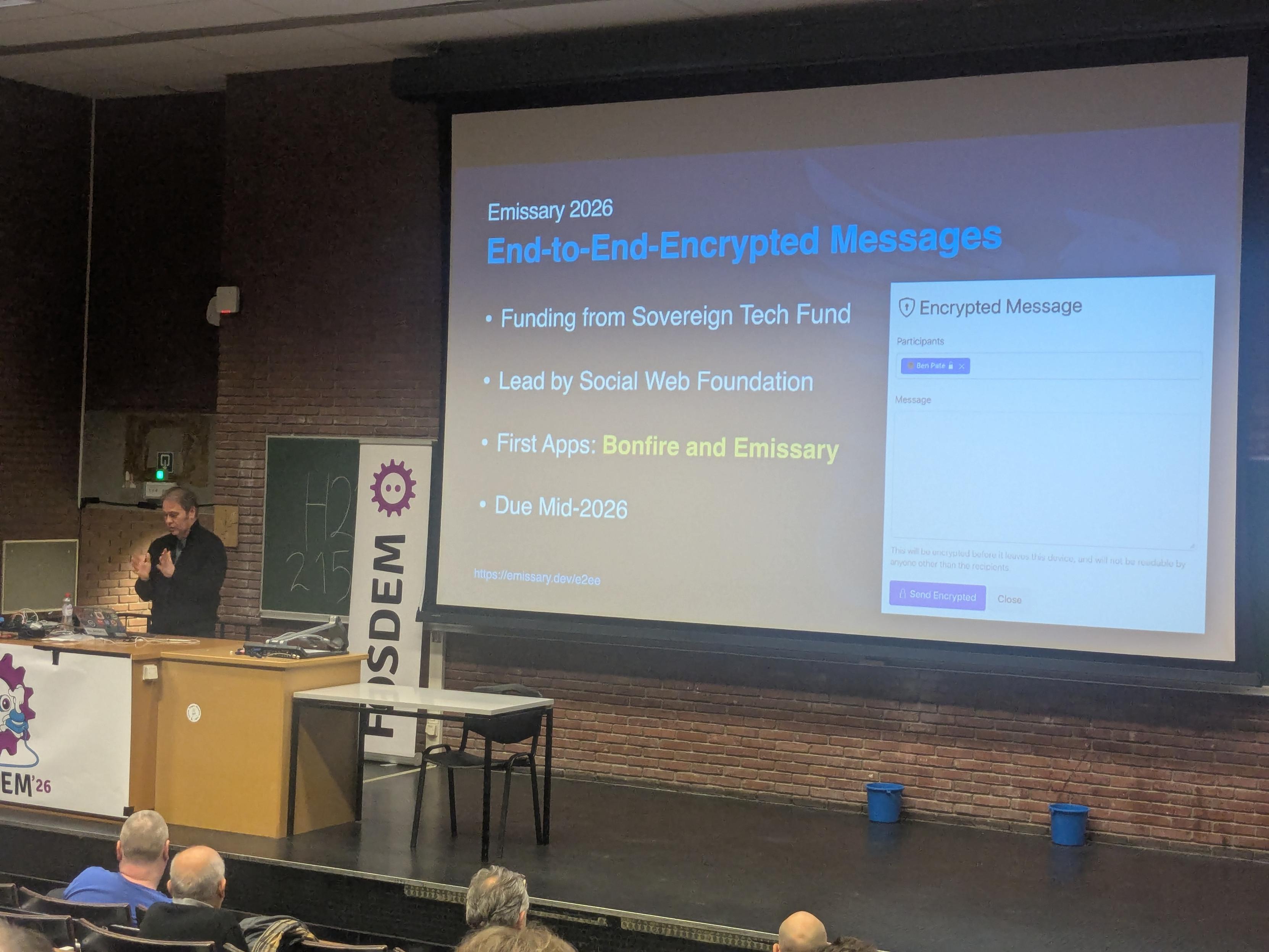
An absolutely awesome talk from @benpateBen Pate 🤘🏻 and highlighting just how early we all are in the journey of the Fediverse as a whole.

The LOLA data portability standard from W3C sounds really awesome and I really hope we see this sort of standard adopted across the fedi as it helps solve one of the bigger pain points where your posts are stuck on the instance you write it on.

There's a whole load of other really good points that again continue to align with the sorts of feedback I see regularly about "why fedi will never be mainstream" and the more talks I'm listening to today, the more confident I am things will become more mainstream and easier to adopt for those new to the network.

0
0

Sagt mal 🏍️-Fahrende, wenn ich Camping-Zeug (Zelt, Feldbett, Klapptstuhl, was auch immer) auf dem Sozius bzw. über dem Seitenkoffer festmachen will, reichen wirklich Gurte mit so Klips-Schnallen (z.B. Rok Straps oder so), oder Ratschenzurrgurt und fertig?

0
0
0
0

Had my exit interview with the new (started 4 days ago) CTO yesterday. Things that stood out:

1. He was surprised to learn that lines of test code should outnumber lines of actual code.
2. He suggested that if he defines a spec and gives that to a code generator, then it would be useless to have the same code generator generate all these unit tests.
3. He couldn’t understand why the number of tests would explode if he intended to thoroughly test the application at the highest level only, ie the output of his code generator.
4. Concepts he looked up during our chat: Testing Pyramid, DDD, Clean Architecture.
5. He studiously avoided saying AI, talking only about a mythical code generator that would unerringly translate his presumably complete spec to code.

Anyway, is it time yet to start a consultancy to help companies fix the problems caused by the parrot?

0
0

First time attending after having been at a few different chaos associated events. The event seems to have a very different, much more technical atmosphere in my very limited experience. There seems to be a strong focus on sharing knowledge. Speakers in the devrooms often revered to people in attendance, it felt like rooms contained active members of the rooms topic.
Different to / but equally nice. I will have to attend more things outside of chaos too.

0
0
0
0

just now realizing that while "Ozymandias" is conventionally read as a parable about the fleeting nature of power, it works just as well as a manifestation of the orientalist need for the middle east to be a history-less tabula rasa ready to be overwritten by western colonialist expansion. i would say "in this essay," but i looked it up and of course there is already a bunch of scholarship about this!

0
0
1
0
0
0

You can limit the depth of the displayed datasets in the "zfs list" output
using the -d parameter. To display only the first level of datasets below
mypool/usr and not the ones deeper than those, run this command:

zfs list -d 1 mypool/usr

-- Benedict Reuschling <bcr@FreeBSD.org>

0

It has been so long since I ran a that I don't even remember which BSD it was. (I could probably dig up that info...)

Circa 20 years ago I used to run BSD gateway/router machines.

I think I'd like to do this again, for a variety of reasons.

But which BSD should I run for this kind of network gateway. It won't host any applications, it won't be a NAS, it'll purely be network/gateway... it'll have the telco router on one side, internal network on another, and one or two DMZ/separate type networks (one for hosting external facing things like Mastodon, the other for untrusted IoT stuff.) It'll run dhcp, dns, and probably be a VPN endpoint.

I do not want to run some specialist gateway adapted customised thing with dashboards etc, just want a plain vanilla OS. (And no bullcrap like containers, docker, etc. Just an OS running on a physical box.)

So, what OS should I run on my network gateway: , ,

0
0
0
0
0
0
0
1
0
0
0
0
0
0
0

Idly reflecting a bit this morning, and realizing that one of the key insights that I bring to a consulting engagement is the in-depth observation "you could write a computer program to do this"

0
1
0

Weird realization: when I help people online, I often talk like ELIZA, repeating back the asker's phrases as a question. That simple program was able to mimic empathy and fool people at the time.

Q: How can I find the try/except around my code?
Me: Why do you say there's a try/except around your code?

0