Comprehensive Hegemony or Deterrence Balance: War Scenarios After the Assault on Iran
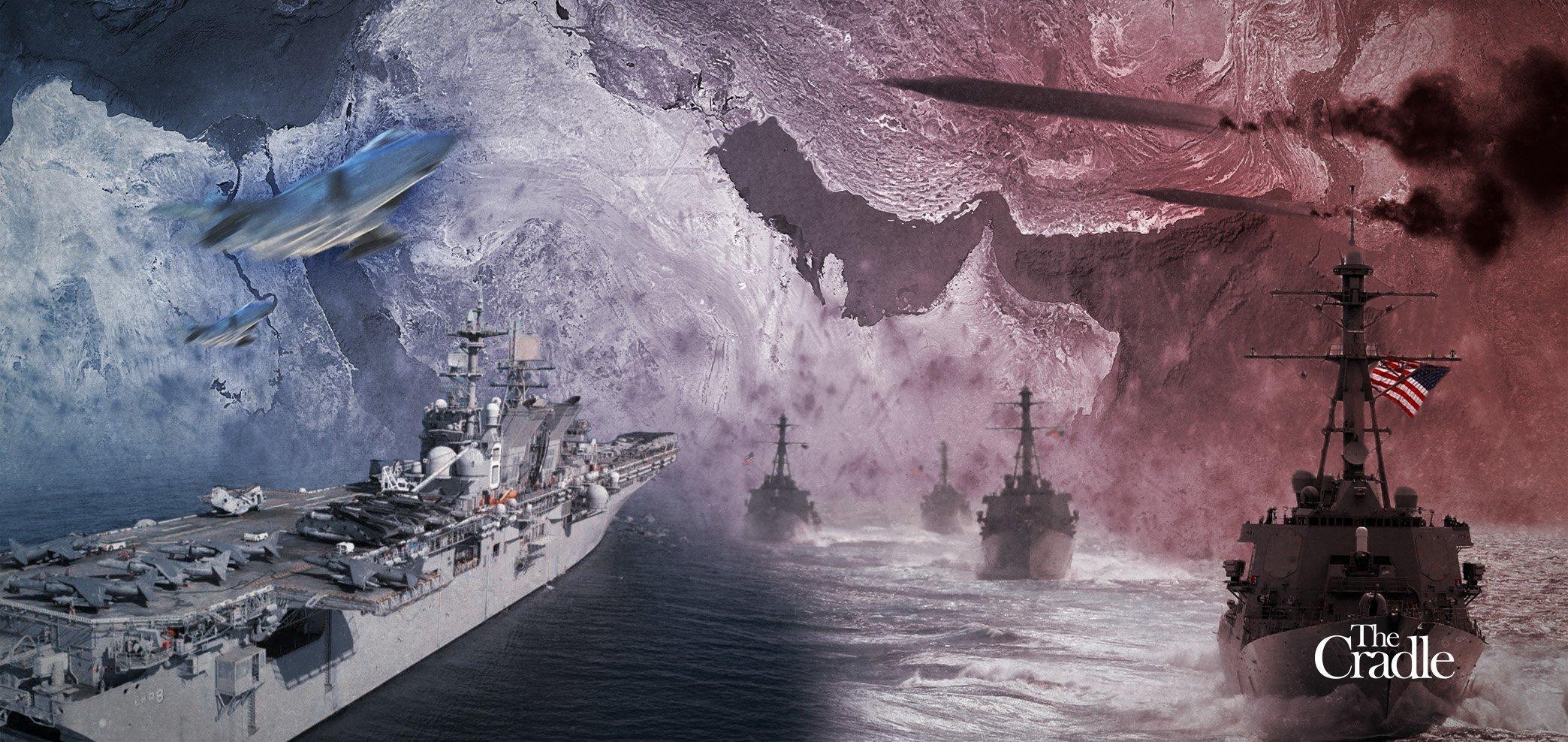
On 28 February 2026, West Asia crossed a red line that had hovered over the region for years, one that diplomats spoke of in cautious tones and military planners gamed out in closed rooms. The US, in full operational coordination with Israel, launched a wide-scale military assault against the Islamic Republic of Iran, targeting the core of its sovereign leadership, its strategic deterrent capabilities, and the infrastructure underpinning both.
Within hours, Tehran responded with cross-border missile strikes against US bases across the Persian Gulf and deep inside occupied Palestine, transforming what Washington had framed as a decisive preventive blow into the opening phase of a regional war Iran had long warned would follow any direct aggression against its territory.
The confrontation quickly moved beyond rhetoric and symbolic retaliation, altering the strategic temperature of the entire region from the very first hours.
Decapitation doctrine: Shock, assassination, and infrastructure strikes
The assault – named “Operation Roaring Lion” by Israel and referred to in Washington as “Operation Epic Fury” – began in the early hours with more than 200 fighter jets, including F-35 aircraft, launching from multiple regional bases under US naval cover in the Arabian Sea.
The sequencing of targets, the depth of penetration, and the use of heavy bunker-buster munitions reflected a clear operational doctrine: decapitate the leadership, sever command networks, and disable retaliatory capacity before it could be fully mobilized.
The first wave focused explicitly on what Israeli and US planners consider the “head of the pyramid.” Sovereign sites in Tehran were struck in rapid succession.
Bombardment hit the Sayyid Khandan district and University Street, targeting Beit al-Rahbari – the complex of Supreme Leader Ali Khamenei – alongside the presidential palace and parliament building. Squadrons of F-35s executed concentrated raids against the security perimeter along Pasteur Street, deploying heavy penetrating munitions designed to collapse hardened underground structures.
By dawn on 1 March, Iranian state television interrupted programming to announce the martyrdom of Ayatollah Khamenei following the destruction of his residence and adjacent command centers. Reports confirmed the killing of senior figures who had been attending an emergency meeting of the Supreme Defense Operations Room, including Defense Minister Brigadier General Aziz Nasirzadeh, senior Revolutionary Guard commanders, the chief of staff, intelligence officials, and the secretary of the Supreme National Security Council.
The assault sought to hollow out what Washington and Tel Aviv viewed as the decision-making core of the Islamic Republic in a single, overwhelming stroke.
Strikes extended well beyond leadership targets. Facilities in Isfahan, Karaj, and Qom linked to uranium enrichment and ballistic missile storage were hit in coordinated waves. Air defense systems were targeted in an attempt to blind and disorient Iran’s layered deterrent shield.
Israeli Army Radio later described roughly 500 objectives as having been struck, including sensitive command installations and missile depots associated with the Revolutionary Guard.
Civilian casualties followed the military onslaught. In the southern city of Minab, an airstrike destroyed the Shajareh Tayyebeh (“Good Tree”) girls’ elementary school, killing over 175 students and injuring dozens. Images from the site circulated rapidly across Iranian media, reshaping the internal political atmosphere. The massacre hardened public resolve, framing the confrontation not as an abstract strategic dispute but as a national trauma with generational consequences.
True Promise 4: Expanding the battlefield
Iran’s response did not unfold over days of deliberation. Less than an hour after the initial assault and only two hours into the bombing campaign, the Islamic Revolutionary Guard Corps (IRGC) announced the launch of “True Promise 4.” The operation marked a decisive and historic escalation: direct targeting of US military installations across West Asia.
Missiles struck the headquarters of the Fifth Fleet in Juffair, Bahrain, a symbol of Washington’s maritime dominance in the Persian Gulf. Al-Udeid Base in Qatar – one of the largest US air installations in the region – was hit, alongside facilities in the UAE, Kuwait, Jordan, and Harir Base in Iraq’s Kurdistan region.
For the first time, Tehran formally placed the entire network of US forward-deployed infrastructure within its declared battlefield, erasing the long-assumed distinction between Israeli targets and American ones.
Iranian Foreign Minister Abbas Araghchi clarified that the response targeted the “sources of aggression,” stressing that Tehran did not consider host states to be the enemy but viewed US bases on their soil as American sovereign extensions. Secretary of the Supreme National Security Council Ali Larijani reinforced this framing, stating that these bases constitute American territory regardless of geography. Essentially, any platform used to attack Iran would be treated as part of the war.
Simultaneously, hundreds of ballistic missiles and drones were launched toward occupied Palestine. Sirens sounded in Jerusalem, Tel Aviv, and Haifa. Despite interception attempts, direct hits were recorded on military installations and strategic facilities, forcing the occupation government to declare a state of maximum emergency and relocate settlers into shelters.
The aura of strategic immunity that had surrounded both US bases and Israeli depth for decades was punctured in a matter of hours.
With the ceasefire already violated by Tel Aviv, Hezbollah, a central pillar of the Axis of Resistance, launched coordinated rocket and drone attacks from south Lebanon toward military targets inside occupied Palestine, signaling that Iran would not stand alone on the battlefield.
The strikes marked the most serious escalation on the Lebanese front since the 2024 war, immediately transforming the crisis into a multi-front confrontation. Tel Aviv responded with heavy airstrikes on south Lebanon and the southern suburbs of Beirut – Dahiye – targeting resistance infrastructure, logistical hubs, and suspected command sites.
The bombing of Beirut reinserted Lebanon directly into the war equation, potentially operationalizing the ‘Unity of Fronts’ doctrine long articulated by the Axis of Resistance. With Hezbollah’s entry, the conflict ceased to be a bilateral US–Iran exchange and instead evolved into a regional confrontation, as the late Khamenei had predicted last month, with overlapping theaters stretching from the Persian Gulf to the eastern Mediterranean.
Washington’s regime-change push and Tel Aviv’s agenda
Politically, Washington and Tel Aviv presented the assault as a strategic necessity rather than an act of escalation. US President Donald Trump declared the objective to be the permanent elimination of what he called the Iranian nuclear threat, openly tying the operation to regime change and urging Iranians to “take control” of their country.
He issued an ultimatum to the IRGC to lay down arms or face destruction, offering immunity to those who complied. The messaging made clear that the assault was not confined to centrifuges and missile depots but aimed at the political core of the Islamic Republic itself.
Israeli Prime Minister Benjamin Netanyahu described the attack as a historic opportunity to reshape West Asia. Israeli security officials framed it as a preemptive strike against Iran’s nuclear ambitions, emphasizing tactical surprise and the breadth of targets struck. For Tel Aviv, the operation aligned with a broader strategic vision in which normalization projects and regional integration initiatives are secured by overwhelming military dominance.
Tehran’s response was equally unequivocal. Iranian officials declared that the era of strategic patience had ended and characterized the assault as political and military suicide for the US–Israeli alliance. Official sources signaled the closure of the Strait of Hormuz to international navigation, a move that immediately rattled global energy markets.
Amid escalating tensions, the IRGC announced it had targeted multiple oil tankers in the Strait of Hormuz and the Gulf, as maritime authorities in Bahrain and Oman reported vessel strikes, casualties, and heightened naval alerts – marking a shift from symbolic retaliation to direct maritime confrontation.
Scenario one: Comprehensive war and systemic rupture
The first and most dangerous trajectory is full regional war. In this scenario, Iran escalates from base targeting to enforcing a comprehensive shutdown of oil exports from the Persian Gulf. A temporary closure of the Strait of Hormuz could become a sustained blockade backed by naval mines, anti-ship missile batteries, and asymmetric maritime tactics. Oil prices could surge beyond $200 per barrel, amplifying global economic fragility and placing immense strain on energy-dependent economies.
With Hezbollah already engaged and the Lebanese front active, Israel would confront simultaneous pressure from Iran, Lebanon, Yemen, and Iraq. The activation of the Unity of Fronts doctrine would stretch Israeli military capacity and compel Washington to consider direct intervention across multiple arenas to shield its principal regional ally.
US bases in Bahrain, Qatar, Kuwait, the UAE, and Iraq would become fixed targets under continuous threat, transforming symbols of projection into liabilities.
Such escalation would test the durability of Washington’s regional architecture. Projects built on the premise of Israeli military supremacy – including normalization tracks and integration corridors – could unravel under sustained fire. Instead of containing Iran, comprehensive war could entrench Tehran and its allies as an unbreakable regional force, accelerating the shift toward a multipolar order in which Russian and Chinese influence expands at the expense of Atlanticist dominance.
Scenario two: Harsh equilibrium under new rules
A second possibility rests on restored deterrence after mutual shock. If Washington calculates that further escalation risks unsustainable military and political losses, and Tehran judges its message sufficiently delivered, an undeclared truce may emerge.
Under such conditions, the US–Israeli camp would frame disruption of Iran’s nuclear trajectory as a strategic achievement while stepping back from explicit regime change. Iran would treat direct strikes on US bases and Israeli depth as proof that western immunity has ended. The confrontation would recede into a new phase of shadow warfare governed by harsher, more permissive rules of engagement.
Yet Hezbollah’s re-entry complicates any swift de-escalation. Multi-front engagement reduces the likelihood of rapid bilateral understanding. Missile exchanges, cyber operations, targeted assassinations, and calibrated strikes could become semi-regular signaling mechanisms. The region would inhabit a persistent gray zone, neither full-scale war nor stable peace, with economic stability perpetually exposed to flare-ups.
Scenario three: Sustained war of attrition
Tehran may instead opt for prolonged attrition designed to erode the logic of US presence without triggering overwhelming retaliation. Rather than granting Washington a pretext for infrastructure devastation, Iran and its allies could raise costs incrementally.
Under this approach, every US base becomes a fortified installation under intermittent fire from drones and missiles. Hormuz and Bab al-Mandab could face periodic disruptions sufficient to unsettle markets without imposing a total shutdown.
Israel would likely intensify assassinations and covert operations, deepening cycles of retaliation. Hezbollah’s sustained engagement from Lebanon would further stretch Israeli military bandwidth and air defense capacity.
Over months, the steady drain on munitions stockpiles, interceptor systems, and defense budgets could erode the strategic rationale of forward deployment. Yet attrition also imposes internal pressure on Iran and Lebanon alike. Sustained confrontation under tightened embargoes demands economic resilience, social cohesion, and political stability. External actors would seek to exploit any internal fractures.
Scenario four: Decisive shock and rapid recalculation
A final trajectory contemplates rapid strategic rupture. One hypothesis envisions the initial assault successfully paralyzing Iranian command structures and forcing sweeping concessions on nuclear and missile programs. Yet the speed and breadth of Iran’s retaliation, conducted despite the loss of senior leadership figures, complicate that assessment.
The alternative centers on an unexpected US setback. A direct hit on a major naval asset, destruction of a central command hub such as the Fifth Fleet headquarters, or disabling strikes on multiple bases could generate domestic backlash in Washington sufficient to compel immediate recalibration. If Israel were subjected to sustained precision fire threatening core infrastructure, US policymakers would confront the risk that continued war jeopardizes their principal regional anchor.
source: The Cradle
https://abolitionmedia.noblogs.org/?p=29243
#aggression #imperialism #iran #palestine #westAsia
 🇨🇦
🇨🇦  dansup



 @
@






 一般 Kyungmi Ahn ꉂꉂ(ᴖᗜᴖ*)




 ikuturso
 (
(

 Chee Aun 🤔






 MJ+
MJ+












 @3/23(日)
 東京オフ主催
  オフ
オフ









 @
@