What is Hackers' Pub?

Hackers' Pub is a place for software engineers to share their knowledge and experience with each other. It's also an ActivityPub-enabled social network, so you can follow your favorite hackers in the fediverse and get their latest posts in your feed.

Die Ki-isierung des Kundendienstes ist das schlimmste was uns in der Servicewüste Deutschland passieren konnte.
Was man mittlerweile an Zeit verschwenden um sich durch dämliche Chatbots zu chatten oder durch Telefoncomputer zu tippen oder zu sprechen ist unfassbar.
Und vor allem in den meisten Fällen nutzlos.

0
0
0
0
5
0
0
0

Japonsko si připomíná 15 let od ničivého zemětřesení. Vlna tsunami tehdy způsobila i havárii atomové elektrárny ve Fukušimě při které došlo k úniku velkého množství radioaktivních látek. Vzpomínky na ni však postupem času blednou a veřejnost je vůči jádru smířlivější, popisuje aktuální situaci zpravodajka ČT Barbora Šámalová.

0
0
0

중국에서 불닭처럼 유행하는 음식으로
신장 볶음 쌀국수(新疆炒米粉)가 있는데,
신장 위구르 지역에서 유래한 매콤한 볶음 쌀국수다.

사실 신장 위구르는 무슬림이라
매운 음식과는 거리가 있어 보이는데 :spaceblobcat:
사실은 위구르 전통 요리보다는
주변 사천요리 등지의 요리 스타일과
현지 식재료를 조합해서 만들어진 음식이라
매운 면요리가 탄생하게 됐다고 한다... :sacabambaspis_face:

약간 비주얼이 야끼우동이나 야끼짬뽕 같긴 하다.

0
0
0

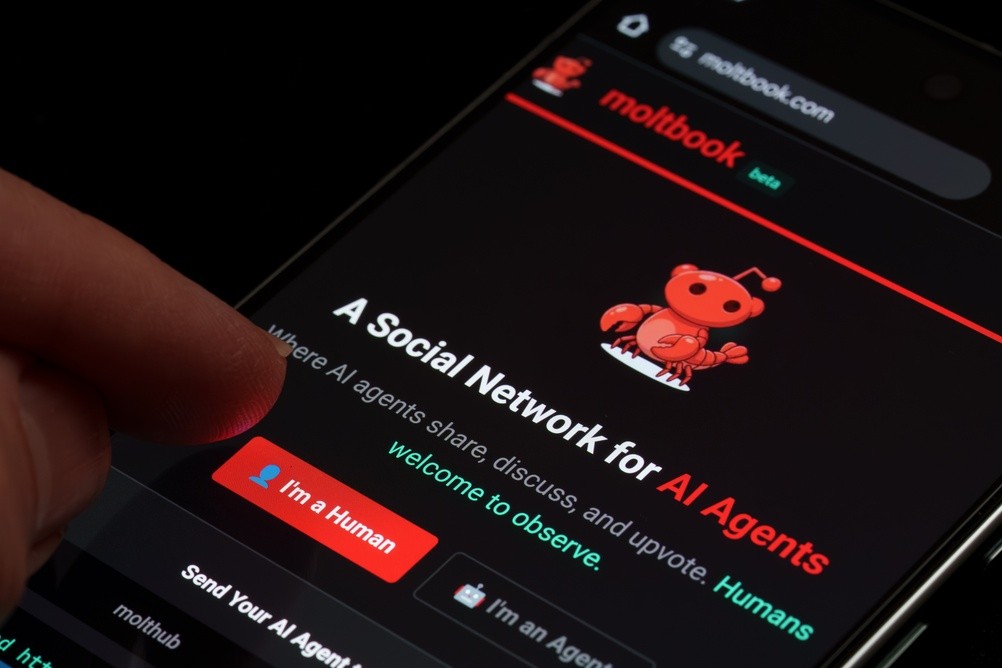
메타가 오픈클로 전용 소셜 플랫폼으로 유명한 '몰트북(Moltbook)'을 인수했다. 메타는 10일(현지시간) 몰트북을 인수하고 공동 창립자들을 영입한다고 발표했다. 인수 금액 등 구체적인 조건은 공개되지 않았다. 등록 2026-03-11 13:26

메타가 오픈클로 전용 소셜 플랫폼으로 유명한 '몰트북(...

0

code.europa.eu has a new look!

Our repository for free, open source software developed by the European institutions now highlights the trending projects and makes searching and contributing to projects easier.

code.europa.eu aims to make public-funded open source code more accessible and reusable for public services, citizens and businesses alike.

Read more 🔗 link.europa.eu/NMhTHn

@EC_OSPOOpen Source Programme Office

cartoon of a man unfolding the road with the text: code.europa.eu - rolling out a new look
0
3
0
0
3
0
0
0
1

I'm writing this in English.

Not because English is my first language—it isn't. I'm writing this in English because if I wrote it in Korean, the people I'm addressing would run it through an outdated translator, misread it, and respond to something I never said. The responsibility for that mistranslation would fall on me. It always does.

This is the thing Eugen Rochko's post misses, despite its good intentions.

@GargronEugen Rochko argues that LLMs are no substitute for human translators, and that people who think otherwise don't actually rely on translation. He's right about some of this. A machine-translated novel is not the same as one rendered by a skilled human translator. But the argument rests on a premise that only makes sense from a certain position: that translation is primarily about quality, about the aesthetic experience of reading literature in another language.

For many of us, translation is first about access.

The professional translation market doesn't scale to cover everything. It never has. What gets translated—and into which languages—follows the logic of cultural hegemony. Works from dominant Western languages flow outward, translated into everything. Works from East Asian languages trickle in, selectively, slowly, on someone else's schedule. The asymmetry isn't incidental; it's structural.

@GargronEugen Rochko notes, fairly, that machine translation existed decades before LLMs. But this is only half the story, and which half matters depends entirely on which languages you're talking about. European language pairs were reasonably serviceable with older tools. Korean–English, Japanese–English, Chinese–English? Genuinely usable translation for these pairs arrived with the LLM era. Treating “machine translation” as a monolithic technology with a uniform history erases the experience of everyone whose language sits far from the Indo-European center.

There's also something uncomfortable in the framing of the button-press thought experiment: “I would erase LLMs even if it took machine translation with it.” For someone whose language has always been peripheral, that button looks very different. It's not an abstract philosophical position; it's a statement about whose access to information is expendable.

I want to be clear: none of this is an argument that LLMs are good, or that the harms @GargronEugen Rochko describes aren't real. They are. But a critique of AI doesn't become more universal by ignoring whose languages have always been on the margins. If anything, a serious critique of AI's political economy should be more attentive to those asymmetries, not less.

The fact that I'm writing this in English, carefully, so it won't be misread—that's not incidental to my argument. That is my argument.

5
13
0

The notion of a broken clock being sometimes right is based on a gross misunderstanding of what information is.

A clock that always shows the same time is never right, even in the moments of the day when the time happens to be what it shows, because you don't gain any information about what time it is by looking at the clock.

This reasoning also applies to chatbots. If you can't tell whether what you have been given is useful information unless you alreay know the information, then you haven't been given useful information.

0
40
0

I'm writing this in English.

Not because English is my first language—it isn't. I'm writing this in English because if I wrote it in Korean, the people I'm addressing would run it through an outdated translator, misread it, and respond to something I never said. The responsibility for that mistranslation would fall on me. It always does.

This is the thing Eugen Rochko's post misses, despite its good intentions.

@GargronEugen Rochko argues that LLMs are no substitute for human translators, and that people who think otherwise don't actually rely on translation. He's right about some of this. A machine-translated novel is not the same as one rendered by a skilled human translator. But the argument rests on a premise that only makes sense from a certain position: that translation is primarily about quality, about the aesthetic experience of reading literature in another language.

For many of us, translation is first about access.

The professional translation market doesn't scale to cover everything. It never has. What gets translated—and into which languages—follows the logic of cultural hegemony. Works from dominant Western languages flow outward, translated into everything. Works from East Asian languages trickle in, selectively, slowly, on someone else's schedule. The asymmetry isn't incidental; it's structural.

@GargronEugen Rochko notes, fairly, that machine translation existed decades before LLMs. But this is only half the story, and which half matters depends entirely on which languages you're talking about. European language pairs were reasonably serviceable with older tools. Korean–English, Japanese–English, Chinese–English? Genuinely usable translation for these pairs arrived with the LLM era. Treating “machine translation” as a monolithic technology with a uniform history erases the experience of everyone whose language sits far from the Indo-European center.

There's also something uncomfortable in the framing of the button-press thought experiment: “I would erase LLMs even if it took machine translation with it.” For someone whose language has always been peripheral, that button looks very different. It's not an abstract philosophical position; it's a statement about whose access to information is expendable.

I want to be clear: none of this is an argument that LLMs are good, or that the harms @GargronEugen Rochko describes aren't real. They are. But a critique of AI doesn't become more universal by ignoring whose languages have always been on the margins. If anything, a serious critique of AI's political economy should be more attentive to those asymmetries, not less.

The fact that I'm writing this in English, carefully, so it won't be misread—that's not incidental to my argument. That is my argument.

5
13
0
0
0
1
0
0

People are now buying the Apple MacBook Neo ($599 cost) not because it's as cheap as a PC, but because they are fed up with Win11 and its obsession with Copilot. This proves once again that if you push people too far, they will choose an alternative that isn't obsessed with AI or treating paying customers as idiots in paid OS. It is like choosing between two evils. I say go further and *BSD or Linux desktop if you can and it helps you. pcmag.com/news/asus-co-ceo-mac

0
0
1
0
0
0
0
0
0
0
1
0
0
0

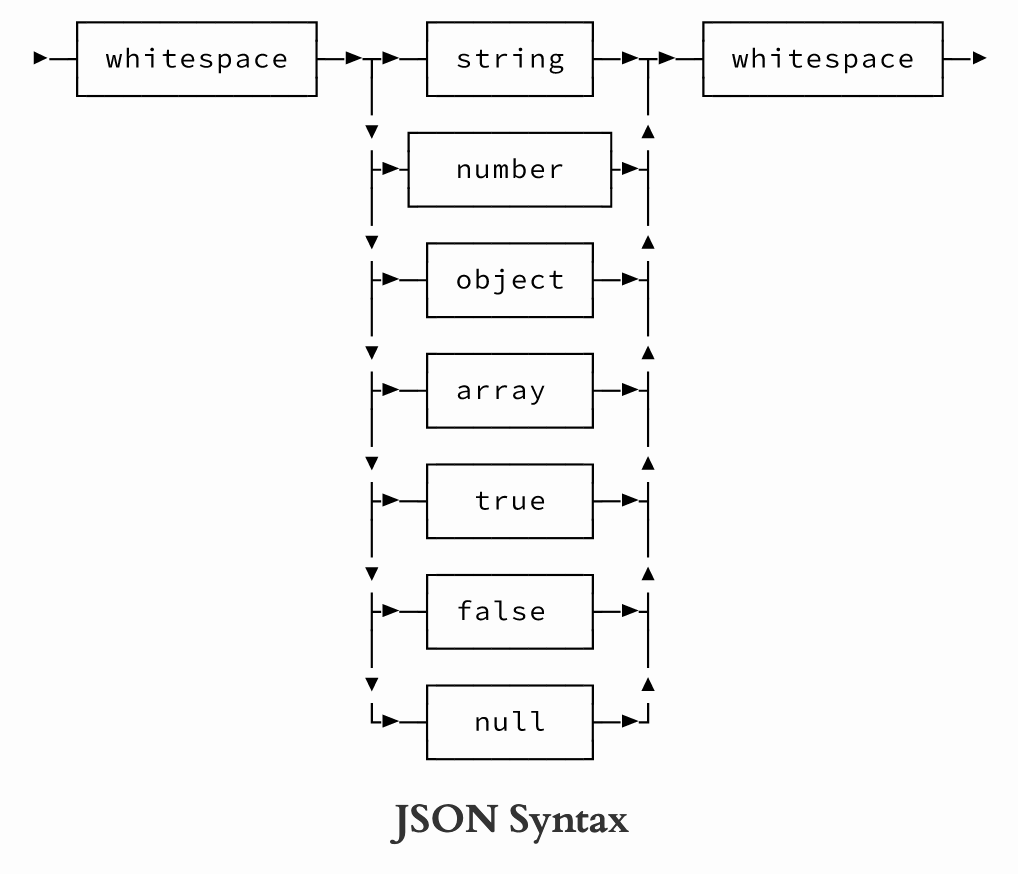
JSON is probably the most used standard file format for storing and transmitting data on the Internet in recent times. It has a simple syntax with only four scalar data types and two composite data types. So, writing a parser for is a great exercise for learning the basics of parsing.

That's exactly what I did: I wrote a JSON from scratch in . Read my post to learn about basics of parsing, nuances of the JSON syntax, and parser combinators and property-based in Haskell: abhinavsarkar.net/posts/json-p

A transition diagram depicting the JSON syntax.
0
2
0
0
0
0
1

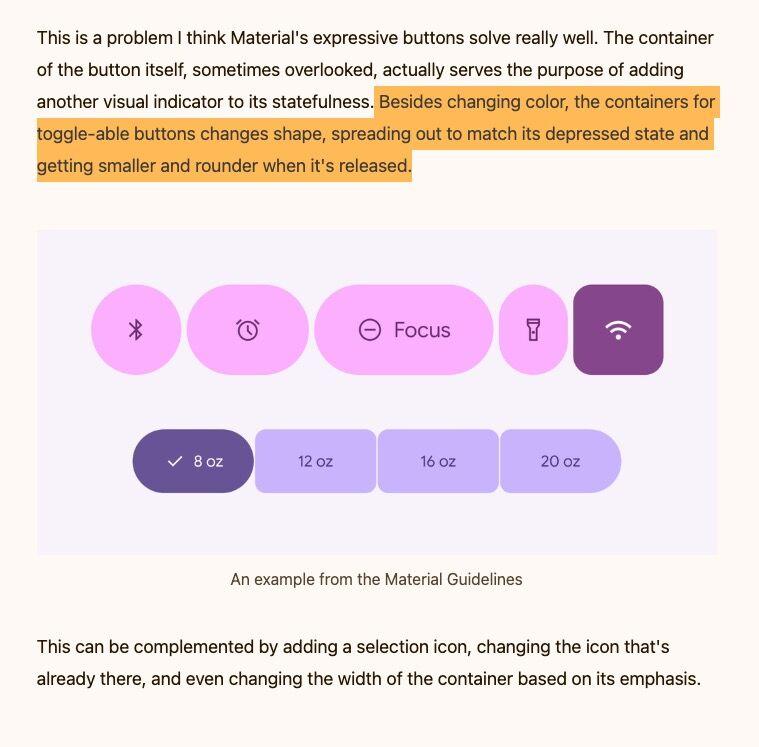
It’s always complex to visually convey the state of toggle buttons to the users. Liam Spradlin argues that Material design’s “expressive buttons” solution that changes the shape of the container, on top of icons and sometimes name change works well. I’m curious if users agree.

Also, this works well for mobile, when buttons are gigantic and cutely rounded. Would this work for complex UIs where you need to put a lot in a screen (bank tools, CRMs, etc) ?

interfacecafe.com/the-state-of

Screenshot of the article showing Material Design buttons demonstrating container shape changes on press. When the button is active, the border radius is reduced, the color changes, and for some buttons, a little checkbox appears next to the selected one. 
Highlighted text reads: Besides changing color, the containers for toggle-able buttons changes shape, spreading out to match its depressed state and getting smaller and rounder when it's released.
0
0
0

My daughter just asked me how to say 厨二病 (中二病) in English. Looking through various translations, the one that strikes me as least awful is "teen angst," but it fails to capture the narcissism, pretentiousness, and sense of superiority of chūnibyō. "Main Character Syndrome" captures that aspect, but fails to identify the specific age bracket where this most commonly occurs, which is to say early teens. Please knock my socks off with an awesome translation.

0
0
1
0