Search results

My partner is looking for work. I'd appreciate boosts.

He's looking to move into , but will accept short or contracts (<12 months). Location: Melbourne Australia, or remote. For a short enough contract he'd go anywhere though.

He's a senior full stack web dev (Linux/python/django/js/elm, ~12 years).

Experienced in dev ops, dev sec ops and automation (ansible, selenium, etc etc).

He has experience with OWASP ZAP, bandit and Snyk, and is part way through the PortSwigger academy.

FOSS contributions include writing a django authentication function for OWASP ZAP, making a wrapper to improve accessibility and usability for selenium (Elemental), and other bits and bobs.

He isn't on any socials, but if you want to get in touch I can share his email or signal ID (or give him yours).

He and I have been the security people for little apps without any dedicated security team, for the last decade or so. If you're in security you might have met him (or me) at conferences (Disobey, BSides, CCC, Defcon and Ruxmon), because we've been attending since we launched our own app in 2014, picking up everything we can to protect our users.

(Yep, he is aware a move to security from senior dev roles will be a step down in seniority and $. He just really likes security.)


0
3
0
0
0
0

Amazon service (AWS) was taken down by AI coding bot named Kiro

futurism.com/artificial-intell

In one incident in December, engineers at AWS allowed its in-house Kiro “agentic” coding tool to make changes that sparked a 13-hour disruption, according to four sources familiar with the matter. The AI, ill-fatedly, had decided to “delete and recreate the environment,” the sources said.

@nixCraft This is wild. AI coding tools need guardrails — especially in production. We're building developer APIs where AI agents can test endpoints safely before touching anything real. The "move fast and break things" era of AI-assisted coding needs better sandboxing.

0

Amazon service (AWS) was taken down by AI coding bot named Kiro

futurism.com/artificial-intell

In one incident in December, engineers at AWS allowed its in-house Kiro “agentic” coding tool to make changes that sparked a 13-hour disruption, according to four sources familiar with the matter. The AI, ill-fatedly, had decided to “delete and recreate the environment,” the sources said.

0

I guess I should do an

I do , specifically , but and are close enough.

I love C# . I can tolerate . I'm interested in . I'm into and . I'm really into the nature of the systems we build.

I'm a .

I like , , and factory/city builder and 4X games. I also like and and various other nerd stuff.

0
0

I've been writing software since the early 90s. Mainly stack and cloud, but I dabble in all sorts of languages and platforms. These days I'm really focused on , , and all things software process - mainly with GitHub, but use what works for you!

I'm based in 🌏 but I travel a bit and I'm "very online". I've worked remotely for about 10 years.

My handle is @damovisaDamian Brady 🥑 :github_logo: just about everywhere.

Hi! Glad to be here! 😊

0

Hi. I'm Saket from the Netherlands.

He/him.

I believe is key to our survival.

Fascists, racists, TERFs, misogynists, etc., give me a wide berth (ideally so wide you fall off the edge of your platform into open-mindedness)

I'm interested in conversations with thoughtful conversationalists on topics such as: , , , , , , , , , , , , , ,

0
1
0
0
2
0

I’m currently looking for a full-time or contract work in SRE / DevOps / IT Operations.
Portland, OR. Open to hybrid, on-site, or remote. Willing to relocate to Seattle.
Schedule: Any

Tools: Python, Bash, PowerShell, Terraform, Jenkins, Puppet, Ansible, Splunk, Grafana, BigPanda
CI/CD: Jenkins, Bitbucket, container builds with Docker/Podman, deployments to Openshift.

I have worked as an IT Operations Engineer in enterprise production environments, supporting on-prem VMware (RHEL and Windows) alongside Azure and AWS. My role included on-call rotations and incident command for high-severity outages.

My responsibilities included monitoring, alert triage, and root cause analysis across infrastructure and application layers, coordinating with infrastructure, development, and product teams to isolate failures, restore service, and prevent recurrence.

My focus was developing Python tooling for automation and production support, with Ansible used for routine infrastructure tasks.

I worked extensively with Splunk, Grafana, and BigPanda, building dashboards for investigation, event correlation, and metrics and trends.

Additional experience includes:

Terraform for cloud provisioning and Puppet for configuration enforcement

Network troubleshooting across Cisco and Arista environments

Production database support: Oracle, SQL Server, MongoDB, Postgres

My DM’s are open! Feel free to message me for my resume.

Git: github.com/Aleph0x
Web: al3f.com

0
0

Yellow
So maybe it's time to present myself.
I'm a fighting on everyday life for a world with less, I mean less work, less troubles, less cops, less bosses, less priests, less consuming, less drama, less empty buildings, less rich people.

yeah, you the rich are the cancer of this world, fck you RICH people, you consume way too much.

and I want more, of course I want more... I want more music, more culture, more friends, more beer, more weed, more life, more water, more plants, more trees, more animals, etc...

And I have this very pessimistic view of humanity, which is slowly changing with the raise of on my life, gives me hope on , on , on , on becoming

nice to be here with all of u. and fck microsoft, because finally we are enough :)

youtube.com/watch?v=SnYfytuReMU

0
0
0
0
0
0

System Administration, Week 2: Physical Disk Structure

We'll take a quick look at what a hard disk drive actually looks like. This helps us understand addressing schemes such as CHS and LBA, what physical aspects affect hard disk performance, as well as partitioning requirements. While a lot of this is tied to old magentic-spinning-platters drives, it explains a lot of assumptions partitions and file systems make even if using SSDs.

youtu.be/HqjxRrhspFo

System Administration, Week 2: Partitions

In this video, we talk about how to divide a single disk -- physical or virtual -- and how the partitions relate to the physical structure of the disk. We show examples partitioning disks on NetBSD, OmniOS, and Linux using the disklabel, fdisk, and format tools.

youtu.be/vmL9ZUh_j2U

0

System Administration, Week 2: Storage Virtualization

In this video, we cover the concept of storage virtualization -- combining individual disks into larger storage pools and utilizing resources from such a pool. This includes a discussion of RAID and some of the different supported levels as well as Logical Volume Management (LVM). We further illustrate some of these properties by example of ZFS.

youtu.be/tw-QTAoYU9w

System Administration, Week 2: Physical Disk Structure

We'll take a quick look at what a hard disk drive actually looks like. This helps us understand addressing schemes such as CHS and LBA, what physical aspects affect hard disk performance, as well as partitioning requirements. While a lot of this is tied to old magentic-spinning-platters drives, it explains a lot of assumptions partitions and file systems make even if using SSDs.

youtu.be/HqjxRrhspFo

0

System Administration, Week 2: Devices and Interfaces

This segment discusses common storage device interfaces, including SCSI, ATA, SSD, Fibre Channel, and hinting at storage configurations like JBOD and RAID, which we'll get back to in the next video. At this point, it feels a bit dated, and I may skip it going forward and perhaps expand more on enterprise storage, but then again, it's only 10 minutes of your time.

youtu.be/C5PXWFFP31A

System Administration, Week 2: Storage Virtualization

In this video, we cover the concept of storage virtualization -- combining individual disks into larger storage pools and utilizing resources from such a pool. This includes a discussion of RAID and some of the different supported levels as well as Logical Volume Management (LVM). We further illustrate some of these properties by example of ZFS.

youtu.be/tw-QTAoYU9w

0

System Administration, Week 2: Storage Models and Disks

In this video, we'll introduce the larger topic of filesystems and storage. In particular, we'll discuss the conceptual storage models, such as Direct Attached Storage (DAS), Network Attached Storage (NAS), Storage Area Networks (SANs), and Cloud Storage.

youtu.be/w-wfCe7Yb68

System Administration, Week 2: Devices and Interfaces

This segment discusses common storage device interfaces, including SCSI, ATA, SSD, Fibre Channel, and hinting at storage configurations like JBOD and RAID, which we'll get back to in the next video. At this point, it feels a bit dated, and I may skip it going forward and perhaps expand more on enterprise storage, but then again, it's only 10 minutes of your time.

youtu.be/C5PXWFFP31A

0

System Administration, Week 1: Warmup Exercise 1 - No Space Left On Device

In this video, we try to find out what happens when we run out of disk space as well as how the system behaves when use up all inodes. This is intended as a warmup exercise for our week 2 topic, introducing the concept of disk storage and filesystem behavior.

youtu.be/eyRNL6fGDM8

System Administration, Week 2: Storage Models and Disks

In this video, we'll introduce the larger topic of filesystems and storage. In particular, we'll discuss the conceptual storage models, such as Direct Attached Storage (DAS), Network Attached Storage (NAS), Storage Area Networks (SANs), and Cloud Storage.

youtu.be/w-wfCe7Yb68

0

System Administration, Week 1: AWS Aliases

System Administrators are notoriously lazy, and AWS commands a notoriously lengthy to type. In this video, we demonstrate the use of shell aliases and functions to save ourselves some typing whenever we run AWS EC2 commands.

youtu.be/fnWdB20_OoY

The aliases and shell functions we use are available here:
github.com/jschauma/cloud-func

System Administration, Week 1: Warmup Exercise 1 - No Space Left On Device

In this video, we try to find out what happens when we run out of disk space as well as how the system behaves when use up all inodes. This is intended as a warmup exercise for our week 2 topic, introducing the concept of disk storage and filesystem behavior.

youtu.be/eyRNL6fGDM8

0

System Administration, Week 1: AWS Aliases

System Administrators are notoriously lazy, and AWS commands a notoriously lengthy to type. In this video, we demonstrate the use of shell aliases and functions to save ourselves some typing whenever we run AWS EC2 commands.

youtu.be/fnWdB20_OoY

The aliases and shell functions we use are available here:
github.com/jschauma/cloud-func

0
0

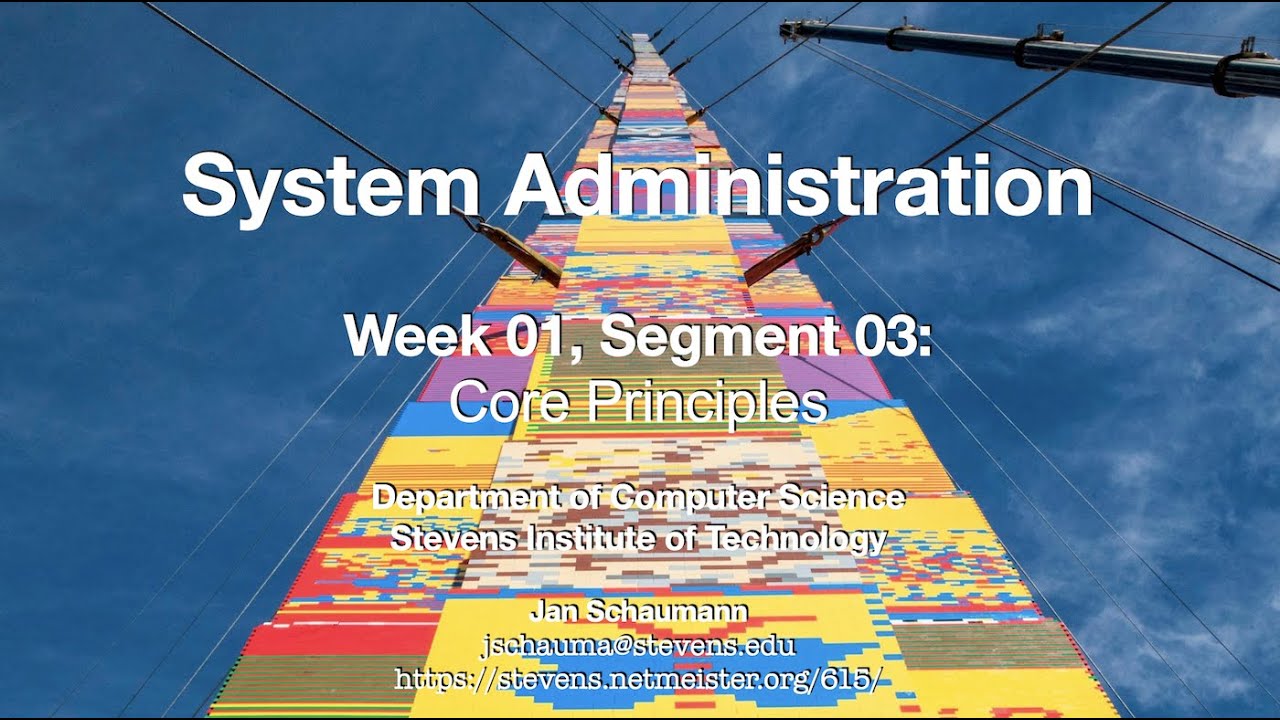
System Administration, Week 1: Core Principles

In this video, we present a few core principles that will guide us throughout the semester: Scalability, Security, and Simplicity. We'll also get to know a few basic "laws", well known by any System Administrator. If you're wondering what all this has to do with Legos, please tune in...

youtu.be/bfqP6PlS6Og

System Administration, Week 1: UNIX History

We're borrowing this video from our "Advanced Programming in the UNIX Environment" class to give a brief summary of the history of the UNIX family of operating systems.

youtu.be/3H7SQWTR6Dw

0

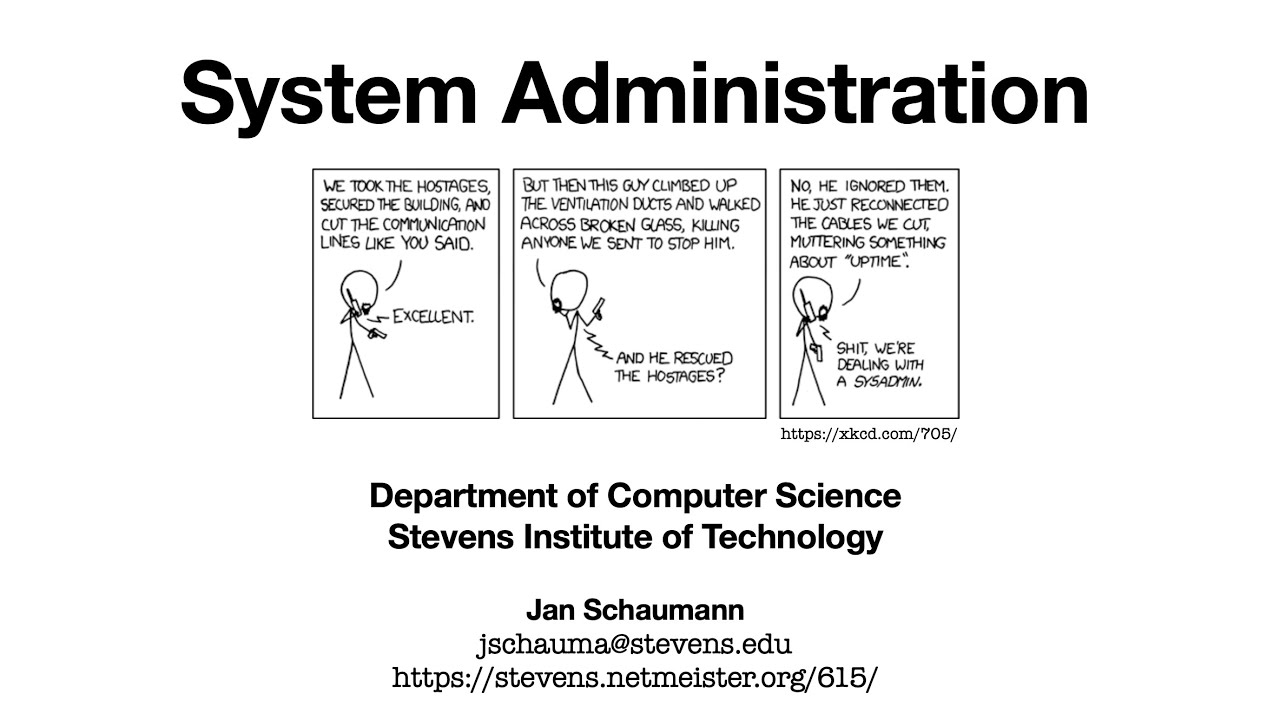
System Administration, Week 1: The Job of a System Administrator

In this video, we try to capture the job of a System Administrator. We show what things SysAdmins may encounter in their day to day routine, ranging from blade servers and routers to cable ties and power tools and everything in between. As we try to define the job, we find out it's not quite that easy...

It's duct tape and WD40 all the way down.

youtu.be/osIO9CbqHQo

System Administration, Week 1: Core Principles

In this video, we present a few core principles that will guide us throughout the semester: Scalability, Security, and Simplicity. We'll also get to know a few basic "laws", well known by any System Administrator. If you're wondering what all this has to do with Legos, please tune in...

youtu.be/bfqP6PlS6Og

0

System Administration, Week 1: Introduction

In this video, we cover a number of administrative issues relating to our course: we discuss why and how System Administration is covered in an academic Computer Science curriculum and outline the course syllabus.

youtu.be/QJL5cNv9dJs

System Administration, Week 1: The Job of a System Administrator

In this video, we try to capture the job of a System Administrator. We show what things SysAdmins may encounter in their day to day routine, ranging from blade servers and routers to cable ties and power tools and everything in between. As we try to define the job, we find out it's not quite that easy...

It's duct tape and WD40 all the way down.

youtu.be/osIO9CbqHQo

0

This semester, I'm teaching my class on System Administration / Internet Operations once again.

The syllabus and all course materials are available here:

stevens.netmeister.org/615/

All videos for the lectures and exercises are public and available for free on YouTube:

youtube.com/c/cs615asa/videos

If you want to follow along, I'll be posting lecture videos and related links in this thread throughout the semester.

System Administration, Week 1: Introduction

In this video, we cover a number of administrative issues relating to our course: we discuss why and how System Administration is covered in an academic Computer Science curriculum and outline the course syllabus.

youtu.be/QJL5cNv9dJs

0