Search results

I just moved instances, so it's time for an

Hi! I'm Jim, a.k.a. Nuncio Bitis

I'm a Software Engineer, dad, and husband to a great guy who I've been married to for 10+ years (together 20+ years)

I love tinkering with electronics. I'm as comfortable with a soldering iron as I am writing C++ classes and bash scripts. I've worked on some really cool projects in the past - military radios (implemnented the Frequency Hopping mode designed by Hedey Lamar for the Black Hawk helicopter radios), GPS satellites, PATRIOT radar, several medical devices. I have a few of my own -based projects at home.

I love reading SciFi and horror/thriller books (Isaac Asimov, Larry Niven, etc, Agatha Christie, Stephen King, Dean Koontz, ...)
I'm here mostly for the cat pix meow.

0
0
0
0
0

Replaced two RaspberryPi 3s that were running dnscrypt-proxy and this Gotosocial instance with a single RaspberryPi 5 (4GiB) running Debian, and hosting a OpenBSD VM for dnscrypt and a FreeBSD VM for Gotosocial.

It's performing exceptionally well with an nvme drive for storage.

Adding a fan to the top blowing air in decreases the operating template by 17degress C, down from 57 to 40 even under modest load.

#raspberrypi #linux #openbsd #freebsd #bsd #gotosocial

A RaspberryPi 5 in a purple 3D printed case. A black fan is attached to the top with a obsda.ms sticker on the side.
0

Thinking of getting a new raspberry pi. Should I get a model 4 or 5? The 4 would still work with my existing USB power adapter and it has an audio jack that I might wanna use. Any downsides Iโ€™m overlooking? Iโ€™d like to host some web-services. Maybe even mastodon. But sure thereโ€™ll be more tasks Iโ€™ll throw on it as time goes by. Home assistant, kodi, jukebox โ€ฆ

0
0

Dear fellow or potential fellow gotosocial instance admins,
I've come up with a novel way to set up a #gotosocial server behind a reverse proxy, which avoids the use of making new firewalling rules - both on a VPS, and creating port forwarding on one's home router. This method is ideal for minimizing the cost of running one's own #ActivityPub/#Mastodon server, in a way that leverages inexpensive fast storage on the backend (say, on a #RaspberryPi 5, 2GB of RAM, with an NVMe). As many valiant and praiseworthy Mastodon server admins might attest to, renting cloud VPS' can cost a lot, especially when storing many tens or hundreds of GB of user data.

My method avoids the need of forwarding ports 443 and 80 into one's home LAN, using DNAT (on the VPS) and port forwarding (on one's home router). In a nutshell, it's a novel use of #Wireguard, in conjunction with #nginx on the frontend, and gotosocial on the backend. This can save the cost of renting a dedicated VPS, to get the exclusive use of ports 443 and 80, in conjunction with static IPv4 and IPv6 addresses. My method optimizes on reliability and cheapness, but it's not the most secure - decryption and re-encryption happens on the VPS, before the data travels down the Wireguard tunnel. This exposes the data to any underlying hypervisor at one's hosting company. So full disclosure there.

I've run my method by the helpful gotosocial furries in their #Matrix Help chatroom (and I'm grateful for their help to debug subtle warts the method had), and got their blessing, at least to the technical soundness of the method.

I have a testing instance of gotosocial 0.21.0 set up with this new method: https://g.toque.im

I'm the user @owlG Toque, the Owl on that instance, should you wish to befriend me there.

I'll make a longer blog post on this in the days to come, and post it in a reply to this post. (This is a cross-post of the original:)
https://autistics.life/@d1/116142628225937092

#DevOps #Linux #infosec #SelfHosting #DataSovereignty #OpenSource

0

A few years ago I designed a way to detect bit-flips in Firefox crash reports and last year we deployed an actual memory tester that runs on user machines after the browser crashes. Today I was looking at the data that comes out of these tests and now I'm 100% positive that the heuristic is sound and a lot of the crashes we see are from users with bad memory or similarly flaky hardware. Here's a few numbers to give you an idea of how large the problem is. ๐Ÿงต 1/5

0

More news out of : Edge Impulse Studio is now fully integrated in the Arduino App Lab, the IDE that lets you write programs that can make use of both the application-class Linux-based and real-time microcontroller chips on the Arduino UNO Q.

For AI.

No, wait, come back! It's the good kind! Machine learning! You can use it to train machine learning models on your own ethically-sourced data and run them entirely on-device.

hackster.io/news/arduino-bring

0

Finally got around to updating my router (new hardware) pairing it together with an AP, funnelling everything through a separate zero running

Bonus: my Raspberry Pi 400 is now setup with OpenBSD's httpd / relayd - ready to host all of my web projects locally!

That was sure a lot of buzz words...I'll gather my detailed thoughts and breakdown everything into a blog post soon ๐Ÿ˜„

0
0
0
0

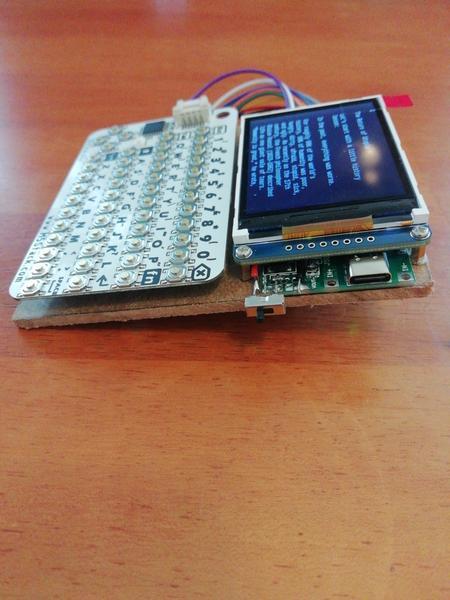
First prototype of my powered by a Zero. Unlike my previous tablet designs, this one is aimed at low power for extended battery life, focussing on command-line use. It will be used mainly for reading ebooks/websites, e-mail, SSH, note-taking and some coding fun. It could work well as a too. It has a 2000mAh battery under the keyboard providing 13 hours of continuous reading time. Next I need to design and print a coverโ€ฆ tobykurien.com/post-1769934638

0
0
0
0
0
0
0
0
0

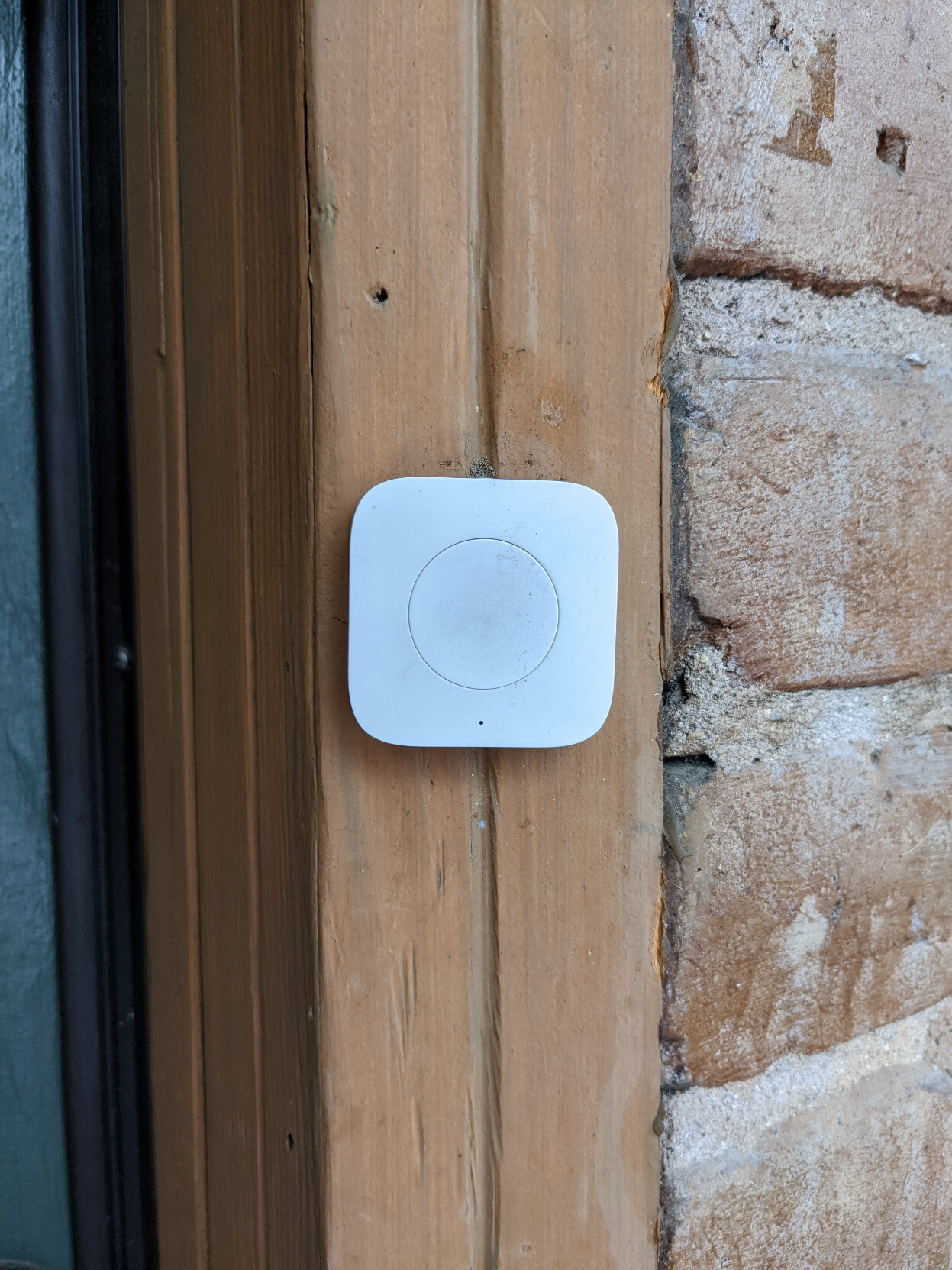
Okay, so let me tell you about my doorbell, from a perspective.

When you push the button by the door, it sends a message over the wireless mesh network in my house. It probably goes through a few hops, getting relayed along the way by the various Zigbee light switches and "smart outlets" I have.

Once it makes it to my utility closet, it's received by a Zigbee-to-USB dongle, through a USB hub (a simple tree network) plugged into an SFF PC. From there, it gets fed into zigbee2mqtt, which, as the name implies, publishes it to my local broker.

The mqtt broker is in the small cluster of nodes I run in my utility closet. To get in (via a couple of switch hops), it goes through , which is basically a proxy-ARP type service that advertises the IP address for the mqtt endpoint to the rest of my network, then passes the traffic to the appropriate container via a veth device.

I have , running in the same Kubernetes cluster, subscribed to these events. Within Kubernetes, the message goes through the CNI plugin that I use, . If the message has to pass between hosts, Flannel encapsulates it in VXLAN, so that it can be directed to the correct veth on the destination host.

Because I like for automation tasks more than HomeAssistant, your press of the doorbell takes another hop within the Kubernetes cluster (via a REST call) so that NodeRed can decide whether it's within the time of day I want the doorbell to ring, etc. If we're all good, NodeRed publishes an mqtt message (more VXLANs, veths, etc.)

(Oh and it also sends a notification to my phone, which means another trip through the HomeAssistant container, and leaving my home network involves another soup of acronyms including VLANs, PoE, QoS, PPPoE, NAT or IPv6, DoH, and GPON. And maybe it goes over 5G depending on where my phone is.)

Of course something's got to actually make the "ding dong" sound, and that's another Raspberry Pi that sits on top of my grandmother clock. So to get *there* the message hops through a couple Ethernet switches and my home WiFi, where it gets received by a little custom daemon I wrote that plays the sound via an attached board. Oh but wait! We're not quite done with networking, because the sound gets played through PulseAudio, which is done through a UNIX domain socket.

SO ANYWAY, that's why my doorbell rarely works and why you've been standing outside in the snow for five minutes.


A nondescript round white button (a doorbell) mounted on a vertical wood member. To the left a part of a door is visible, and to the right, bricks.
0
0
0
0

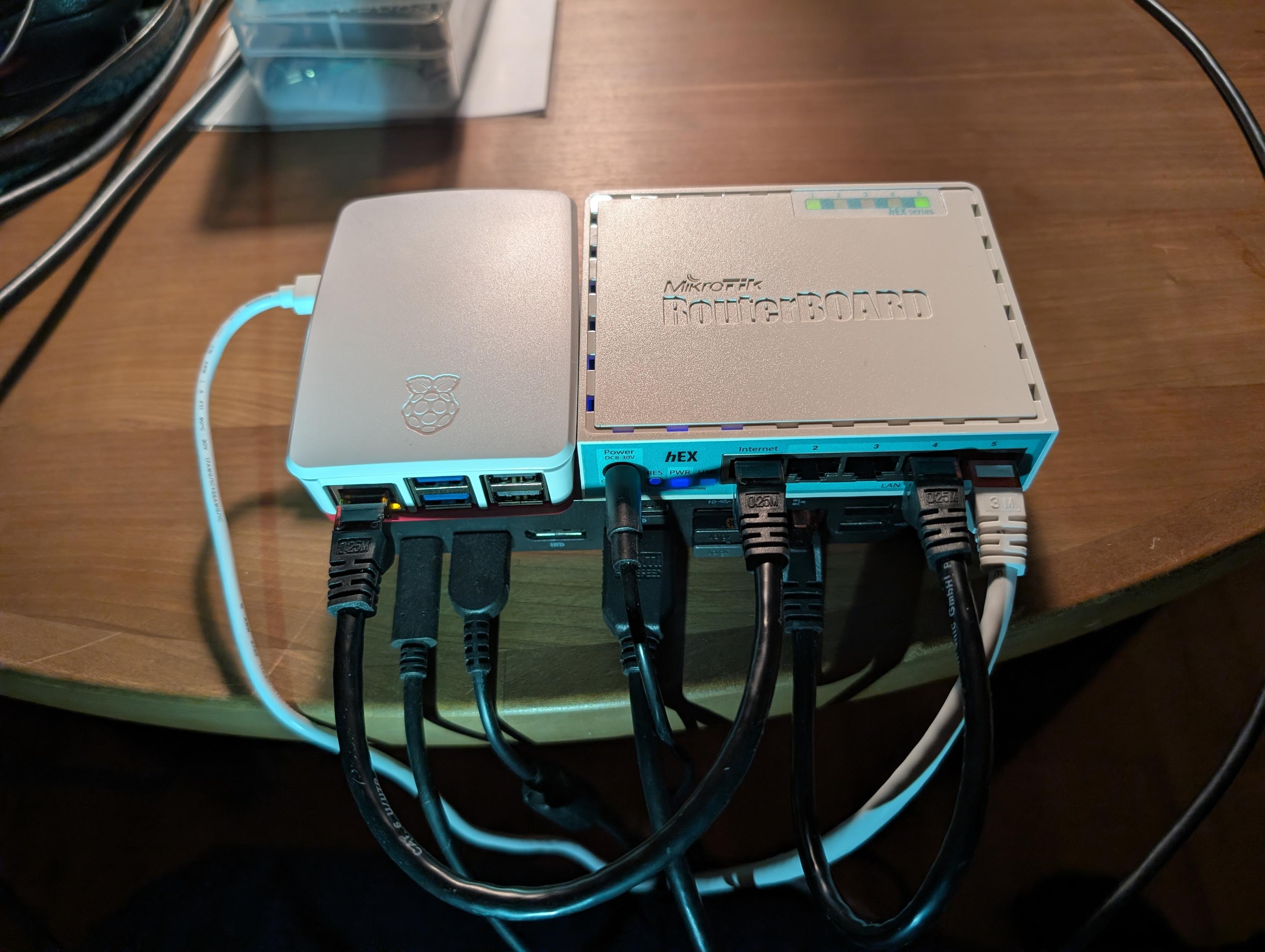
Playground setup with Raspberry Pi 5 and Mikrotik hEX router.

The Pi, with a M.2 HAT+ Compact, is running Raspberry Pi OS Desktop.

The hEX is running RouterOS 7.20.6, without a default configuration. Right now it's acting more like a switch.

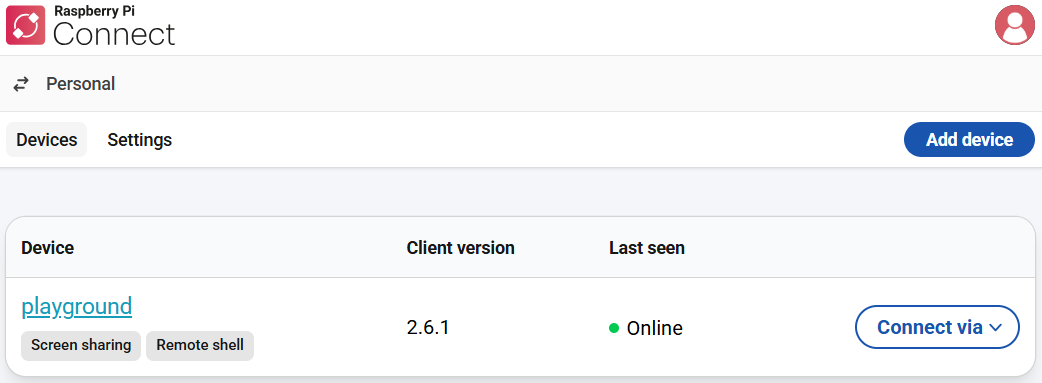
I'm using Raspberry Pi Connect to access the Pi from outside my home network, and mostly ssh and WinBox to access the devices when inside, but Connect also works here.

Photo of Raspberry Pi 5 in a standard white case and a MikroTik hEX router, sitting next to each other, and on top of a USB-C docking stationScreen shot from Raspberry Pi Connect, showing a device named "playground". The device is online and offers "Screen sharing" and "Remote shell" access
0
0
0
0
0
0
0

Moved to a new instance, so time for a

My name is Vince, I live in in the

I love to talk and play with all sorts of including but not limited to , and much more.

I watch on repeat and .

I like to tinker with code in mainly.

For a day job from 1st March 2024 I am now the Customer Support Manager for in their Local Government Software department.

0
0
0
0
0
0
0
0
0

NixOS tests are pretty cool!

I've been fixing an issue where, if you do a deployment to a remote machine (with 'nixos-rebuild switch --target-host=foo'), and the connection would get broken off during the 'switch', the switch would be aborted - worst-case leading to that connection not getting restored.

I initially tested this manually, with the Raspberry Pi I encountered this problem with, which was elaborate and painful (especially when I got something wrong and the connection was lost). What's more, this would be useless to someone reviewing my code, as they don't have my pi sitting on their desk.

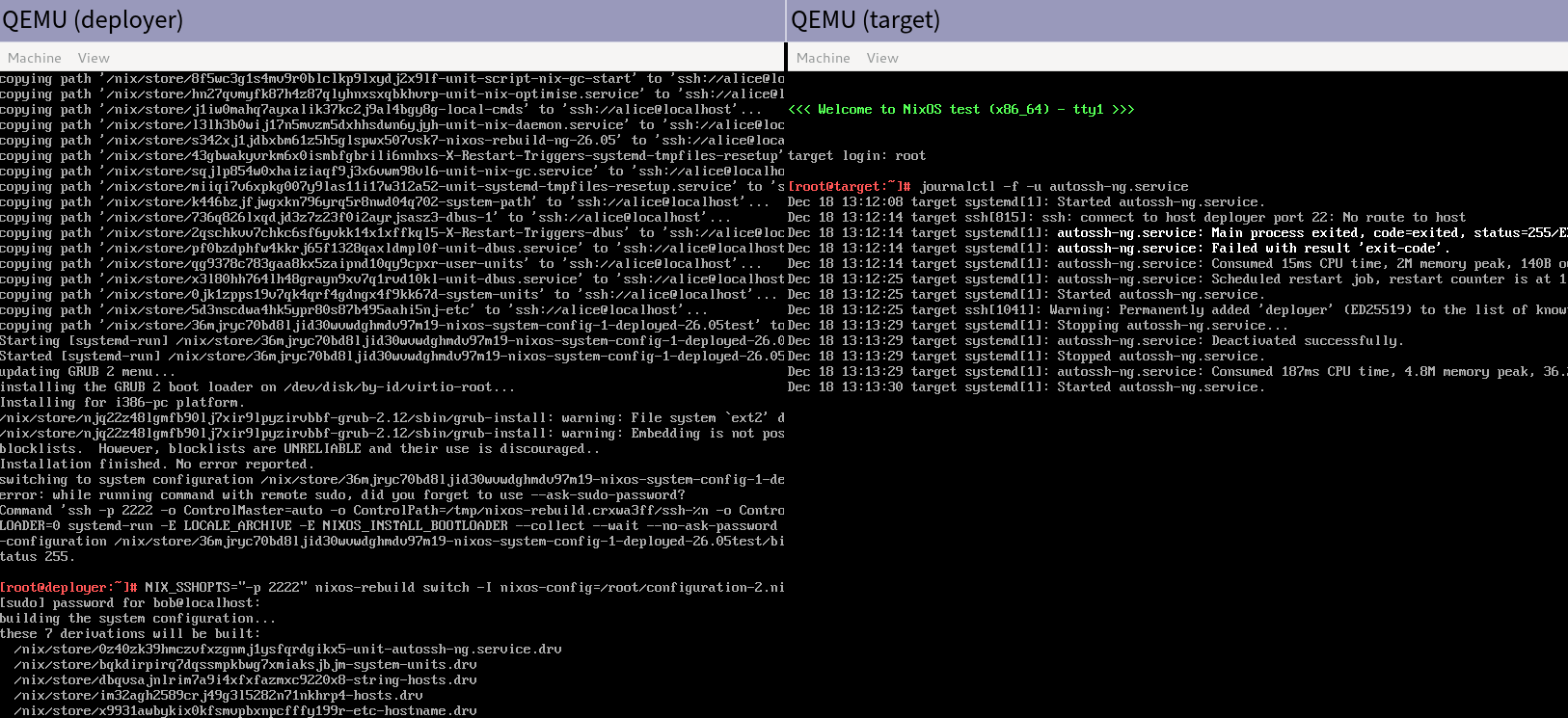
I now recreated the situation in a NixOS test, which spins up 2 VM's and exercises them with some Python code. Very smooth, and there's also an 'interactive' mode where you get access to the Python REPL and the consoles of the QEMU VM's for manual inspection and manipulation.

github.com/NixOS/nixpkgs/pull/

Also at arnout.engelen.eu/blog/nixos-t

The 'deployer' and 'target' QEMU VM consoles in interactive mode
0
0

Just realised itโ€™s been two weeks and Iโ€™ve never done an toot, so here we go!

Iโ€™m Gareth, but more commonly Gazz, owner of the Mastodon server Gamepad.club.

: mostly
-
-
-


- Mostly
- learning


- , mostly

Other stuff:
-
-
- Parenting
- and more!

Dayjob -

0
0
0
0

When the Compute Module 5 came out, you couldn't use the IO Case's bundled fan and heatsink at the same time - which was spun as letting people try out passive and active cooling separately.

Well, that definitely-not-a-design-flaw-honest has been fixed: the latest IO Case shifts the fan to allow clearance underneath for the heatsink.

hackster.io/news/raspberry-pi-

When the Compute Module 5 came out, you couldn't use the IO Case's bundled fan and heatsink at the same time - which was spun as letting people try out passive and active cooling separately.

Well, that definitely-not-a-design-flaw-honest has been fixed: the latest IO Case shifts the fan to allow clearance underneath for the heatsink.

hackster.io/news/raspberry-pi-

0
0