What is Hackers' Pub?

Hackers' Pub is a place for software engineers to share their knowledge and experience with each other. It's also an ActivityPub-enabled social network, so you can follow your favorite hackers in the fediverse and get their latest posts in your feed.

0

I just kept noticing how AI SREs are generally framed as nameless "gonna replace this role" products, whereas coding assistants are framed as partners and are given names.

I decided to expand on this by backing it with data, borrowing ideas from how older AI assistants named after women (eg. cortana, siri, alexa) were all coded like secretaries to argue that the framing devices used to create these new AI products reveals a lot about how the builders and the buyers perceive the roles these tools are supposed to support or replace.

I also take a bit of time to write about the challenges and risks of picking self-limiting analogies in how you frame and construct your system even though it is initially helpful to make progress, and what that might imply for software engineers going forward.

ferd.ca/the-picture-they-paint

0
1
0
0
0
0
0
0
2
0
0
13
0

I'll Still Write Formal Proofs by Myself

ChatGPT 5.2 Thinking proved the original version of a theorem about accessible elements in 6 minutes and 20 seconds; I spent 11 hours, 11 minutes, and 45 seconds to prove it.

- ChatGPT 5.2 Thinking's proof: paste.sr.ht/~chabulhwi/5cc4cf5
- My proof: git.sr.ht/~chabulhwi/tpil-solu

I dropped out of Korea Aerospace University in 2023, and I don't know much about undergraduate mathematics, although I've been using the Lean theorem prover for four years.

I'm not sure whether I'll be able to prove undergraduate-level theorems as fast as the state-of-the-art AI agents, even after I become more knowledgeable about undergraduate mathematics.

However, I'll keep proving theorems by myself for the following reasons:

1. While trying to prove a theorem, I find out which lemmas are important for achieving my goal.
2. I understand a theorem much better after I prove it without looking at an AI agent's proof.
3. Reviewing an AI agent's proof isn't fun.

Still, it's impressive that GPT-5.3-Codex, Claude Sonnet 4.6, Claude Opus 4.6, and Gemini 3.1 Pro can write Lean 4 code to prove basic theorems about induction and recursion. Personally, I don't want to pay money for using these models, so I'll try to find ways to use them for free.


0
0
2
0

One thing "AI" has in common with cryptocoin that pretty much every posited scenario is disastrous to some degree, just a question of flavour and distribution of said disaster.

If doomers are right: disaster

If naysayers—"it's dysfunctional"—are right: disaster ("Congrats! all software is broken")

If "moderate" boosters are right: disaster (mass unemployment)

If optimists are right: disaster (also mass unemployment)

If the AGI folks are right: disaster ( "Congrats! Digital chattel slavery")

0
6
0
0
1
0
0
0
0
0
0

Linuxulator, is a mechanism to run unmodified Linux binaries under FreeBSD. It does not involve virtual machines or emulation; instead, it provides the binaries with kernel interfaces identical to those provided by a real Linux kernel[1]

Linuxulator on FreeBSD Feels Like Magic hayzam.com/blog/02-linuxulator

[1] wiki.freebsd.org/Linuxulator (project wiki page)

0
1
0
0
8
0

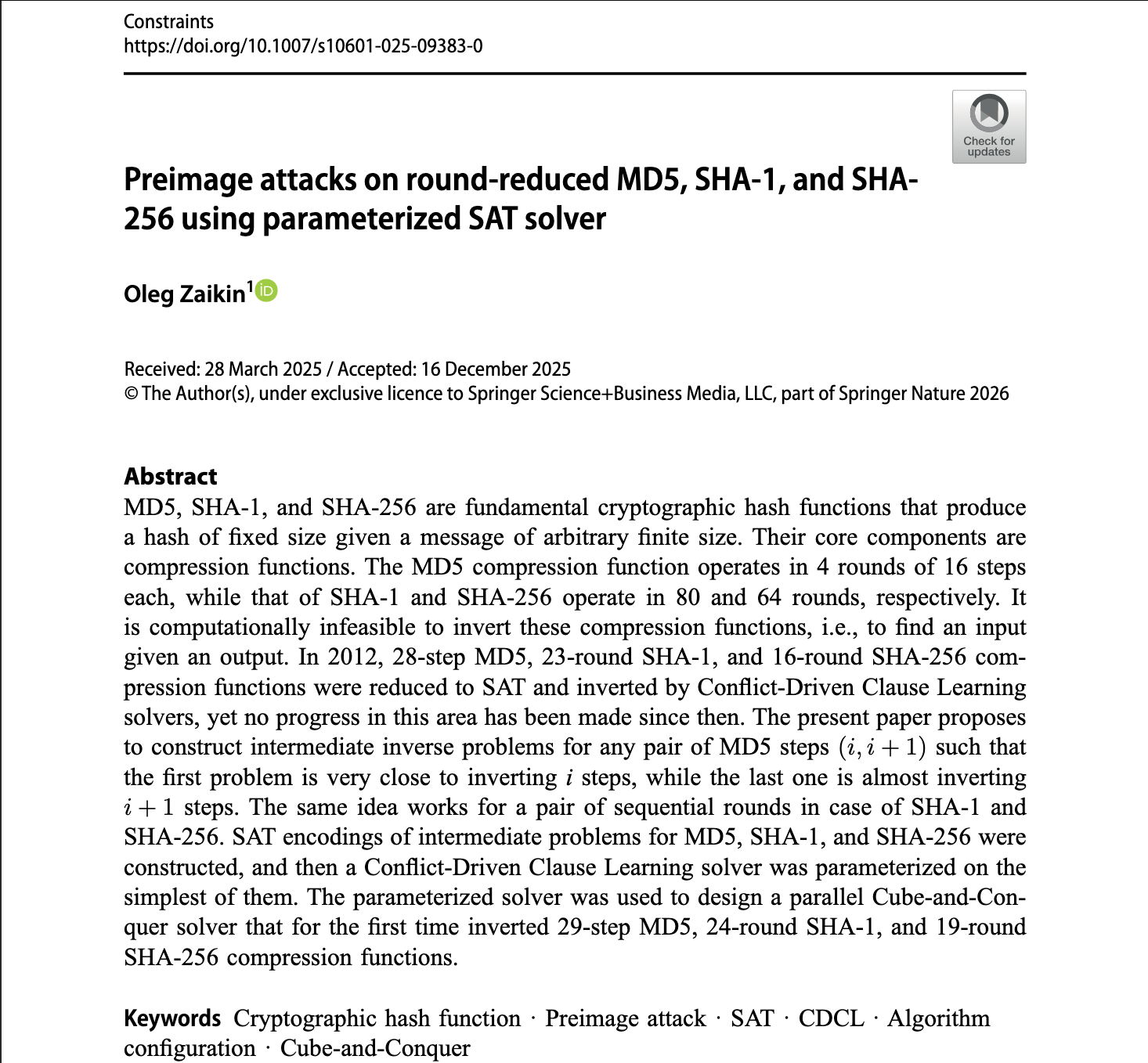
1/2 Exciting news: we just published a new paper: "Preimage attacks on round-reduced MD5, SHA-1, and SHA-256 using parameterized SAT solver", by Oleg Zaikin

If you are interested in security, cryptology, or Constraint Programming, definitely give this paper a read!

link.springer.com/article/10.1

Abstract: MDS, SHA-1, and SHA-256 are fundamental cryptographic hash functions that produce a hash of fixed size given a message of arbitrary finite size. Their core components are compression functions. The MDS compression function operates in 4 rounds of 16 steps each, while that of SHA-1 and SHA-256 operate in 80 and 64 rounds, respectively. It is computationally infeasible to invert these compression functions, i.e., to find an input given an output. In 2012, 28-step MDS, 23-round SHA-1, and 16-round SHA-256 compression functions were reduced to SAT and inverted by Conflict-Driven Clause Learning solvers, yet no progress in this area has been made since then. The present paper proposes to construct intermediate inverse problems for any pair of MDS5 steps (i, i + 1) such that the first problem is very close to inverting i steps, while the last one is almost inverting i + 1 steps. The same idea works for a pair of sequential rounds in case of SHA-1 and SHA-256. SAT encodings of intermediate problems for MD5, SHA-1, and SHA-256 were constructed, and then a Conflict-Driven Clause Learning solver was parameterized on the simplest of them. The parameterized solver was used to design a parallel Cube-and-Conquer solver that for the first time inverted 29-step MDS, 24-round SHA-1, and 19-round SHA-256 compression functions.
Keywords: Cryptographic hash function; Preimage attack; SAT; CDCL; Algorithm
configuration + Cube-and-Conquer
0

Die FuZo ist auch zu einem Propagandablatt wie der Rest des Kuriers verkommen ...

Laut dem norwegischen Werften-Betreiber VARD fahren wir mit nuklearbetriebenen Schiffen in eine emissionfreie Zukunft.
futurezone.at/science/dp-schif

0
0
0
0
0
1

Fedora Pocketblue Remix is an atomic Linux distro for mobile devices (phones and tablets)

Fedora Pocketblue Remix is a mobile Linux distribution designed to let you run Fedora on a smartphone or tablet. But unlike most mobile Linux distros, Pocketblue is an atomic distro.

In a nutshell, that means it’s an operating system that’s harder to break because of the way updates are installed. Basically, new package updates are either fully installed or not installed at all – if something […]

Read more: liliputing.com/fedora-pocketbl
0

Dammit. My calendar runner over . And yet. YET. I still managed to miss a bloodwork appointment because for some reason despite all the hoops to jump through in scheduling with life labs, they managed to send no actual appointment invite, no reminders, and I received no SMS despite signing up for one.

0
0
1
0
0
0

1/2 Exciting news: we just published a new paper: "Preimage attacks on round-reduced MD5, SHA-1, and SHA-256 using parameterized SAT solver", by Oleg Zaikin

If you are interested in security, cryptology, or Constraint Programming, definitely give this paper a read!

link.springer.com/article/10.1

Abstract: MDS, SHA-1, and SHA-256 are fundamental cryptographic hash functions that produce a hash of fixed size given a message of arbitrary finite size. Their core components are compression functions. The MDS compression function operates in 4 rounds of 16 steps each, while that of SHA-1 and SHA-256 operate in 80 and 64 rounds, respectively. It is computationally infeasible to invert these compression functions, i.e., to find an input given an output. In 2012, 28-step MDS, 23-round SHA-1, and 16-round SHA-256 compression functions were reduced to SAT and inverted by Conflict-Driven Clause Learning solvers, yet no progress in this area has been made since then. The present paper proposes to construct intermediate inverse problems for any pair of MDS5 steps (i, i + 1) such that the first problem is very close to inverting i steps, while the last one is almost inverting i + 1 steps. The same idea works for a pair of sequential rounds in case of SHA-1 and SHA-256. SAT encodings of intermediate problems for MD5, SHA-1, and SHA-256 were constructed, and then a Conflict-Driven Clause Learning solver was parameterized on the simplest of them. The parameterized solver was used to design a parallel Cube-and-Conquer solver that for the first time inverted 29-step MDS, 24-round SHA-1, and 19-round SHA-256 compression functions.
Keywords: Cryptographic hash function; Preimage attack; SAT; CDCL; Algorithm
configuration + Cube-and-Conquer
0

We all know the internet's algorithm overlords have decided they get to curate your digital life. Our newsletter is different. It's the antidote to algorithmic paternalism.

Every week, at least one new funny strip appears in your inbox like a tiny comic relief to your everyday stress. No mysterious feed suppression, no engagement metrics.

Just you, us, and the funnies. And you decide when to read. Revolutionary, we know.

0
2
0
0
0

RE: hachyderm.io/@mekkaokereke/116

Mekka's take on the methodological implications on the (lack of) cross-tabs on this study are on point, but there's another thing to look at here: our definition of "platforming". So much discussion of "platforming" is conducted from the perspective of "are these ideas dangerous, is it OK to let people hear these dangerous ideas". That's not what is happening. The speech acts involved are not "conveying ideas" and letting people analyze them.

One way to look at this is to say "oh, algorithmic feeds make people more racist" but the way that attitudes are being measured, the entire way that attitudes *work*, is actually showing something different here: what algorithmic feeds do is *allow racists to efficiently find each other*. "platforming" in this context is not allowing people to hear racist ideas, it is allowing people to *build a command and control network for white supremacist violence*.

0
1
0
0
1

hearing that "good first issue" tagging is becoming useless because it just prompts a bunch of identical ai-generated PRs.

makes me wanna burn down a datacenter. fucking. god. what a pointless salting of the earth.

0
5
0
0
13
0

It's demotivating to think that:

- LLMs aren't good at producing original / novel work
- You still need experts to advance that stuff
- It will always be slower to move without using LLMs
- Once an innovation is done though, an innovation can always be scooped up by the LLM users
- "Bro why are you doing all this manually, I just vibe coded that in a weekend"

Will it always be this way? It's depressing in the meanwhile, at least.

0
1
0

Folks on here have often said to me that they don't believe there's many apps for AT Protocol, well, maybe this will change minds: semble.so/profile/byarielm.fyi

It's just like how the Fedi has it's "big" apps and most people don't know about all the other apps being developed.

Semble is also an AT Protocol app, and it interoperates with margin.at, which is a really cool annotating the web app.

0
0

We all know the internet's algorithm overlords have decided they get to curate your digital life. Our newsletter is different. It's the antidote to algorithmic paternalism.

Every week, at least one new funny strip appears in your inbox like a tiny comic relief to your everyday stress. No mysterious feed suppression, no engagement metrics.

Just you, us, and the funnies. And you decide when to read. Revolutionary, we know.

0
2
0
0

Tidal has this bug where occasionally when you tell it to play a song it will play a *completely different song* from somewhere completely different in its enormous library. Right now I am listening to what Tidal claims is "Music is Math" by Boards of Canada but is instead some ambient piece with muted piano over a high-timbral melange of synth pads and distorted flutes. It is absolutely gorgeous. There is basically no way for me to ever find out what that song was

0
1

UPDATE: thanks for all the good recs and sharing! i think i got a lot to forward :D

a medical professional in berlin asked me for a referral for paid help migrating from windows to debian on their work laptop (thinkpad), is there a cool small company (or freelancer) in berlin who does that sort of thing that you can recommend?

0
18
0