Stock Taking Sense | Varia
Stock Taking SenseDisclaimer: This text was written before a new version of the Varia website was put out. Some links might be outdated.IntroductionThe promise of taking stockHistory of VariaWhat a website could not beObservation methodQuestionnaireStats, graphs and listsReflections on taking stockLimits of the principleWill we actually make a website?Priorities and proposalsDemocracy and velocityThe Big Minimal ConspiracyTowards mendingLooking backLooking forwardIntroductionIn this text, we report on the first stage of the Tool Sheds fellowship that Varia is participating in at Het Nieuwe Instituut. During this fellowship, we focus on Varia’s public-facing digital channels of communication and access to the collective infrastructure we maintain.In this current research trajectory, we are concerned with ways of preserving and sustaining the culture that Varia creates and inhabits within the cultural sector. The tools we maintain are not just technical, but also include methodologies and ethics. In making these tools and this research public and accessible, we aim to make a contribution to the wider network of those searching for collective ways of working.Our research within the 6-month fellowship is organised in three stages:Taking stock, inspired by permaculture practicesMending, where community building and co-maintenance come togetherPatchworking, where we will weave together the tools, vocabularies and methods developed in the first two phasesThis report reflects on relevant aspects of the history of Varia, from our own particular recollections. It has been prepared by a workgroup of four Varia members who are participating in the fellowship: Danny Tirthdas van der Kleij, Alice Strete, Luke Murphy and Simon Browne. From the observations we have made during the ’taking stock’ stage, we find ways forward in the coming stages of the research.The promise of taking stockTo understand our approach, we need to first introduce the concepts it draws from:
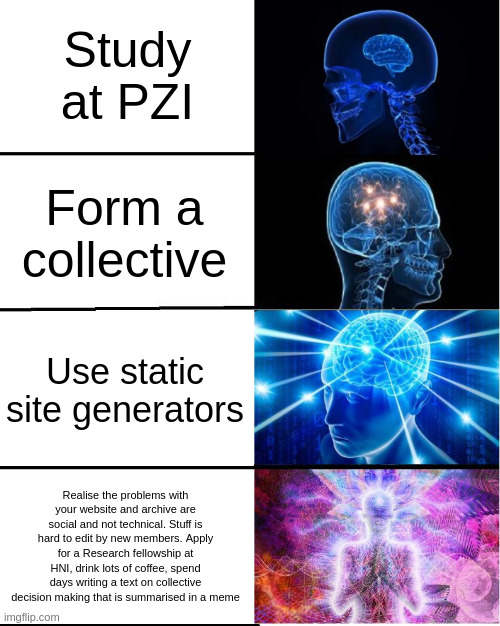
permacomputing -> permaculture -> taking stock.Permacomputing is a concept and community of practice. This emerging focus within computing is oriented around issues of resilience and regenerativity in computer and network technologies. Concerned with notions of permanence, environmental impact and sustainability, it is inspired by permaculture. Permaculture deals with the design, development and maintenance of sustainable, self-sufficient and permanent agricultural practices.As a result of our involvement in the permacomputing community, we have begun to look more closely at the principles of permaculture. Taking stock is a strategy based on permaculture’s humble first principle to ‘observe and interact’. The aim of this initial step is to take time to engage with a location to understand what is going on with its various elements. Through this approach we ask: why are Varia’s website and archive configured in this way? Who is, or is not working on them? What are the dynamics at play?By beginning with an observation period, we avoid the rush towards early implementation of digital infrastructure. Often, the latter sets in place solutions before understanding our needs as a collective. We see taking stock as an opportunity to rethink the usual top-down decision making that permeates the cultural field. Varia is organised around work-in-progress principles which promote decision making from the bottom-up. In practice however, this is in itself no guarantee that we are immune to the tendency. This is why taking stock provides a moment of reflection and insight, while including others in the process.History of VariaVaria was founded in 2017 as an association, around a shared necessity to have a new space in Rotterdam that engages critically with technology. Initial members identified the need to have public moments without the implicit need for formality or performative gestures. Unfinished work, unproductive approaches, unresolved discussions and early-stage research could be presented without pretence. At the same time, there was a desire to share the value of such work with a greater public.The definition of Varia was still in progress and the space was run on the energies and finances of its members. Varia was shaped by the urgencies of the day. Who is here? What do they want to do? How will we get it done together? In the spirit of figuring things out, Varia’s internal structure was first based on members forming ‘workgroups’ around shared interests and a ‘core group’ for administration and decision making. The workgroups became popular and increased in number due to high levels of energy, participation and ambitious aspirations. The output of these workgroups began to circulate within Varia, but could it also feature on the website?Since then, the number of workgroups has decreased and the core group has dissolved. We find ourselves settling on a ‘minimum viable’ number of groups. This shouldn’t necessarily be seen as a reduction in eagerness to organise, but instead as a desire to work more closely and equitably. We believe this has resulted in the increase of workgroup activity but perhaps at the cost of diversity of output (e.g. the untimely demise of the ‘window stickers workgroup’, the demonic rise of the ‘finance workgroup’). However, we still want workgroups to be seen within the collective as not only necessary functional parts of Varia but also places of creative expression, collective research and reflection on self-organisation.Running events was and remains a popular publishing format within Varia and the website reflects this reality. However, as the years passed, the organising skills and experience of members increased, which gave rise to new ideas about ways to publish. In contrast to those early days, the Varia of today has more members, more collaborators, more events and a publicly-funded year programme. Public money means public responsibilities.What a website could not beThe website workgroup was one of the first to be formed at Varia and has a long, stop-start history. From the beginning, the idea of its members was to make ’not just a website’. Instead, their desire was to explore the deeper possibilities that exist around creating such a platform for a collective like Varia. How could a website reflect our needs, wishes and practices?In 2018, two members published an essay titled ‘What a website can be’ to reflect on the choices they had made in the process of designing and developing the Varia website. They wanted to explore ‘how one could do web publishing in a self-hosted, minimal, portable, documented, FLOSS and playful way’. Minimal, in that the chosen method for web publishing was through a static website, using plain text files. This meant that everything could be easily archived and modified through a text editor.Between 2018 and 2022, the number of Varia members grew significantly to around 20. While the website was fulfilling its technical function, the editorial desires evolved.The website workgroup became a site for highly experimental ideas. Self-organised skillshares on programming and other technical work were held in order to make collective progress. However, technical difficulties, learning curves and lack of time contributed to the realisation of the challenges involved in this type of work.Due to these obstacles, participation in the website workgroup was beginning to decline. One of the final attempts to tackle this again was in a well-attended worksession. Its purpose was to re-design a single website. Instead, we ended up with ‘many’. Consensus wasn’t to be found and we left the session with homework to design our own individual versions of the Varia website. Very few were designed and we hesitated to proceed with this proposal.In 2022, we were writing an application for the Stimuleringsfonds 1-year activity programme. At that point, it seemed possible to integrate designing a new website into the application. The goal was a ‘complete overhaul, to prepare the website for the next years’, which involved different forms of publishing and increased accessibility. The website workgroup was reanimated with 4 members and a provisional budget of EUR 32,000, which was roughly 1/3 of the total application budget.A week later, the plans were reduced and the budget was cut to EUR 12,500 due to overestimating our capacities. By February 2023, the website redesign had been completely taken out of the application.Now, in 2024, within the context of taking stock, we are decidedly not just reanimating the website workgroup. Instead of thinking of fixing a ‘broken’ website (it does still work, what is really broken?), we want to improve the way it, and the way we as a collective, function.Observation methodDuring the first stage, we decided on some qualitative and quantitative research methods. These methods were chosen as they offered us an overview of the history and current status of our website and archive, and plenty of insights to reflect upon. Namely, we chose to have discussions, hand out a questionnaire and analyze statistics from our software repository.QuestionnaireWe determined that we needed to involve all of Varia in the decision to develop our website and archive. We used the questionnaire as a medium to collectively share our thoughts, needs and desires. We received 10 questionnaire responses back from the 13 members. We asked 9 open questions, organised under 4 categories: the website, the archive, usability and public-facing tools.We asked what types of information, content and functionality we would like to have visible, and what the ideal process of publishing on the website and archive would look like. We also wanted to know how members want Varia to be perceived through our website and archive. We asked everyone to be as imaginative as possible and, in the spirit of the website workgroup, feel free to go galaxy brain.After going through the questionnaire responses, we invited all Varia members to a feedback meeting. Desires for the website ranged from having a basic search function and a calendar, to documenting workgroup and other non-event-based work. In some cases, important information is missing from the current website, with no clear memory of the reasons why it was omitted. For example: the website does not list any members’ names. Another example: we currently mostly post events that Varia members are organising and rarely publish other events happening in the space.Some members remember that these decisions were taken at some point, but can’t recall the context or whether they were actually put through a consensus decision-making process. Since these decisions are not documented anywhere or made explicit, this means that newer members do not have access to this implicit internal knowledge. This makes the process of publishing on the website unclear for new members.When asked in the questionnaire whether they have contributed to the archive, many Varia members simply replied ’no’. That is either because they did not know how to do it or because they had forgotten, due to the relatively tedious steps involved. The practice of archiving documentation in a designated place is often not ingrained in the work that is done in Varia. Photos are added to the archive when it is required, such as when writing reports for funding bodies. Furthermore, the archive itself is not easily discoverable from the website. There is also no direct connection between the promotion of an event on the website, and its documentation in the archive.Stats, graphs and listsAlongside the qualitative methods above, we also dived into quantitative research. This was facilitated by software such as Git, which gave us different overviews and statistics.According to the Varia website Git repository, the content is split into posts, documents, pages and images. The majority of content is in both English and Dutch.The posts are contained in folders from 2017 to 2024. Posts comprise mostly of events, with the occasional article. The only noticeable difference between these two types of posts is the size each occupies on a page.The ‘documents’ folder contains PDFs of publications; currently only bilingual versions of the first edition of our printed newsletter SomeTimes/Af en Toe. Within the ‘pages’ folder, there is a range of mostly administrative content such as: our Code of Conduct, the About page, accessibility guidelines, a description of our 15% solidarity fee on commissions and details about our open hours. In addition, the ‘Opinions’ page, which was published in 2023, is one of the few website posts that went through a consensus decision-making process.Currently, there is no search function. The only way to find something within the website is to travel back in time through the posts until you reach it, or wander through various pages in the hope you will find a link to what you need.The posts on the website fall under different categories that are defined in the metadata as tags. The choices vary from ‘2020’ to ‘workshop’ and ‘workshops’ which denotes that there is not much consistency in what can be defined through a tag. All of the tag links on this category page lead to 404 nowhere.We unpacked the process of posting something on the Varia website at the moment. We then represented the different paths in numbered lists and graphs. Currently, members choose one of two paths when posting on the website: through the browser or through the command line. In both cases, this process involves using Git, and around 70 steps from start to finish. The browser interface is most suited for those who are not as comfortable using the command line for such tasks, as it allows writing and editing in a text field, creating new files, and easily saving your progress. However, some functions are still unclear and not obvious in the browser, for example making a new folder for an event in a new year. By going through the Git statistics, we realised most website edits are made through the browser. However, this is also a result of the top editor (more than 25% of all edits) being a member who organises events very often and does most of the translation work. Additionally, the 4 newest Varia members, who joined in the past 8 months, have not yet contributed to the website, despite having co-organised events during this period.Making a post on the website through the command lineMaking edits and additions using a text editor involves having a sufficient understanding and comfort with Git and the command line interface. This hinders some members from posting on the website in this way.The HTML templates used for posts involve specific ways to write the date and time of the event. Oftentimes, getting this format wrong is the main cause of the website not displaying events correctly, or at all. This means multiple edits and Git commits are needed for debugging each published post. The amount of edits can add up to over 20 for one post. For example, as seen below, for 48 events published in 2023, most of them in 2 languages, the website was edited over 600 times.
year sum
2017 86 |██
2018 564 |██████████████
2019 388 |██████████
2020 456 |███████████
2021 549 |██████████████
2022 400 |██████████
2023 615 |███████████████
2024 24 |
Statistics of commits made each year from the Varia website Git repositoryThe Varia archive consists of folders with images, using a software created and maintained by Varia and friends called Distribusi. It converts the contents of folders into web pages.The archive can only be updated through a command line interface on the Varia server. This requires system administration access rights which all Varia members can have. Before running Distribusi one has to copy files to the server using SCP (Secure Copy Protocol), then run the command ‘make’ to execute a makefile. This process regenerates the whole archive webpage to include the new additions. There are no statistics on how often this process is run.Reflections on taking stockLimits of the principleWhile the principle of ‘observe and interact’ is more or less self-explanatory, the implication is often not. In other words, the idea is not to immediately dive into implementing solutions, but rather to observe and interact with the material at hand.Based on our experiences of running a collective space, there are often several competing social and technical factors. These conspire to drive an impulse to ‘just get something done’. The most profound example of one of these factors is that we are carrying this work out in the context of a research fellowship with a deadline and a budget. Another factor is our own individual motivations and ambitions. Lastly, we can’t forget the expectations of our peers, our fellow Varia members.We are of course not observing nature, we are observing and interacting with ourselves as Varia. In this sense, there has been an aspect of tension involved in this research. Even if we were at some point convinced we knew ‘what to do’, we resisted the temptation. Solutions are typically seen in a positive and creative light, or a step forward which opens up new horizons through action. In reality, solutions are often the chief cause of problems. We came to see the idea of solutions in this period as an end to the creative moment and limiting our possibilities.Will we actually make a website?In the introduction to this text, we framed taking stock as a strategy. A strategy implies a relation to an objective. While we could point to our strategy of postponing solutions, it is more difficult to point to one single goal.When we reflected on the results of the questionnaire, a Varia member asked: ‘Will we actually have a website at the end of this process?’. For those who don’t know,‘making a website’ within the cultural field can range between a 15 minute job handcrafting a single HTML page and a several years-long process to develop an entire web application.Admittedly, one of our stated goals was indeed to make a website during this fellowship. However, through our discussions we realised that this impulse (‘just make something’) is precisely what could sabotage this goal.The reasons we are collectively unhappy with our website have mostly to do with our seemingly peripheral social processes and not just our technical choices. Therefore implementing new technical choices will not solve the issues in our social processes. Other questions need to be answered within the collective first. For example, how do we make decisions? How much do we work on inclusivity and access? What time do we make for skillsharing?In this sense, we can say we are relieved to propose an ammendment to our initial goals. If we do not have a different Varia website and archive at the end of all this, we do aim to have a working consensus on how to do so.Priorities and proposalsVaria is currently a collective of 13 members and we have seen many ebbs and flows in participation, energy and capacity to keep the wheels turning. In a group of this scale, there is a constant negotiation of individual needs and collective responsibilities. Priorities shift rapidly and not all tasks are treated equally. Some tasks affect more members, have tighter deadlines or have a larger impact on how the world might perceive Varia as an organisation.The responsibility to update and maintain the website has been a nearly constant task since Varia began. Earlier in this text, we reflected on the overall gains and losses of the website workgroup. As participation in this workgroup declined, responsibility fell on individual members to keep the website updated and maintained.The task of updating the Varia website has been an exotic cocktail of prioritisation and maybe one of the most challenging topics on which to achieve consensus. We believe we have only just come to this realisation.Some updates to the website are done in a flash, when they involve publishing an individual member’s event. We have already agreed on this event within our public programme and we are collectively aware of this decision.However, in the case of the Opinions page, there has been a rigorous internal debate, proposal building, consensus decision making and a collective writing process. The result of this is publicly visible as ‘just’ a new page on the website. To the public it is even harder to discover, compared to an event announcement.Furthermore, many proposals for large-scale or impactful additions to the website have never been implemented. Why is this the case? One observation is that nearly all of these proposals were not brought to our collective decision-making process.Democracy and velocityIn informal decision making structures, reasons for not going forward are often the result of so-called ‘stop energy’. This occurs when one member expresses a significant doubt in the proposal of another and there is no clear way to proceed. Receiving criticism and rejection is hard and without agreed methods of recourse, work to make larger proposals or impactful decisions comes to a halt.Thus, we have seen very little collective decision making surrounding changes to the website in the recent past, with the exception of the Opinions page. We believe that the rate at which decision making is happening around a specific topic is a useful indicator of how the group relates to that topic as a ‘collective decision health’ indicator.The more that members of a collective feel at ease to put forward a proposal, the more they will feel empowered to make and implement changes. As a precaution, we know that fear of judgement from our peers is a strong demotivating factor and formal decision-making structures can help provide ‘guard rails’ to channel critique into constructive moments. It’s not how fast the decisions are being made, it’s that they are being proposed and implemented.However, structure isn’t a magic formula. We do realise that consensus is not always possible and there are conditions required for its success. We do not want to dogmatically copy and paste tactics for use in Varia, nor contribute to this idea in other collectives. You do you.The Big Minimal ConspiracyEarlier, we mentioned the particular technical minimalism that we sought to achieve with what our website could be. It should be lightweight and easily archiveable. This ethos permeates the aspirations of Varia to refuse wasting resources and favour free and open-source software made and shared within a commons.The archive uses Distribusi and the website uses Pelican. Both of these generate web pages without the use of dynamic server-side software. In theory, these tools are simple, have few resource dependencies, require little technical maintenance and as such present playful opportunities for experimentation. In reality, both of these tools have caused problems in the long run.The social problems minimal software can create are bigger than the technical problems they solve. For example, in the beginning, not everyone had system administrator access. This eventually changed. In hindsight, it is not enough to simply give all members server access and expect that they would be equally comfortable using this power. There is a big gap between knowing how to use the command line and using it to update a website that an entire collective depends on. This gap is a social issue regarding skillsharing, decision making and having the freedom to make mistakes. In a collective, working with technical minimalism requires a form of labour maximalism. This means taking extra time to make sure everyone has the knowledge and can implement it as needed.Towards mendingLooking backComing to the end of taking stock, we have managed to build a solid foundation and a collective understanding of the task at hand. Several individual experiences and reflections have come to the foreground. Our understanding on how to make progress in the following stages has deepened through this period of reflection.As a ‘group within a group’, we have achieved consent and mandate from Varia to continue this work. We will build towards proposals and solutions for a new Varia website and archive. This process can also play a role as an example for further exploration work within the collective. How will we bring new ideas and proposals for change further through dialogue?We also consider the time spent working on and publishing this document as an outcome in itself. It contributes to the Varia collective memory and gives insight into how Varia works.Looking forwardIn our next stage of mending, we aim to revisit the internal processes which surrounded the making of the ‘Opinions’ page on the current Varia website. We believe this effort offers a prototype for how we can shape our social processes.We will take time to revisit our decision-making protocols and undertake a series of skillshares to deepen our collective understanding of how these tools can help us change Varia. Our protocols have remained unfinished for some time, subject to changes in scale and experience. We now believe it could be time to consolidate our approach.We are curious what role the revival of a website workgroup can play in the future maintenance of the website and archive. Doing content and/or software work will always contain a measure of technical skill.Taking stock has shown that beyond our technical choices, we should prioritise listening to the collective. Improved social processes increase the likelihood that the website and archive will work for everyone, including members and the public. This direction will provide an idea for what Varia could be.
varia.zone

 洪 民憙 (Hong Minhee)


 @
@

 infinite love ⴳ




 kat
kat

 Em
Em 

 かちかちなまこ


 @
@![This is a pop-up window titled "Follow This Blog" with the subtext "Get new posts delivered straight to your Mastodon timeline — no algorithms, no ads, no email inbox clutter. Just chronological blog posts from a fellow human." It has two main sections: the first section states "1 Already on Mastodon? Enter your server below:" with a text input field displaying "[@] mastodon.social" and a green "Follow" button below it. The second section states "2 New to Mastodon? It's a social network where you are in control." followed by three bullet points: "No ads, no algorithms deciding what you see" with a red circle icon, "Your feed is just posts from people you follow, in order" with a purple square icon, and "No company owns your account — you can move it anytime" with an orange lock icon, along with a green button labeled "Create a free account →". Below these sections, under the heading "OTHER OPTIONS", are buttons labeled "RSS Feed" and "Substack", each accompanied by a small icon. The window also has an "X" button in the top right corner to close it.](https://media.hachyderm.io/media_attachments/files/116/206/471/606/849/265/original/c36b1b3f6f382e4f.png)

 Glyph
Glyph







 Christine Lemmer-Webber
 Evan Prodromou




 Cat 🐈🥗 (D.Burch)



 @
@ @
@ @
@




 📷
📷 

 FediForum

 Joe McLaughlin


 @
@ @
@ @
@

 Inside Fediverse